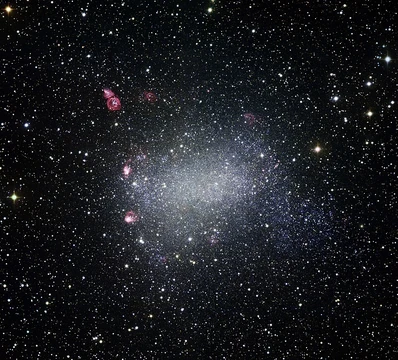
NGC 2273
A barred spiral galaxy with a multiring structure and active nucleus.

NGC 2273 is a barred spiral galaxy in the constellation Lynx, approximately 95 million light-years from Earth. It is notable for its multiring structure, active Seyfert II nucleus, and the presence of a water kilomaser.
Quick Facts
- Epoch
- J2000
- Ra
- 06 · 50 · 08.7
- Dec
- +60 · 50 · 45
- Dist Ly
- 94.5 ± 13 Mly (29.0 ± 4.0 Mpc)
- Z
- 0.006138 ± 0.000013
- H Radial V
- 1,840 ± 4 km/s
- Appmag V
- 11.6
- Constellation Name
- Lynx
- Notes
- Seyfert galaxy
Facts from the source article.
Lore & Background
NGC 2273 was discovered by Nils Dunér on September 15, 1867. The galaxy exhibits a multiring structure, featuring an inner ring and two outer pseudorings formed by two sets of spiral arms. It is inclined at 41 degrees. The galaxy hosts a significant amount of hydrogen gas, mostly in the outer pseudoring, and large amounts of molecular gas indicated by CO lines, suggesting active star formation. Its total infrared luminosity is 10^10.25 solar luminosities. The bar has a radius of 40 arcseconds.
Hubble Space Telescope observations of the central 20 arcseconds revealed spiral arms corresponding to the inner ring. The central ovoid contains a bar-like structure and two arc structures forming a partial nuclear ring, with emission associated with HII regions. A dusty ring-like structure with a radius of 7 arcseconds surrounds the nucleus, best seen in the northwest, and another dusty ring of 20 arcseconds radius is also observed.
The nucleus is classified as a type II Seyfert galaxy based on emission lines. A water kilomaser has been detected in the nuclear region, possibly created by the active nucleus or a prominent star formation site. X-ray observations by BeppoSAX, XMM Newton, and Chandra indicate the nucleus is obscured by a Compton-thick column with high column density; harder X-rays penetrate and are dominated by reflection from cold material, as shown by the Fe-K line. The nuclear spectrography is weakly polarized, more prominent in H-alpha. The broad X-ray spectrum comprises a thermal or scattered soft component, a reflected component, and an absorbed power law component. The 2–10 keV X-ray flux is estimated at 10^42 erg/s. The nucleus also emits radio waves, with a linear radio source composed of two unequal features separated by about 170 parsecs, identified as radio jets. A linear jet-like feature extending 2 arcseconds east of the nucleus was observed in [O III] λ5007 images, aligned with the radio jets and possibly of nuclear origin. The most accepted energy source for the active nucleus is an accretion disk around a supermassive black hole, whose mass is estimated based on kinematics of the water maser circumnuclear disk; the disk appears warped.
Reader's Guide
NGC 2273 is significant as the brightest member of its galaxy group, which includes NGC 2237B and UGC 3504. Its multiring structure and active Seyfert II nucleus make it a valuable object for studying galaxy morphology and nuclear activity. The detection of a water kilomaser in its nucleus provides a tool for probing the dynamics and mass of the central supermassive black hole, with the circumnuclear disk appearing warped. The galaxy's complex X-ray spectrum, including a Compton-thick obscuring column and reflected components, offers insights into the environment around active galactic nuclei. The presence of radio jets and a linear jet-like feature in [O III] emission further characterizes the outflow activity. NGC 2273 is often compared to similar Seyfert galaxies such as NGC 1386 and NGC 3081, highlighting its role in understanding the interplay between galaxy structure and nuclear phenomena.
Did You Know?
- NGC 2273 has a multiring structure with an inner ring and two outer pseudorings.
- Its nucleus is a type II Seyfert galaxy and hosts a water kilomaser.
- The galaxy is the brightest member of the NGC 2273 group.
- The central supermassive black hole mass is estimated from the kinematics of the water maser disk.
More in NGC Objects, Part 3 1-24
Spotted an error? Know more?
Reader corrections go straight into our review queue. Suggest an edit · How this site is sourced