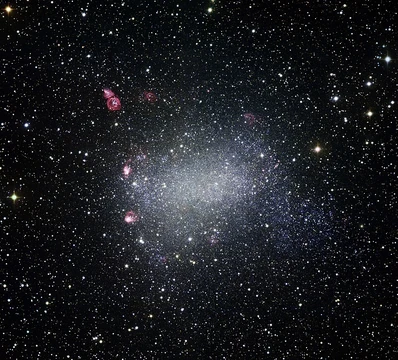
NGC 2264
Open cluster and H II region in Monoceros.

NGC 2264 is a single New General Catalogue entry that actually covers two distinct objects: an open star cluster known as the Christmas Tree Cluster and an H II region called the Cone Nebula. This pair sits in the constellation Monoceros, roughly 720 parsecs (2,300 light-years) away. Because it’s both relatively close and large, astronomers have studied it extensively.
The region also includes two related features not formally part of the designation: the Snowflake Cluster and the Fox Fur Nebula. The Snowflake Cluster gets its name from a pinwheel-like shape and a mix of bright colors, while the Christmas Tree Cluster consists of young stars hidden behind thick dust clouds. Those clouds, along with hydrogen and helium, fuel the birth of new, luminous stars. The combination of dense material and varied colors produces a rich spectrum of wavelengths. Images from the Spitzer Space Telescope reveal a clear contrast between young red stars and older blue ones.
The youth of these stars drives constant change in the clusters and nebula. For a cluster to qualify as a Snowflake, its stars must still occupy the positions where they originally formed. Overall, the emission nebula’s striking snowflake and Christmas tree shapes come from a diverse palette of colors and the ongoing structural evolution that follows star formation. The ratio of brown dwarfs to stars here falls between 1 to 2.5 and 1 to 7.5.
Quick Facts
- Credit
- SIRTF/NASA/ESA.
- Subtype
- emission nebula
- Epoch
- J2000.0
- Ra
- 6 · 41
- Dec
- +9 · 53
- Dist Ly
- 2350 ±
- Appmag V
- 4.1
- Constellation
- Monoceros
- Names
- NGC 2264, Cr 112
Facts from the source article.
Lore & Background
NGC 2264 is the location where the Cone Nebula, the Stellar Snowflake Cluster, and the Christmas Tree Cluster have formed in this emission nebula. The Snowflake Cluster was granted its name due to its unmistakable pinwheel-like shape and its assortment of bright colors. The Christmas Tree star formation consists of young stars obscured by heavy layers of dust clouds; these dust clouds, along with hydrogen and helium, are producing luminous new stars. The combination of dense clouds and an array of colors creates a color map filled with varying wavelengths. As seen in photographs taken by the Spitzer Space Telescope, it is possible to differentiate between young red stars and older blue stars. With varying youthful stars comes vast changes to the overall structure of the clusters and nebula. For a cluster to be considered a Snowflake, it must remain in the original location the star was formed. The ratio of brown dwarfs to stars is between 1 to 2.5 and 1 to 7.5.
Reader's Guide
NGC 2264 is notable for its diverse arrangement of brilliant colors and an evolving process of structure that follows star formation in a nebula. The region is a well-studied example of how dense clouds and hydrogen and helium produce luminous new stars, with the Spitzer Space Telescope revealing color differences between young red stars and older blue stars. The Snowflake Cluster's requirement to remain at its original formation location provides insight into stellar birth environments. The measured ratio of brown dwarfs to stars offers a constraint on star formation models. The combination of the Christmas Tree Cluster, Cone Nebula, Fox Fur Nebula, and Snowflake Cluster within a single NGC designation makes it a rich target for understanding multiple stages of stellar and nebular evolution in one region.
Did You Know?
- NGC 2264 includes the Christmas Tree Cluster and the Cone Nebula as a single object.
- The Snowflake Cluster is located about 2,700 light-years away in Monoceros.
- The Fox Fur Nebula is associated with NGC 2264 but not specifically included in the designation.
- The ratio of brown dwarfs to stars in NGC 2264 is between 1:2.5 and 1:7.5.
More in NGC Objects, Part 3 1-24
Spotted an error? Know more?
Reader corrections go straight into our review queue. Suggest an edit · How this site is sourced