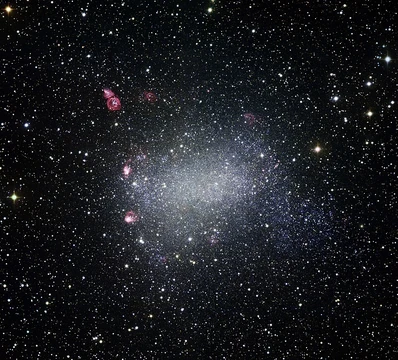
NGC 2239
An open cluster in the Rosette Nebula with massive O-type stars.

NGC 2239 is an open cluster of stars in the Rosette Nebula, located in the constellation Monoceros. It is also known as Caldwell 50 or the Satellite Cluster, and contains several O-type stars that generate large amounts of radiation and stellar wind.
Quick Facts
- Epoch
- J2000
- Ra
- 6 · 31 · 54
- Dec
- +4 · 56
- Dist Ly
- 5.2 kly kly
- Appmag V
- 4.8
- Radius Ly
- 18 ly
- Constellation
- Monoceros
- Names
- Caldwell 50, Satellite Cluster, NGC 2239, Cr 99
Facts from the source article.
Lore & Background
NGC 2239 is an open cluster embedded within the Rosette Nebula in Monoceros. Its brightest star in the direction of the cluster is 12 Monocerotis, a foreground K-class giant. The two brightest members are HD 46223, an O4V star 400,000 times brighter than the Sun and about 50 times more massive, and HD 46150, an O5V star with a luminosity 450,000 times that of the Sun and up to 60 times more massive, though HD 46150 may actually be a double star. These stars do not appear to pulsate, consistent with stellar modeling of stars with similar global parameters.
A study from 2023 found that brown dwarfs in NGC 2239 form closer to OB-stars than to other stars, possibly due to photoevaporation of the outer layers of prestellar cores that would otherwise form low-mass or intermediate-mass stars. The study also found a low disk fraction for low-mass objects later than K0. One cluster member has shown signs of an eroding disk, reminiscent of a proplyd.
Reader's Guide
NGC 2239 is notable for its population of extremely hot O-type stars, which produce intense radiation and stellar winds that shape the surrounding Rosette Nebula. The cluster's age of less than 5 million years places it among young stellar groupings, offering insight into early stellar evolution. The presence of massive stars like HD 46223 and HD 46150, with luminosities hundreds of thousands of times that of the Sun, provides a natural laboratory for studying the life cycles of the most massive stars. The 2023 finding that brown dwarfs preferentially form near OB stars suggests that photoevaporation plays a key role in limiting the formation of lower-mass objects in such environments. The low disk fraction for low-mass objects and the detection of an eroding disk around one member further indicate that the cluster's harsh radiation environment affects planet formation. As a result, NGC 2239 contributes to understanding how massive stars influence their stellar and substellar neighbors, and how star and brown dwarf formation proceeds in high-radiation regions.
More in NGC Objects, Part 3 1-24
Spotted an error? Know more?
Reader corrections go straight into our review queue. Suggest an edit · How this site is sourced