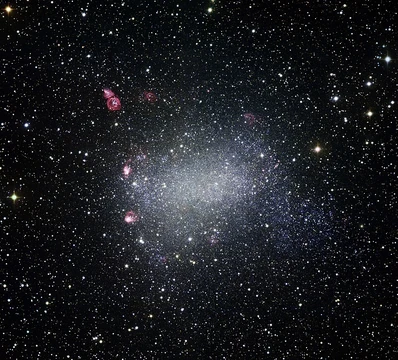
NGC 2237
Part of the Rosette Nebula, an H II region in Monoceros.

NGC 2237 is a designation for part of the nebulous region of the Rosette Nebula, an H II region located near one end of a giant molecular cloud in the Monoceros region of the Milky Way Galaxy. The Rosette Nebula is also known as Caldwell 49 and is sometimes called the Skull Nebula due to its shape reminiscent of a human skull, though it is not to be confused with NGC 246, which shares that nickname.
Quick Facts
- Epoch
- J2000.0
- Ra
- 06 · 33 · 45
- Dec
- +04 · 59 · 54
- Dist Ly
- 5,200
- Dist Pc
- 1,600
- Appmag V
- 9.0
- Constellation
- Monoceros
- Radius Ly
- 65
- Notes
- Multipart nebula
- Names
- SH 2-275, CTB 21, Caldwell 49
Facts from the source article.
Lore & Background
NGC 2237 is one of several New General Catalogue designations for parts of the Rosette Nebula complex, which also includes NGC 2238, NGC 2239, NGC 2244, and NGC 2246. The open cluster NGC 2244, discovered by John Flamsteed in 1690, lies within the nebula and its stars formed from the nebula's matter. The radiation from these young stars excites atoms in the nebula, causing them to emit radiation and producing the emission nebula observed.
The nebula and cluster lie at a distance of 5,000 light-years from Earth and measure roughly 130 light years in diameter. The mass of the nebula is estimated to be around 10,000 solar masses. A survey with the Chandra X-ray Observatory revealed numerous new-born stars inside the optical Rosette Nebula and within a dense molecular cloud, with approximately 2500 young stars in the star-forming complex, including the massive O-type stars HD 46223 and HD 46150, which are primarily responsible for blowing the ionized bubble.
Most ongoing star-formation activity occurs in the dense molecular cloud to the southeast of the bubble. The nebula contains nine known infrared clusters. A diffuse X-ray glow between the stars in the bubble is attributed to a super-hot plasma with temperatures ranging from 1 to 10 million K, significantly hotter than the 10,000 K plasmas seen in H II regions, likely from shock-heated winds from the massive O-type stars.
Reader's Guide
NGC 2237, as part of the Rosette Nebula, contributes to the understanding of star formation within giant molecular clouds. The complex is notable for its association with the open cluster NGC 2244, whose stars were born from the nebula's matter, illustrating the process of stellar birth and feedback. The presence of approximately 2500 young stars, including massive O-type stars HD 46223 and HD 46150, highlights the region as a significant star-forming complex. The Chandra X-ray Observatory survey revealed new-born stars and a super-hot plasma between stars, indicating shock-heated winds from massive stars. The nebula's nine known infrared clusters and ongoing star-formation in the southeast molecular cloud underscore its active nature. On April 16, 2019, the Oklahoma Legislature passed HB1292 making the Rosette Nebula the official state astronomical object, signed into law by Governor Kevin Stitt on April 22, 2019, reflecting its cultural and scientific significance.
Did You Know?
- The open cluster NGC 2244 within the nebula was discovered by John Flamsteed in 1690.
- Approximately 2500 young stars lie in the Rosette Nebula star-forming complex.
More in NGC Objects, Part 3 1-24
Spotted an error? Know more?
Reader corrections go straight into our review queue. Suggest an edit · How this site is sourced