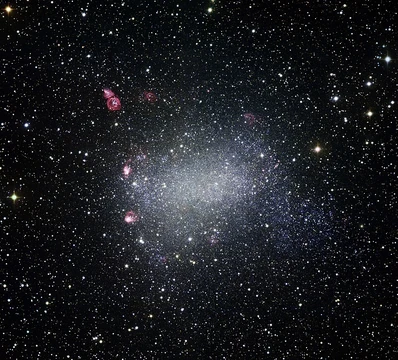
NGC 2207
A colliding spiral galaxy paired with IC 2163.

NGC 2207 is a spiral galaxy in the constellation Canis Major, located about 80 million light-years away. It is notable for its ongoing collision and merger with the smaller companion galaxy IC 2163, a pair collectively nicknamed the Cosmic Owl.
Quick Facts
- Epoch
- J2000
- Ra
- 06 · 16 · 22.0 / 06 · 16 · 28.0
- Dec
- -21 · 22 · 22 / -21 · 22 · 33
- Dist Ly
- 81 ± 39 Mly / (24.9 ± 12 Mpc)
- Z
- 0.0092 / [ 2741 ± 15 / 2765 ± 20 km/s ]
- Appmag V
- 12.2 / 11.6
- Constellation Name
- Canis Major
- Notes
- colliding galaxies
- Names
- RR132a / RR132b, PGC 018749 / 018751, UGCA 124/125, NGC 2207/IC 2163, Cosmic Owl
Facts from the source article.
Lore & Background
NGC 2207 was discovered by British astronomer John Herschel on 24 January 1835. It is classified as an intermediate spiral galaxy with a weak inner ring structure around its central bar. The galaxy is in the first stage of colliding and merging with its smaller companion, IC 2163, which was discovered by Herbert Howe on 11 February 1898. Unlike the Antennae or Mice Galaxies, the two remain separate spirals, though NGC 2207 is tidally stripping IC 2163. In about a billion years they are expected to merge into an elliptical or possibly a disk galaxy. Both galaxies contain vast amounts of dust and gas, and infrared images show enhanced star formation rates. Five supernovae have been observed in NGC 2207: SN 1975A (Type Ia, mag. 14.4, discovered 15 January 1975), SN 1999ec (Type Ib, mag. 17.9, discovered 2 October 1999), SN 2003H (Type Ib, mag. 17.8, discovered 8 January 2003), SN 2013ai (Type II, mag. 17.4, discovered 1 March 2013), and AT 2019eez (Type II, mag. 16.7, discovered 27 April 2019).
Reader's Guide
NGC 2207 and IC 2163 are significant as a nearby example of an early-stage galactic collision, offering astronomers a view of tidal interactions before full merger. The pair's nickname, the Cosmic Owl, reflects their distinctive appearance in imagery. The James Webb Space Telescope's MIRI image has provided detailed infrared views of the dust and gas fueling star formation. The five supernovae recorded in NGC 2207, along with one in IC 2163 and one on the outskirts, make the system a valuable site for studying supernova rates and types in interacting galaxies. The eventual merger, predicted in about a billion years, will likely produce an elliptical or disk galaxy, contributing to models of galaxy evolution.
Did You Know?
- NGC 2207 and IC 2163 are nicknamed the Cosmic Owl.
- The pair are still separate spiral galaxies, unlike the Antennae or Mice Galaxies.
- NGC 2207 was discovered by John Herschel on 24 January 1835.
More in NGC Objects, Part 3 1-24
Spotted an error? Know more?
Reader corrections go straight into our review queue. Suggest an edit · How this site is sourced