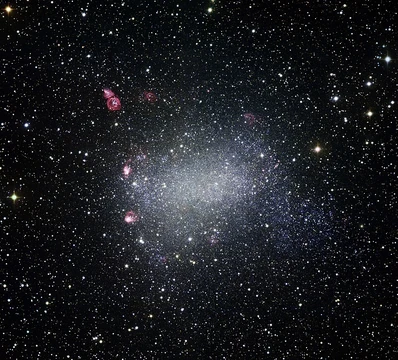
NGC 2194
Rich open cluster in Orion with a revised young age.

NGC 2194 is an open cluster of stars in the constellation of Orion, located about 10,000 light years from Earth. It is a rich and moderately concentrated cluster, notable for its diverse stellar population and the significant revision of its age and distance by a 2025 photometric study.
Quick Facts
- Epoch
- J2000
- Constellation
- Orion
- Ra
- 06 · 13 · 46
- Dec
- +12 · 49 · 05
- Dist Ly
- 3,510 ly
- Dist Pc
- 1,076 pc
- Appmag V
- 8.5
- Age
- 30 million years
- Names
- Cr 87, Mel 43
Facts from the source article.
Lore & Background
NGC 2194 was discovered by William Herschel on 11 February 1784 and catalogued as IV 5, later added to the General Catalogue as 1383. Adolph Cornelius Petersen observed it in 1849 with an 18 cm refractor at the Altona Observatory, and Hermann Carl Vogel also observed it without noting its General Catalogue number. John Louis Emil Dreyer added it to the GCS as number 5380, attributing it to Heinrich Louis d'Arrest's discovery of 18 September 1862, unaware it was already catalogued.
The cluster is rich and moderately concentrated, with a Trumpler class of III1r. Its brightest stars are of magnitude 10, the brightest being magnitude 10.26. It has 149 members down to 15th magnitude, with a main sequence turnoff at magnitude 14.5 and few red giants. Some stars bluer than the turnoff may be blue stragglers. Photometric studies have given ages of 550 Myr (Sanner et al.) and 400 Myr (Piatti et al.), with distances of 2,900 pc and 3,200 pc respectively. The cluster has low metallicity (−0.27 ± 0.06) and lies 130 pc south of the galactic plane.
In summer 2025, NASA SEES interns conducted a photometric study of 817 stars using B, V, and R filters. They revised the distance to 1,076.17 parsecs (3,510 ly) and determined an age of about 30 million years. The stellar distribution across concentric regions showed the inner region dominated by F-, G-, K-, and M-type stars (2,000–7,000 K), while outer regions contained A- and F-type stars and a halo of faint K- and M-type stars. A color–magnitude diagram and H–R diagram confirmed most stars lie on the main sequence, with a turnoff near spectral type B–A.
Reader's Guide
NGC 2194's significance lies in its role as a benchmark for understanding open cluster evolution and the impact of modern photometric reanalysis. The 2025 study by NASA SEES interns dramatically revised the cluster's age from hundreds of millions of years to about 30 million years, and its distance from roughly 10,000 light years to 3,510 light years, challenging earlier estimates. The detailed mapping of stellar types across concentric regions—from hot A- and F-type stars in intermediate zones to cooler K- and M-type stars in the inner core and outer halo—provides a clear picture of stellar population gradients. The identification of a clear main sequence turnoff near spectral type B–A and the presence of possible blue stragglers offer insights into stellar evolution and cluster dynamics. The publicly archived dataset of 817 stars with magnitudes, corrected color indices, and spectral classifications serves as a valuable resource for future research. This cluster exemplifies how citizen science and intern-led projects can contribute meaningful astronomical data, refining our understanding of star clusters and their properties.
Did You Know?
- The cluster's age was revised to about 30 million years by a 2025 NASA SEES intern study.
- The 2025 study analyzed 817 stars using B, V, and R filters.
- The cluster lies 130 parsecs south of the galactic plane.
More in NGC Objects, Part 3 1-24
Spotted an error? Know more?
Reader corrections go straight into our review queue. Suggest an edit · How this site is sourced