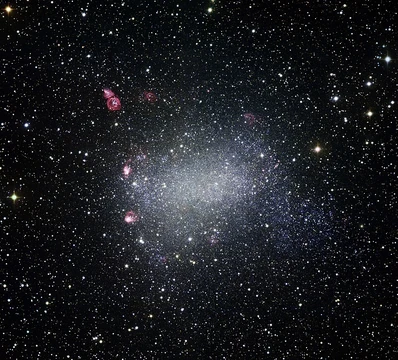
NGC 2158
A metal-poor open cluster of intermediate age in Gemini.

NGC 2158 is an open cluster of stars in the constellation Gemini. It is notable for its unusually rich stellar population and intermediate age, which initially caused it to be mistaken for a globular cluster. Located about 11,000 light years from Earth, it lies immediately southwest of the unrelated open cluster Messier 35, from which it is roughly 9,000 light years more distant.
Quick Facts
- Epoch
- J2000
- Ra
- 06 · 07 · 25
- Dec
- +24 · 05.8
- Dist Ly
- 11,000+ ly
- Appmag V
- 8.6
- Radius Ly
- 8 ly
- Age
- ~2 billion yrs
- Constellation
- Gemini
- Names
- OCL 468, Lund 206, Melotte 40
- Dist Pc
- 3600±400 pc
- Galaxy
- Milky Way
- Mass Msol
- 3067 ±69.84
Facts from the source article.
Lore & Background
NGC 2158 was once thought to be a globular cluster, but it is now known to be a metal-poor open cluster belonging to the old thin disk population. Trumpler first classed it as an open cluster, and Shapley later confirmed this classification due to its diffuse core. Early photographic photometry of about 900 stars by Arp & Cuffey (1962) described it as intermediate between regular star clusters and globular clusters; later photometry of more than 2000 stars was obtained by Karchenko, Andruk & Schilbach (1997).
The cluster's rich stellar content and brightness make it appear globular-like, and only with suitable equipment can its diffuse nature be seen. It also possesses a red giant population similar to that of globular clusters. Its anomalously low metal abundance and age of about 2 billion years place it as an intermediate object between globular clusters and typical open clusters.
NGC 2158 contains stars in three mass regimes: high mass, low mass, and very low mass. It exhibits a red giant population, an M-dwarf discontinuity, one cataclysmic variable star (the fourth known in an open cluster), and five Delta Scuti variables. Most binary systems within the dense environment are unresolved, appearing as point-like sources except for wide binaries.
Reader's Guide
NGC 2158 holds significance as an intermediate-age, metal-poor open cluster that bridges the characteristics of globular clusters and ordinary open clusters. Its populous nature—containing over 3000 stars within a compact radius—and its red giant population mimic those of globular clusters, yet its diffuse core confirms its open cluster status. The cluster's low metallicity and age of 2 billion years provide a valuable laboratory for studying stellar evolution in an environment that is neither as sparse as typical open clusters nor as dense as globulars. The discovery of a cataclysmic variable star and five Delta Scuti variables within it adds to its astrophysical interest, as such variables are rare in open clusters. Its location near the brighter Messier 35 makes it a frequent target for comparative studies, despite the two clusters being unrelated and at very different distances. The cluster's unresolved binary systems and mass segregation across three mass regimes offer insights into dynamical evolution in intermediate-density stellar groups.
Did You Know?
- NGC 2158 contains a cataclysmic variable star, the fourth known to exist in an open cluster.
- It has five Delta Scuti variable stars.
- The cluster is about 9,000 light years farther away than the neighboring open cluster Messier 35.
- It was once misclassified as a globular cluster due to its rich stellar content and brightness.
More in NGC Objects, Part 3 1-24
Spotted an error? Know more?
Reader corrections go straight into our review queue. Suggest an edit · How this site is sourced