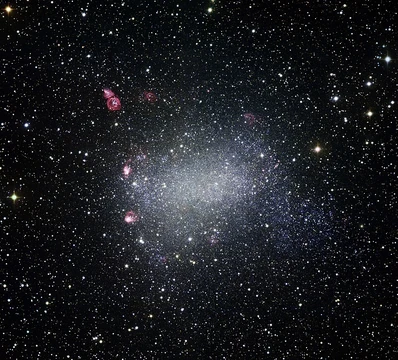
NGC 2146
A barred spiral galaxy with a dusty arm bent by a past collision.

NGC 2146, called the Dusty Hand Galaxy, is a barred spiral galaxy classified as SB(s)ab pec, located in the constellation Camelopardalis. It was first observed in 1876 by Friedrich August Theodor Winnecke. The galaxy has an isophotal diameter of 38.3 kiloparsecs, making it slightly larger than the Milky Way. Its most striking feature is a dusty spiral arm that appears to cut across the galaxy's core from our viewpoint; this arm was bent by about 45 degrees during a close encounter with a smaller galaxy, likely NGC 2146A, roughly 0.8 billion years ago. That interaction triggered the high rates of star formation that classify NGC 2146 as a starburst galaxy.
Three supernovae have been observed in NGC 2146. SN 2005V, a Type Ib/c, reached magnitude 16 and was discovered on 30 January 2005 by LIRIS. SN 2018zd, a Type II possibly of the IIn subclass and a candidate for the first electron-capture supernova, was discovered on 2 March 2018 by Kōichi Itagaki at magnitude 17.8. SN 2024abfl, a Type II, was discovered on 15 November 2024 by Kōichi Itagaki at magnitude 17.5.
Quick Facts
- Epoch
- J2000
- Constellation Name
- Camelopardalis
- Ra
- 06 · 18 · 37.710
- Dec
- +78 · 21 · 25.27
- Dist Ly
- 19.550 +/-
- Z
- 0.002999 · 0.000003
- Appmag V
- 11.38 · 0.13
- Appmag B
- 10.59 · 0.13
- Mag J
- 8.228 · 0.020
- Mag H
- 7.416 · 0.021
- Mag K
- 7.063 · 0.023
Facts from the source article.
Lore & Background
NGC 2146 was discovered in 1876 by Friedrich August Theodor Winnecke. Its most conspicuous feature is the dusty lanes of a spiral arm lying across the core of the galaxy as seen from Earth. This arm was bent by 45 degrees during a close encounter with a smaller galaxy, possibly NGC 2146A, about 0.8 billion years ago. The encounter triggered high rates of star formation, qualifying NGC 2146 as a starburst galaxy. The galaxy has hosted three known supernovae: SN 2005V (Type Ib/c, magnitude 16), discovered on 30 January 2005 by LIRIS; SN 2018zd (Type II, possibly Type IIn, magnitude 17.8), discovered on 2 March 2018 by Kōichi Itagaki and possibly the first electron-capture supernova; and SN 2024abfl (Type II, magnitude 17.5), discovered on 15 November 2024 by Kōichi Itagaki.
Reader's Guide
NGC 2146 is significant as a nearby example of a starburst galaxy whose activity was triggered by a galactic interaction. Its bent dusty arm provides a clear visual record of a past close encounter, offering astronomers a case study in how collisions reshape galaxies and ignite star formation. The galaxy's isophotal diameter of 38.3 kpc makes it slightly larger than the Milky Way, placing it among the larger galaxies in its region. The supernovae observed in NGC 2146, particularly SN 2018zd, have drawn attention because of the possibility that it represents the first confirmed electron-capture supernova, a rare type that may help refine models of stellar evolution. The repeated discoveries by Kōichi Itagaki underscore the galaxy's ongoing role as a site of transient events. The galaxy's legacy lies in its demonstration of how a relatively minor gravitational interaction can produce dramatic structural and energetic changes, and in its contribution to the study of supernova diversity.
Did You Know?
- NGC 2146 is also called the Dusty Hand Galaxy.
- Its spiral arm was bent 45 degrees by a close encounter with a smaller galaxy about 0.8 billion years ago.
- SN 2018zd may be the first electron-capture supernova ever observed.
More in NGC Objects, Part 3 1-24
Spotted an error? Know more?
Reader corrections go straight into our review queue. Suggest an edit · How this site is sourced