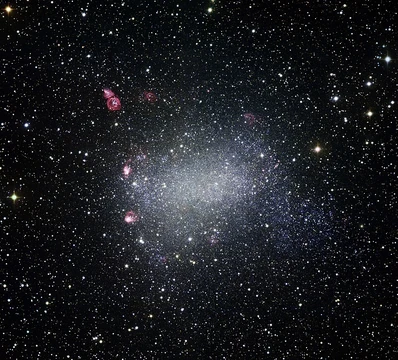
NGC 2139
Barred spiral galaxy with tidal features and an offset nuclear cluster.

NGC 2139 is a barred spiral galaxy in the constellation Lepus, discovered by William Herschel on November 17, 1784. It is notable for its irregular form with spiral arms and tidal features, suggesting a potential recent merger, and for hosting a luminous filament through its center with an offset nuclear cluster.
Quick Facts
- Epoch
- J2000
- Constellation Name
- Lepus
- Ra
- 06 · 01 · 07.963
- Dec
- −23 · 40 · 20.35
- Z
- 0.0061480.000017
- Dist Ly
- 36.98 Mpc
- Appmag V
- 11.6
- Appmag B
- 11.98
- Notes
- Bulgeless
Facts from the source article.
Lore & Background
NGC 2139 was discovered on November 17, 1784, by the German-English astronomer William Herschel. The galaxy is located at a distance of 36.98 Mpc from the Sun and is receding with a radial velocity of 1,836 km/s. Its overall form is irregular with spiral arms and the appearance of tidal features, suggesting a potential recent merger event. There is no central bulge of significance, and the morphological classification is SAB(rs)cd, indicating a barred spiral galaxy with a transitional inner ring structure and loosely wound spiral arms. It is a star-forming galaxy, and a plume extends to the south of the galaxy.
A luminous filament runs through the center of the galaxy, which includes a small nuclear cluster. This cluster is offset at a distance of 320 pc from the center of the galaxy and may come to rest there on a time scale of around 100 million years. The cluster is a source of X-ray emission. Three supernovae have been observed in NGC 2139: SN 1995ad (Type II, mag. 14), discovered by Robert Evans and associates on 28 September 1995; SN 2022qhy (Type Ibn, mag. 15.889), discovered by ATLAS on 1 August 2022; and SN 2023zcu (Type II, mag. 19.054), discovered by ATLAS on 8 December 2023.
Reader's Guide
NGC 2139 is significant as a barred spiral galaxy exhibiting signs of a potential recent merger, evidenced by its irregular form, tidal features, and lack of a significant central bulge. The presence of a luminous filament through its center and an offset nuclear cluster—which is a source of X-ray emission and may settle into the galactic center over roughly 100 million years—provides a rare opportunity to study the dynamics of nuclear cluster migration and post-merger evolution. The galaxy's classification as SAB(rs)cd places it among intermediate barred spirals with loosely wound arms and a transitional ring structure, contributing to the understanding of galaxy morphology. Its active star formation and the observation of three supernovae (including a Type Ibn, a relatively rare subclass) further highlight its ongoing stellar evolution and explosive events. The discovery of SN 1995ad by Robert Evans and associates, along with later ATLAS discoveries, underscores the continued monitoring of this galaxy for transient phenomena. Overall, NGC 2139 serves as a valuable laboratory for studying merger-induced star formation, nuclear cluster dynamics, and supernova diversity.
Did You Know?
- NGC 2139 has a small nuclear cluster offset 320 pc from its center that may come to rest there in about 100 million years.
- The galaxy's morphological classification is SAB(rs)cd, indicating a barred spiral with a transitional inner ring and loosely wound arms.
More in NGC Objects, Part 3 1-24
Spotted an error? Know more?
Reader corrections go straight into our review queue. Suggest an edit · How this site is sourced