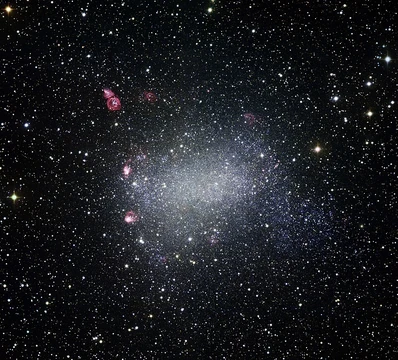
NGC 2126
A faint open cluster in Auriga discovered by William Herschel in 1787.

NGC 2126 is a fairly rich open star cluster in the northern constellation Auriga. William Herschel, a German-British astronomer, first spotted it on November 12, 1787. The cluster sits about midway between the brighter stars Beta Aurigae and Xi Aurigae, but its stars are faint—13th magnitude and dimmer—making it tough to see in a small telescope. It has an apparent visual magnitude of 10.2 and spans 6 arcminutes across. Its estimated distance is 1265.0 parsecs.
The cluster’s Trumpler classification is III 2 m :b, meaning its stars are fairly spread out (III), show a moderate range in brightness (2), and number a medium amount (m). It’s of intermediate age. The King core radius is 0.98, and the tidal radius is 7.15. After removing background stars, a 2003 study by A. Gáspár and colleagues found 103 members within a given radius. As of 2024, 129 stars have been identified with at least a 90% probability of belonging to the cluster.
In 2003, Gáspár’s team also discovered six variable stars in the cluster’s field: two δ Scuti variables, two long-period variables, an Algol-type variable, and a possible eclipsing binary with a pulsating component. By 2009, 16 more variables were found within a 1° field, including four eclipsing systems, at least one W UMa binary, and an RS CVn variable. By 2025, data from the Transiting Exoplanet Survey Satellite showed 25 variable stars that are cluster members and 85 field variables within a 9‑arcminute radius of NGC 2126.
Quick Facts
- Epoch
- J2000
- Constellation
- Auriga
- Ra
- 06 · 02 · 37.9
- Dec
- 49 · 52 · 59
- Dist Ly
- 1265.0 pc
- Appmag V
- 10.2
- Names
- NGC 2126, Melotte 39, Collinder 78
Facts from the source article.
Lore & Background
NGC 2126 was discovered by William Herschel on November 12, 1787. It is classified as Trumpler type III 2 m :b, indicating a fairly disparate set of stars with a moderate range of brightness and a medium number of stars. The cluster is of intermediate age. Its King core radius is 0.98 and tidal radius is 7.15. A 2003 study by A. Gáspár and associates identified 103 members within a certain radius after removing contaminating stars. By 2024, 129 stars had been identified with a membership probability of at least 90%.
Reader's Guide
NGC 2126 is notable for its variable star population. In 2003, A. Gáspár and associates discovered six variable stars in the field around the cluster, including two δ Scuti variables, two long period variables, an Algol variable, and a possible eclipsing binary with a pulsating component. The variable count increased by 16 in 2009 within a 1° field of view, adding four eclipsing systems, at least one W UMa binary, and an RS CVn variable. By 2025, data from the Transiting Exoplanet Survey Satellite indicated 25 cluster member variables and 85 field variables within a 9 arcminute radius of NGC 2126. This rich variable star content makes the cluster a valuable target for studies of stellar variability and binary systems.
Did You Know?
- The cluster lies roughly halfway between Beta Aurigae and Xi Aurigae.
- A 2003 study found six variable stars in the field, including two δ Scuti variables.
- By 2025, TESS data revealed 25 cluster member variables within 9 arcminutes of the cluster.
More in NGC Objects, Part 3 1-24
Spotted an error? Know more?
Reader corrections go straight into our review queue. Suggest an edit · How this site is sourced