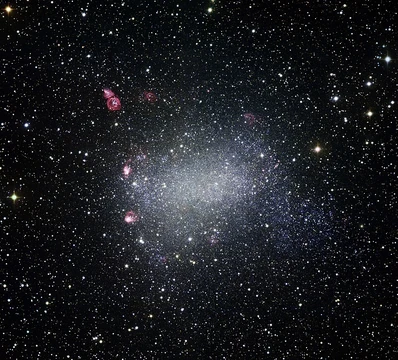
NGC 2110
A lenticular Seyfert galaxy with a supermassive black hole and complex nuclear structures.

NGC 2110 is a lenticular galaxy in the constellation Orion, approximately 120 million light-years from Earth. It is notable as a Seyfert galaxy with an active nucleus that emits bright X-rays and features complex structures including dust lanes, a nuclear bar, and circumnuclear star clusters.
Quick Facts
- Epoch
- J2000
- Ra
- 05 · 52 · 11.4
- Dec
- -07 · 27 · 22
- Dist Ly
- 120 Mly (36.9 Mpc)
- Z
- 0.007647 ± 0.000063
- H Radial V
- 2,293 ± 19 km/s
- Appmag V
- 13.5
- Constellation Name
- Orion
- Notes
- Seyfert galaxy
- Names
- MCG -01-15-004, PGC 18030
Facts from the source article.
Lore & Background
NGC 2110 was discovered by William Herschel on October 5, 1785. It is classified as a lenticular galaxy, though it was once considered elliptical. Hubble Space Telescope images revealed curved dust lanes about one arcsecond west of the nucleus, and infrared observations detected a bar of material measuring 90 by 35 parsecs at the nucleus. Four star clusters in the circumnuclear region, observed by the Keck Observatory in the near infrared, form a semicircular structure 90 parsecs in diameter. Gemini Observatory observations indicate a ring of intermediate-age stars (100–700 million years) with a diameter of 140 parsecs, while the star population closer to the nucleus is predominantly old.
The galaxy's nucleus is active, classified as a type II Seyfert galaxy. It is a bright X-ray source, and a broad double-peaked H-alpha emission line suggests a hidden broad line region obscured by a dust torus. The energy source is believed to be an accretion disk around a supermassive black hole, with an estimated mass of 1.95 billion solar masses based on velocity dispersion. The X-ray spectrum resembles that of Seyfert 1 galaxies but is obstructed by a complex absorber with column densities between 4 and 30 × 10^22/cm². Observations by Chandra, XMM-Newton, and Suzaku confirmed a patchy absorber around the nucleus. The FeKα line has two components: one from distant Compton-thick material and one variable from material near the black hole. The hot corona temperature is estimated in keV.
Radio observations show emission extending 4 arcseconds, with two S-shaped jets emanating north and south from the nucleus. H-alpha and OIII imaging reveal a narrow, curved outflow north of the nucleus, and ionized gas in an s-shaped pattern extends 4 arcseconds north and south. Soft X-ray emission is detected north of the nucleus beyond the radio jet and south of the nucleus extending 30 arcseconds. Gas kinematics indicate an inflow of cold gas of 2.2 × 10⁻² solar masses per year and an outflow of 0.9 or 0.5 solar masses per year. The outflow produces blueshifted gas (100 km/s) southwest and redshifted gas (40 km/s) northeast. Other kinematic components include a cold gas disk (velocity dispersion 60–90 km/s), a hot gas disk (220–600 km/s), and an ionized gas cloud 1–4 arcseconds north of the nucleus, which is devoid of CO 2–1 emission.
Reader's Guide
NGC 2110 is significant as a nearby Seyfert 2 galaxy that provides a laboratory for studying active galactic nuclei and their interaction with the host galaxy. Its complex nuclear environment—including a supermassive black hole, dust torus, jets, and outflows—offers insights into the mechanisms powering active galaxies. The detection of a broad double-peaked H-alpha line challenges simple Seyfert 2 classifications, suggesting a hidden broad-line region. Multi-wavelength observations from X-ray to radio have revealed a patchy absorber, S-shaped jets, and ionized gas structures that trace feedback processes. The galaxy's circumnuclear star clusters and intermediate-age ring indicate recent star formation linked to nuclear activity. Its well-studied gas kinematics, including inflows and outflows, help constrain models of black hole growth and galaxy evolution. NGC 2110 remains a key target for understanding the connection between supermassive black holes and their host galaxies.
Did You Know?
- It is a type II Seyfert galaxy with a supermassive black hole estimated at 1.95 billion solar masses.
- The galaxy features S-shaped radio jets and an ionized gas outflow extending 4 arcseconds north and south.
More in NGC Objects, Part 3 1-24
Spotted an error? Know more?
Reader corrections go straight into our review queue. Suggest an edit · How this site is sourced