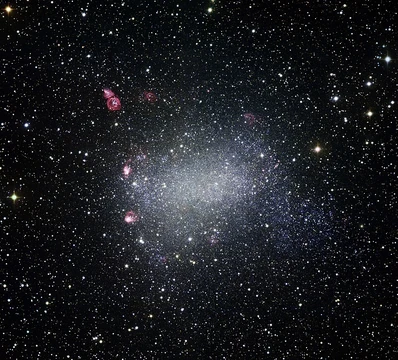
NGC 2060
A loose cluster in the Tarantula Nebula linked to a supernova remnant and pulsar.

NGC 2060 is a star cluster in the Large Magellanic Cloud, sitting inside the Tarantula Nebula right next to the bigger NGC 2070 cluster, which hosts R136. John Herschel first spotted it in 1836. This loose cluster is about 10 million years old and lies within one of the Tarantula Nebula's superbubbles, likely created by the combined stellar winds of its stars or by ancient supernovae. The name NGC 2060 is often used interchangeably with the supernova remnant N157B (also called 30 Doradus B), a larger patch of faint nebulosity that emits strong radio waves. That supernova happened roughly 5,000 years ago as seen from Earth. In 1998, astronomers found a pulsar there, designated PSR J0537-6910, spinning extremely fast at 16 milliseconds per rotation and matching the remnant's age. The runaway O-type main-sequence star VFTS 102, also associated with NGC 2060, is thought to have been the pulsar's companion, flung away when the supernova exploded. NGC 2060 is one of the few known places hosting OVz stars—stars with unusually strong helium absorption at 468.6 nm, pointing to weak stellar winds and relatively low brightness for their class. These stars appear in extremely young clusters and are considered a very early stage in the lives of the most massive stars. Similar OVz stars also turn up in the much more massive NGC 2070 cluster nearby in the Tarantula Nebula.
Quick Facts
- Credit
- NASA, ESA
- Epoch
- J2000.0
- Constellation
- Dorado
- Ra
- 05 · 37 · 51.6
- Dec
- -69 · 10 · 23
- Dist Ly
- 160,000 ly
- Dist Pc
- 50,000 pc
- Appmag V
- 9.59
Facts from the source article.
Lore & Background
NGC 2060 was discovered by John Herschel in 1836 as a star cluster within the Tarantula Nebula. It is a loose cluster about 10 million years old, situated inside one of the Tarantula Nebula's superbubbles, which were formed either by the combined stellar winds of the cluster or by old supernovae. The cluster is very close to the larger NGC 2070 cluster that contains R136.
The object is often used synonymously for the supernova remnant N157B (30 Doradus B), a larger area of faint nebulosity and strong radio emission. The supernova that created this remnant occurred approximately 5000 years ago from our point of view. In 1998, a pulsar named PSR J0537-6910 was discovered within the region, with a very fast rotation period of 16 milliseconds and an age similar to that of the supernova remnant.
NGC 2060 has been identified as one of the few locations for OVz stars, which are stars with unusually strong HeII 468.6 nm absorption indicative of weak stellar winds and relatively low luminosity for their class. These stars are found in extremely young clusters and are thought to represent a very early stage in the evolution of the most massive stars. They are also found in the much more massive NGC 2070 cluster nearby in the Tarantula Nebula. Additionally, VFTS 102, a runaway O-type main-sequence star, has been found within NGC 2060 and is proposed to be a companion of the pulsar ejected at the time of the supernova explosion.
Reader's Guide
NGC 2060 holds significance as a star cluster intimately connected to a supernova remnant and a fast-spinning pulsar, providing a rare laboratory for studying the aftermath of a stellar explosion. The discovery of the 16-millisecond pulsar PSR J0537-6910 in 1998, with an age matching the supernova remnant N157B, offers a direct link between a supernova event and its compact remnant. The proposed association of the runaway star VFTS 102 as a former companion of the pulsar, ejected during the supernova, adds a dynamic dimension to understanding binary evolution and supernova kick mechanisms.
The cluster's identification as one of the few locations for OVz stars—stars with weak stellar winds and low luminosity for their class—makes it a key site for studying the earliest evolutionary stages of the most massive stars. These OVz stars, also found in the nearby NGC 2070 cluster, are thought to represent a very short-lived phase, and their presence in NGC 2060 helps constrain models of massive star formation and evolution. The cluster's location within a superbubble of the Tarantula Nebula further ties it to the larger-scale feedback processes that shape star-forming regions in the Large Magellanic Cloud.
Did You Know?
- The pulsar PSR J0537-6910 within NGC 2060 rotates once every 16 milliseconds.
- VFTS 102 is a runaway O-type star proposed to have been ejected as a companion of the pulsar during the supernova.
- NGC 2060 is one of the few known locations for OVz stars, which have unusually strong HeII absorption.
More in NGC Objects, Part 3 1-24
Spotted an error? Know more?
Reader corrections go straight into our review queue. Suggest an edit · How this site is sourced