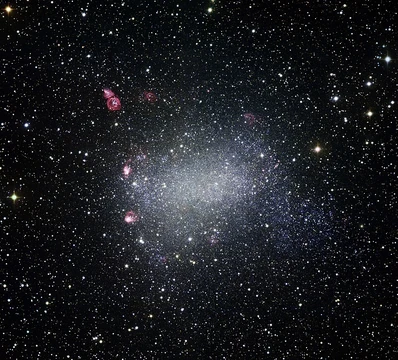
NGC 2008
A distant Sc spiral galaxy in Pictor, discovered by John Herschel.

NGC 2008 is a spiral galaxy in the constellation Pictor, discovered by John Herschel in 1834. It is classified as an Sc-type galaxy, featuring a small central bulge and loosely wound spiral arms. Its speed relative to the cosmic microwave background is 10,367 ± 11 km/s, which gives a Hubble distance of roughly 153 ± 11 megaparsecs (about 499 million light-years). The galaxy has a luminosity class of III and an apparent magnitude of 13.2.
Four non-redshift measurements place its distance at about 135.750 ± 10.521 megaparsecs (roughly 443 million light-years), which falls within the Hubble distance range. Using the Hubble distance, the galaxy’s diameter would be approximately 77 kiloparsecs (about 253,000 light-years). According to Soares and colleagues, NGC 2007 and NGC 2008 form a pair, but since NGC 2007 has a Hubble distance of 67.57 ± 4.73 megaparsecs (about 220 million light-years), the two are considered an optical pair rather than a physically bound one.
Quick Facts
- Epoch
- J2000
- Ra
- 05h 35m 03s
- Dec
- -50° 58 00
- Constellation Name
- Pictor
- Sbrightness
- 23.27 mag/arcsec2
- Appmag B
- 14.64
- Dist Ly
- 499 Mly (152.91 Mpc)
- Names
- PGC 17480, ESO 204-20, AM 0533-505
- Z
- 0.034387
- H Radial V
- 10,309 km/s
Facts from the source article.
Lore & Background
NGC 2008 was discovered by British astronomer John Herschel in 1834. Its speed relative to the cosmic microwave background is 10,367 ± 11 km/s, which corresponds to a Hubble distance of 153 ± 11 Mpc (~499 million ly). The galaxy has a luminosity class of III and an apparent magnitude of 13.2. It is classified as a type Sc galaxy with a small central bulge structure and open spiral arms.
Four non-redshift measurements yield a distance of 135.750 ± 10.521 Mpc (~443 million ly), which falls within the Hubble distance range. The NASA/IPAC database uses the average value of independent measurements to calculate a galaxy's diameter; consequently, if the Hubble distance were used, the diameter of NGC 2008 would be approximately 77 kpc (~253,000 ly).
According to Soares and his colleagues, NGC 2007 and NGC 2008 form a pair of galaxies. However, the Hubble distance of NGC 2007 is 67.57 ± 4.73 Mpc (~220 million ly), indicating that these two galaxies form a purely optical pair rather than a physical one.
Reader's Guide
NGC 2008 holds significance as a spiral galaxy of type Sc, characterized by its small central bulge and open spiral arms. Its discovery by John Herschel in 1834 places it within the historical catalog of deep-sky objects. The galaxy's distance measurements present an interesting case: while its Hubble distance is 153 ± 11 Mpc, four non-redshift measurements give an average distance of 135.750 ± 10.521 Mpc, both values overlapping within uncertainties. This discrepancy highlights the challenges in determining extragalactic distances. The galaxy's diameter, if calculated using the Hubble distance, would be about 77 kpc, making it a relatively large spiral. Its pairing with NGC 2007 is noted as purely optical, as the two galaxies have significantly different Hubble distances, underscoring the importance of radial velocity data in assessing physical associations. NGC 2008 thus contributes to the understanding of galaxy morphology and the complexities of measuring cosmic distances.
Did You Know?
- NGC 2008 is a type Sc spiral galaxy with a small central bulge and open spiral arms.
- NGC 2008 and NGC 2007 form a purely optical pair, not a physical one.
More in NGC Objects, Part 3 1-24
Spotted an error? Know more?
Reader corrections go straight into our review queue. Suggest an edit · How this site is sourced