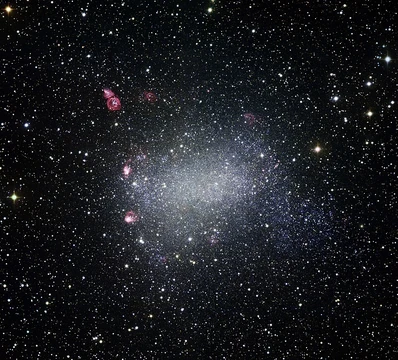
NGC 1999
A reflection nebula with a keyhole-shaped void of empty space.

NGC 1999 is a dust-filled bright reflection nebula that shines from the light of the variable star V380 Orionis. It is also known as The Cosmic Keyhole, due to a prominent black patch of empty space visible within the nebula. Located 1,500 light-years away in the constellation Orion, it is notable for this hole, which was initially thought to be a dense dark nebula but was later confirmed to be truly empty.
Quick Facts
- Epoch
- J2000
- Ra
- 05 · 36 · 27.00
- Dec
- -06 · 43 · 18.0
- Dist Ly
- 1,500
- Constellation
- Orion
- Radius Ly
- ~0.3
Facts from the source article.
Lore & Background
NGC 1999 was previously believed to contain a dark nebula—a dense cloud of dust and gas that blocks light. However, analysis by the infrared telescope Herschel on October 9, 2009, which can penetrate dense cloud material, showed continued black space in that patch. This led to two possibilities: either the cloud was immensely dense, or an unexplained phenomenon had been detected. Ground-based observations using the submillimeter bolometer cameras on the Atacama Pathfinder Experiment radio telescope on November 29, 2009, and the Mayall (Kitt Peak) and Magellan telescopes on December 4, 2009, determined that the patch looks black not because it is an extremely dense pocket of gas, but because it is truly empty. The exact cause of this phenomenon is still being investigated. It has been hypothesized that narrow jets of gas from some of the young stars in the region punctured the sheet of dust and gas, and that powerful radiation from a nearby mature star may have helped to create the hole. HH 1/2, the first recognized Herbig-Haro Object, is located near NGC 1999.
Reader's Guide
The discovery that the black patch in NGC 1999 is empty space rather than a dense dark nebula represents a significant shift in understanding of such features. Researchers believe this discovery should lead to a better understanding of the entire star forming process. The hole may have been created by narrow jets of gas from young stars or by powerful radiation from a mature star, offering insight into how stellar activity can shape surrounding material. The use of multiple observatories—Herschel, the Atacama Pathfinder Experiment, and the Mayall and Magellan telescopes—demonstrates how combining infrared and submillimeter observations can resolve ambiguities in nebular structures. The proximity of HH 1/2, the first recognized Herbig-Haro Object, further ties NGC 1999 to active star formation. The ongoing investigation into the exact cause of the hole continues to inform models of how young stars interact with their environment.
More in NGC Objects, Part 3 1-24
Spotted an error? Know more?
Reader corrections go straight into our review queue. Suggest an edit · How this site is sourced