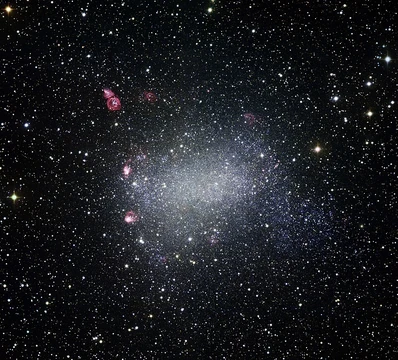
NGC 1973
A reflection nebula in Orion's Sword, part of the Running Man.

NGC 1973 is a reflection nebula located in the constellation Orion, embedded within the larger H II region Sh 2-279. It is one of three NGC nebulae that, together with NGC 1975 and NGC 1977, form the bright nebulous complex that includes the Running Man Nebula.
Quick Facts
- Epoch
- J2000.0
- Ra
- 05 · 35 · 16.2
- Dec
- -04 · 47 · 07
- Dist Ly
- 1,500
- Appmag V
- 7.0
- Constellation
- Orion
- Radius Ly
- ~7.5 ly (1977), 2 ly (1975) / 1 ly (1973)
- Names
- Sh-279, NGC 1977-73-75
Facts from the source article.
Lore & Background
NGC 1973 was first noted by German astronomer Heinrich Louis d'Arrest in 1862. It is one of three reflection nebulae catalogued in the New General Catalogue in 1888 that lie within the Sh 2-279 complex, the northernmost part of the asterism known as Orion's Sword, located 0.6° north of the Orion Nebula. The three NGC nebulae—NGC 1973, NGC 1975, and NGC 1977—are divided by darker nebulous regions. The whole region was later catalogued as Orion 1c and, in 1966, van den Bergh distinguished the weak clustering of reflection nebulae that includes Sh 2-279 as Ori R2.
Reader's Guide
NGC 1973 is significant as a component of the Running Man Nebula, a popular target for amateur astrophotographers due to its proximity to the Orion Nebula and many nearby guide stars. The outline of the running man shows up primarily in photographs; it is difficult to perceive visually through telescopes, though the reflection nebula itself is visible in small to medium apertures in dark skies. The entire reflection nebula region is likely excited by the hot young star c Orionis (42 Orionis), a 4.6 magnitude star in NGC 1977. The region also contains proplyds, with six discovered by the Hubble Space Telescope in 2016 and one by the Spitzer Space Telescope, all pointing to 42 Orionis as the main source of ultraviolet radiation. This marks the first instance of a B-type star being responsible for photoevaporation of protoplanetary disks, as opposed to the O-type star Theta1 Orionis C in the Orion Nebula. The proplyds in NGC 1977 lie within 0.3 parsec of 42 Orionis and have been studied with JWST MIRI, revealing extreme mass loss in the closest disk.
Did You Know?
- NGC 1973 was discovered by Heinrich Louis d'Arrest in 1862.
- It is one of three NGC nebulae that make up the Running Man Nebula.
- The nebula lies 0.6° north of the Orion Nebula in the constellation Orion.
- The region contains proplyds photoevaporated by the B-type star 42 Orionis.
More in NGC Objects, Part 3 1-24
Spotted an error? Know more?
Reader corrections go straight into our review queue. Suggest an edit · How this site is sourced