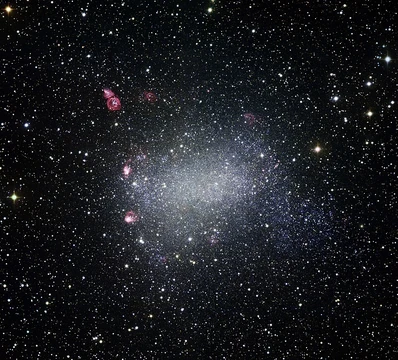
NGC 1961
A distorted spiral galaxy with an X-ray corona and four supernovae.

NGC 1961 is a spiral galaxy found in the constellation Camelopardalis. Its outer arms are highly irregular, and two long, straight arms extend from the galaxy's northern side. Although the galaxy appears distorted, no companion galaxy or double nucleus has been detected that would indicate a recent merger. A luminous X-ray corona has been observed around it. NGC 1961 is the central member of a small group of nine galaxies, called the NGC 1961 group.
German-British astronomer William Herschel discovered the galaxy on 3 December 1788. French astronomer Guillaume Bigourdan also observed it on 22 December 1891, leading to its additional listing in the Index Catalogue as IC 2133. The galaxy's velocity relative to the cosmic microwave background gives a Hubble distance of 57.65 ± 4.04 Mpc, but seven non-redshift measurements place it much closer, at 44.586 ± 8.390 Mpc.
Four supernovae have been observed in NGC 1961. SN 1998eb (Type Ia, magnitude 17.8) was found by the Lick Observatory Supernova Search on 17 August 1998. SN 2001is (Type Ib, magnitude 17.6) was discovered by BAO and LOTOSS on 22 December 2001. SN 2013cc (Type II, magnitude 17) was discovered by Kōichi Itagaki on 28 April 2013. SN 2021vaz (Type II, magnitude 17.5) was also discovered by Kōichi Itagaki on 5 August 2021.
Quick Facts
- Epoch
- J2000
- Ra
- 05 · 42 · 04.6477
- Dec
- +69 · 22 · 42.375
- Dist Ly
- 44.586 ± 8.390 Mpcned
- Z
- 0.013122ned
- Appmag V
- 10.9
- Constellation Name
- Camelopardalis
Facts from the source article.
Lore & Background
NGC 1961 was discovered by German-British astronomer William Herschel on 3 December 1788. It was later observed by Guillaume Bigourdan on 22 December 1891, which led to its listing in the Index Catalogue as IC 2133. The galaxy has been distorted, yet no companion galaxy or double nuclei have been detected that would indicate a recent merger. Its outer arms are highly irregular, and two long straight arms extend from the north side of the galaxy. A luminous X-ray corona has been detected around NGC 1961. The galaxy is the central member of a small group of nine galaxies, the NGC 1961 group. Four supernovae have been observed in NGC 1961: SN 1998eb (Type Ia, mag. 17.8) discovered by the Lick Observatory Supernova Search on 17 August 1998; SN 2001is (Type Ib, mag. 17.6) discovered by BAO and LOTOSS on 22 December 2001; SN 2013cc (Type II, mag. 17) discovered by Kōichi Itagaki on 28 April 2013; and SN 2021vaz (Type II, mag. 17.5) discovered by Kōichi Itagaki on 5 August 2021.
Reader's Guide
NGC 1961 holds significance as a distorted spiral galaxy with a luminous X-ray corona, a feature that suggests energetic processes in its halo. Its highly irregular outer arms and two long straight arms on the north side indicate a disturbed morphology, yet the absence of a detected companion or double nuclei leaves the cause of the distortion unresolved. The galaxy's distance is disputed: its velocity relative to the cosmic microwave background yields a Hubble distance of 57.65 ± 4.04 Mpc, while seven non-redshift measurements give a much closer distance of 44.586 ± 8.390 Mpc. As the central member of the NGC 1961 group, it anchors a small collection of nine galaxies. The four supernovae observed within it—spanning Types Ia, Ib, and II—provide a record of stellar explosions over more than two decades, with two discovered by Kōichi Itagaki. These events contribute to the study of supernova rates and types in a disturbed galaxy environment. The galaxy's legacy lies in its combination of morphological peculiarity, X-ray emission, and multiple supernovae, making it a subject of ongoing interest for understanding galaxy evolution and interaction.
Did You Know?
- NGC 1961 was discovered by William Herschel on 3 December 1788.
- It was also observed by Guillaume Bigourdan on 22 December 1891, earning it the Index Catalogue designation IC 2133.
- Four supernovae have been observed in NGC 1961, including SN 2013cc and SN 2021vaz, both discovered by Kōichi Itagaki.
More in NGC Objects, Part 3 1-24
Spotted an error? Know more?
Reader corrections go straight into our review queue. Suggest an edit · How this site is sourced