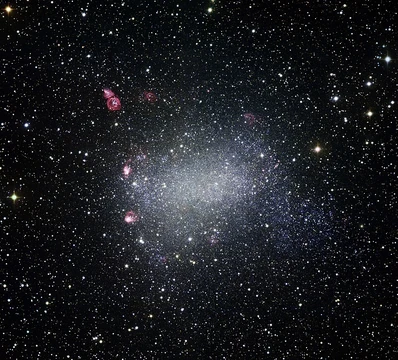
NGC 1832
Barred spiral galaxy with bright nucleus and two supernovae.

NGC 1832 is a barred spiral galaxy located in the constellation Lepus, approximately 80 million light years from Earth. It spans about 55,000 light years across and was discovered by William Herschel on February 4, 1785. The galaxy is notable for its bright nucleus, prominent bar with bright ansae, and a nearly grand design spiral pattern that includes a pseudoring in H-alpha.
Quick Facts
- Epoch
- J2000
- Ra
- 05 · 12 · 03.4
- Dec
- -15 · 41 · 16
- Dist Ly
- 78.8 ± 19.0 Mly (24.15 ± 5.8 Mpc)
- Z
- 0.006468 ± 0.000017
- H Radial V
- 1,939 ± 5 km/s
- Appmag V
- 11.3
- Constellation Name
- Lepus
- Names
- MCG -3-14-10, IRAS 05098-1544, PGC 16906
Facts from the source article.
Lore & Background
NGC 1832 has a bright nucleus and a bar with bright ansae at its ends. Two loosely wound arms in a nearly grand design pattern emanate from the bar, forming a nearly complete inner ring at the bar's end. The ring has a radius of 13 arcseconds and an estimated star formation rate of 0.70 ± 0.20. It appears as a pseudoring in H-alpha, with H-alpha emission also detected from the nucleus but not between the nucleus and the inner ring. The west arm is diffuse and resembles narrow spiral arm fragments, while the east arm is better defined; both arms complete less than half a revolution before fading. Many HII regions lie along both arms, the largest exceeding two arcseconds across. The star formation does not appear to be driven by a leading density wave causing a pressure shock to the arms.
Two supernovae have been observed in NGC 1832. SN 2004gq, a Type Ib supernova with a peak visual magnitude of 15.3, was discovered independently on December 11, 2004, by H. Pugh and W. Li using the Katzman Automatic Imaging Telescope, and by F. Manzini as part of the Stazione Astronomica di Sozzago Supernova Search. SN 2009kr, a Type II-L supernova, was discovered by Kōichi Itagaki on November 6, 2009, at an apparent magnitude of 16. Its progenitor star was identified in Hubble Space Telescope images as a luminous supergiant with a mass over 18 solar masses, marking the first time a progenitor of a Type II-L supernova was identified.
NGC 1832 is the foremost galaxy of the NGC 1832 Group (also known as LGG 129), which includes spiral galaxies MCG-3-14-1, MCG-3-14-4, MCG-2-14-2, and MCG-2-14-4.
Reader's Guide
NGC 1832 holds significance as a barred spiral galaxy with a well-studied structure, including a bright nucleus, bar with ansae, and a pseudoring in H-alpha that indicates ongoing star formation. Its star formation rate of 0.70 ± 0.20 and the presence of many HII regions along its arms provide insights into the processes shaping such galaxies. The galaxy's legacy is enhanced by the observation of two supernovae: SN 2004gq, a Type Ib event, and SN 2009kr, a Type II-L supernova whose progenitor was identified as a luminous supergiant over 18 solar masses—the first such identification for a Type II-L supernova. This discovery contributed to understanding the evolutionary paths of massive stars. As the foremost member of the NGC 1832 Group, it serves as a reference point for studying galaxy interactions and group dynamics. The galaxy's discovery by William Herschel in 1785 places it within the historical catalog of deep-sky objects, and its continued observation with modern instruments like the Hubble Space Telescope underscores its value in contemporary astrophysics.
Did You Know?
- The galaxy has a pseudoring in H-alpha with a radius of 13 arcseconds.
- SN 2009kr was the first Type II-L supernova with an identified progenitor star.
- The galaxy is the foremost member of the NGC 1832 Group (LGG 129).
Frequently Asked Questions
What is NGC 1832?
NGC 1832 is a barred spiral galaxy sitting roughly 80 million light-years away in the constellation Lepus. It stretches about 55,000 light-years across and features a bright central nucleus flanked by a prominent bar structure.
Who discovered NGC 1832 and when?
William Herschel first recorded the galaxy on February 4, 1785, during his systematic surveys of the southern sky.
What does NGC 1832 look like to observers?
The galaxy displays a bright nucleus, a well-defined bar with glowing ansae at its ends, and a near grand-design spiral pattern. In H-alpha imaging, a pseudoring structure is also visible around the core.
Has a supernova been observed in NGC 1832?
Yes—two supernovae have been caught there: SN 2004gq, a Type Ib event that peaked at magnitude 15.3, and SN 2009kr, a Type II-L that reached magnitude 16.
Why is NGC 1832 notable among nearby galaxies?
Its combination of a clean barred structure, a nearly grand-design spiral, and the rare occurrence of two observed supernovae makes it a favorite target for both visual observers and researchers studying star formation.
More in NGC Objects, Part 3 1-24
Spotted an error? Know more?
Reader corrections go straight into our review queue. Suggest an edit · How this site is sourced