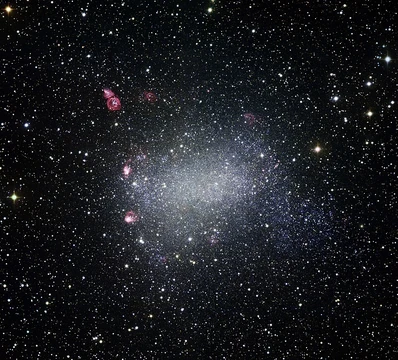
NGC 1817
An open cluster in Taurus, possibly linked with NGC 1807.

NGC 1817 is an open cluster of stars in the constellation Taurus. Discovered by German-English astronomer William Herschel in February 1784, it has an apparent magnitude of 7.7 and spans 20 arc minutes across the sky. The cluster is notable for its proximity to NGC 1807, separated by just 25 arc minutes, and the two may actually be parts of a single extended cluster.
Quick Facts
- Epoch
- J2000
- Constellation
- Taurus
- Ra
- 05 · 12 · 15.(0)
- Dec
- +16 · 41 · 2(4)
- Dist Ly
- 1972 pc
- Appmag V
- 7.7
- Age
- 0.8−1.2 Gyr
- Names
- C 0509+166, Collinder 60
Facts from the source article.
Lore & Background
NGC 1817 was discovered by William Herschel in February 1784. The cluster is around the same age as the Hyades, or perhaps a little younger, with an estimated age of 0.8–1.2 billion years. Its turnoff point—where stars above a certain mass are evolving through the red giant stage—is twice the mass of the Sun. The cluster lies on the opposite side of the sky from the Galactic Center, at a separation of 9.9 kpc from the core, and is about 0.4 kpc away from the Galactic plane.
Measurements of the proper motion of 810 stars within a 1.5° region centered on the cluster suggest that it has at least 169 members. Among these, there is a total of 26 variable stars, including three candidate Gamma Doradus variable stars and sixteen Delta Scuti variables. This unusually high proportion of Delta Scuti variables is likely the result of the turnoff point being located within the instability strip.
Reader's Guide
NGC 1817 holds significance as an open cluster whose turnoff point falls within the instability strip, leading to an unusually high proportion of Delta Scuti variable stars. This characteristic makes it a valuable subject for studying stellar evolution and pulsation, particularly for stars around twice the solar mass. The cluster's age, comparable to or slightly younger than the Hyades, provides a reference point for understanding star cluster development in the Taurus region. Its proximity to NGC 1807—separated by only 25 arc minutes—raises the possibility that the two clusters are actually parts of a single extended cluster, a detail that invites further investigation into their physical relationship. The cluster's location on the opposite side of the sky from the Galactic Center, at a distance of 9.9 kpc from the core and 0.4 kpc from the Galactic plane, situates it in a relatively isolated region of the Milky Way, offering a clear view of its stellar population without significant background confusion. The identification of at least 169 members through proper motion measurements underscores its richness, while the presence of 26 variable stars, including candidate Gamma Doradus and Delta Scuti variables, highlights its dynamic nature.
Did You Know?
- It is separated from the NGC 1807 cluster by just 25 arc minutes, and the two may be parts of a single extended cluster.
- The cluster has an unusually high proportion of Delta Scuti variable stars, likely because its turnoff point lies within the instability strip.
- Its age is estimated at 0.8–1.2 billion years, similar to or slightly younger than the Hyades.
Frequently Asked Questions
What is NGC 1817?
NGC 1817 is an open star cluster nestled in the constellation Taurus, appearing as a faint grouping of stars with an apparent magnitude of 7.7. It spans roughly 20 arc minutes of sky, giving it a modest but observable footprint.
Who discovered NGC 1817 and when?
German-English astronomer William Herschel catalogued this cluster in February 1784 as part of his sweeping surveys of the Milky Way. It has carried his designation ever since.
Is NGC 1817 actually the same cluster as NGC 1807?
The two sit a mere 25 arc minutes apart in Taurus, and many astronomers suspect they are really fragments of one larger, extended cluster that Herschel simply split into two entries. Whether they are truly a single system or just neighbors remains an open question.
How old is NGC 1817 and where does it sit in the Galaxy?
Estimates put the cluster's age between 0.8 and 1.2 billion years, placing it firmly in the mature open-cluster category. It resides about 9.9 kiloparsecs from the Galactic core and only 0.4 kiloparsecs above the Galactic plane.
Can I actually see NGC 1817 from a backyard?
At magnitude 7.7, a small telescope or even steady binoculars under reasonably dark skies will reveal it as a loose, faint patch of stars. Its 20-arc-minute spread makes it a comfortable target at low to medium magnification, especially when you also sweep over to its close companion NGC 1807.
More in NGC Objects, Part 3 1-24
Spotted an error? Know more?
Reader corrections go straight into our review queue. Suggest an edit · How this site is sourced