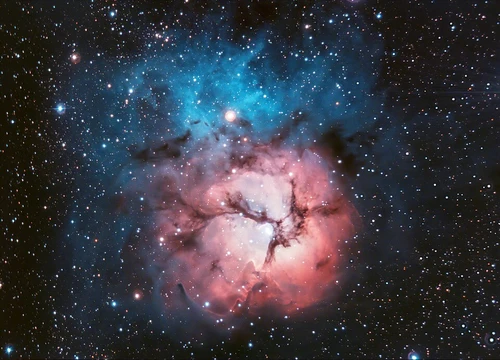
Taurus molecular cloud
Possibly the nearest large star formation region, rich in complex molecules.

The Taurus molecular cloud (TMC-1) is a region of interstellar gas and dust located in the constellations Taurus and Auriga. At a distance of about 430 light-years (140 parsecs) from Earth, it may be the closest large area where stars are actively forming. Within this cloud, a stellar nursery contains hundreds of young stars. Once thought to belong to the Gould Belt—a ring of stars and gas around the Solar System—it was identified in January 2020 as part of the Radcliffe wave, a much larger, wave-shaped structure in the local arm of the Milky Way.
This cloud has been crucial for studying star formation across the entire electromagnetic spectrum. Its proximity and abundance of young stars make it ideal for searching for protoplanetary disks and exoplanets, as well as for identifying brown dwarfs. The region is especially suited for directly imaging young exoplanets, which shine brightly in infrared light.
The Taurus molecular clouds are notable for their rich chemistry, containing over 100 different molecules. These include 75 main isotopic species, 20 carbon-13 substituted species, and seven deuterium-substituted species. This makes TMC-1 the most productive source of interstellar molecular discoveries. The molecular populations here contrast sharply with those in protoplanetary disks: TMC-1 is rich in unsaturated hydrocarbons, while protostellar disks contain oxygen-rich organics from sublimated ices. Discovered molecules include cyanopolyynes (HCnN for n = 3,5,7,9), cumulene carbenes (H2Cn for n = 3–6), N-chlorosuccinimide, thioketenes, thioacetaldehyde, tricarbon monosulfide (HC3S+), vinylacetylene, allenyl acetylene, propionitrile, ethynyl cyclopropenylidene (1,2), cyclopentadiene, and indene. The QUIJOTE survey has also found cyanoacenaphthylene (3,4), ortho-benzyne, and fulvenallene. In 2007, the polyatomic anion octatetraynyl radical was detected here, making it the second type of anion found in the interstellar medium and the largest such molecule detected at that time. 1-Butyne has been tentatively identified.
The stars in the Taurus molecular cloud are very young, only 1–2 million years old. The stellar association of the cloud, known as the Taurus–Auriga association, includes the variable star T Tauri, the prototype for T Tauri stars. HH 30 is a protoplanetary disk seen edge-on within TMC-1.
Quick Facts
- Constellation
- Taurus
- Epoch
- J2000.0
- Ra
- 04 · 41.0
- Dec
- +25 · 52
- Names
- HCL 2, Heiles's cloud 2, TMC-1, Taurus molecular cloud 1
- Dist Ly
- 430
- Dist Pc
- 140
- Notes
- Close distance, numerous molecular species
Facts from the source article.
Lore & Background
The Taurus molecular cloud was identified in the past as a part of the Gould Belt, a large structure surrounding the Solar System. More recently (January 2020) the Taurus molecular cloud was identified as being part of the much larger Radcliffe wave, a wave-shaped structure in the local arm of the Milky Way. It has been important in star formation studies at all wavelengths of the electromagnetic spectrum. The many young stars and the close proximity to Earth make it uniquely well-suited to search for protoplanetary disks and exoplanets around stars, and to identify brown dwarfs in the association. Members of this region are suited for direct imaging of young exoplanets, which glow brightly in infrared wavelengths.
The Taurus molecular clouds are notable because they contain many complex molecules, some of which are organic, and so far there have been over 100 different molecules including 75 main isotopic species, 20 carbon-13 substituted species, and seven deuterium-substituted species. The number of molecular species discovered make it the most prolific source of interstellar molecular discoveries. There is a stark contrast of the populations of molecules between TMC-1 and protoplanetary disks around protostars. TMC-1 has many unsaturated hydrocarbons while the disk of protostars have oxygen-rich organics found in sublimated ices.
The stars in the Taurus molecular cloud are newly formed having an age of only 1–2 million years. The Taurus–Auriga association, which is the stellar association of the cloud, contains the variable star T Tauri, which is the prototype of T Tauri stars. HH 30 is a protoplanetary disk seen edge-on located in TMC-1. Based on distance estimates of HP Tau G2, the right side of the cloud is a farther edge of the nebula.
Reader's Guide
The Taurus molecular cloud has been important in star formation studies at all wavelengths of the electromagnetic spectrum. Its close proximity to Earth and hundreds of newly formed stars make it uniquely well-suited to search for protoplanetary disks and exoplanets, and to identify brown dwarfs. Members of this region are suited for direct imaging of young exoplanets, which glow brightly in infrared wavelengths. The cloud is the most prolific source of interstellar molecular discoveries, with over 100 different molecules detected, including complex organic species. The stark contrast between the unsaturated hydrocarbons in TMC-1 and the oxygen-rich organics in protoplanetary disks provides insight into chemical evolution. The Taurus–Auriga association includes many stars with circumstellar disks or exoplanets, such as HL Tauri (directly imaged disk), CI Tauri (one confirmed exoplanet), V830 Tauri (exoplanet V830 Tauri b), DH Tauri (exoplanet DH Tauri b), V1298 Tauri (four confirmed transiting exoplanets), and 2M0437b (directly imaged exoplanet). The cloud also hosts brown dwarfs with disks and planet candidates, such as 2MASS J04442713+2512164.
Did You Know?
- The Taurus molecular cloud is only 140 pc (430 ly) away from Earth, making it possibly the nearest large star formation region.
- It has over 100 different molecules detected, including 75 main isotopic species, making it the most prolific source of interstellar molecular discoveries.
- The cloud hosts the prototype T Tauri star and the edge-on protoplanetary disk HH 30.
More in Nebulae, Part 2 1-24
Spotted an error? Know more?
Reader corrections go straight into our review queue. Suggest an edit · How this site is sourced