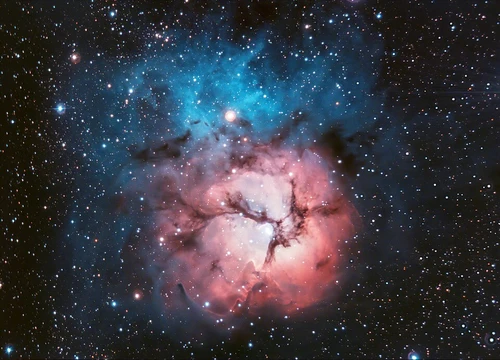
Barnard 30
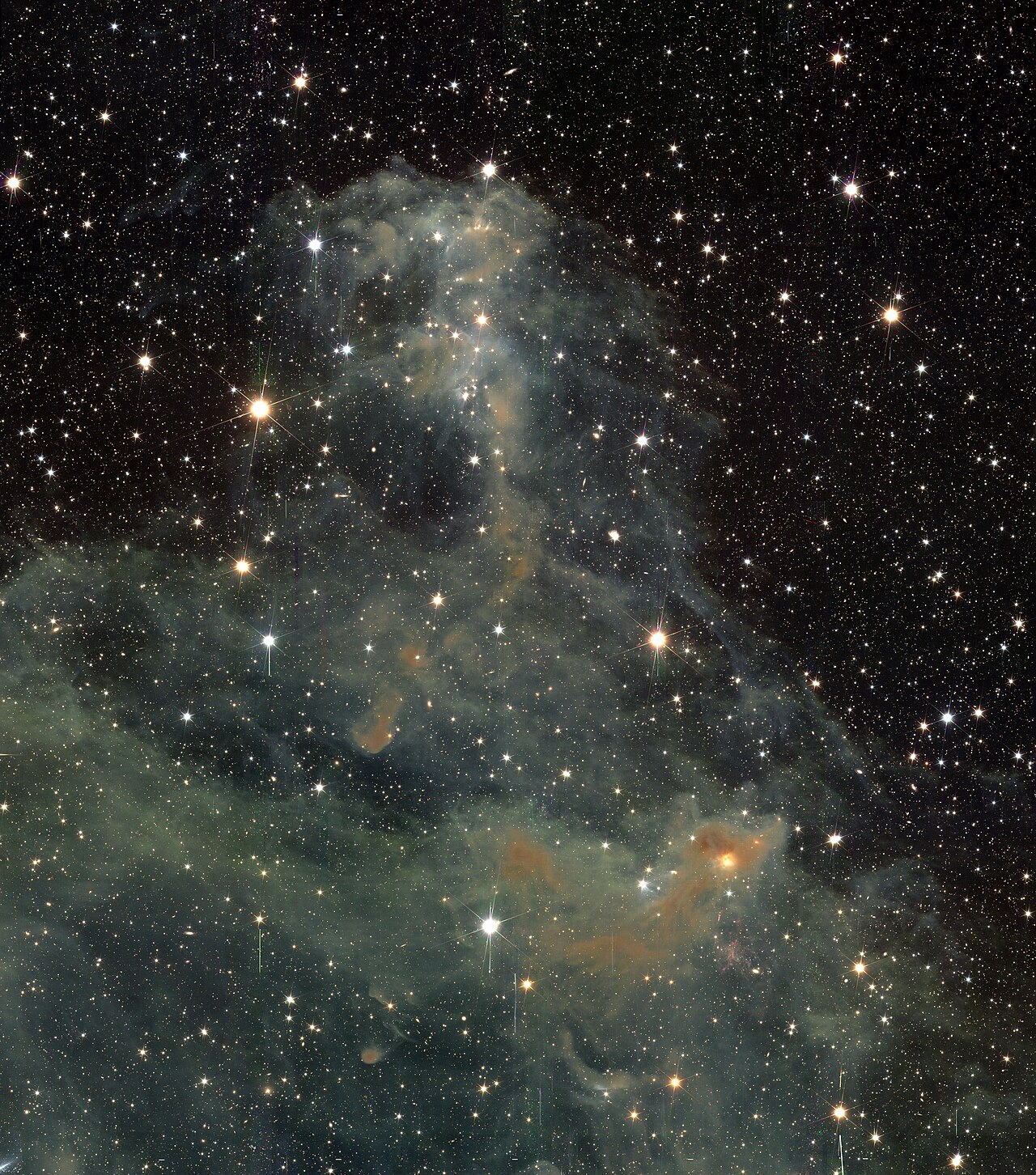
A dark cloud in the Lambda Orionis ring with young stars.

ESA/Euclid/Euclid Consortium/NASA/ERO2024 & Melina Thévenot · CC BY-SA 4.0
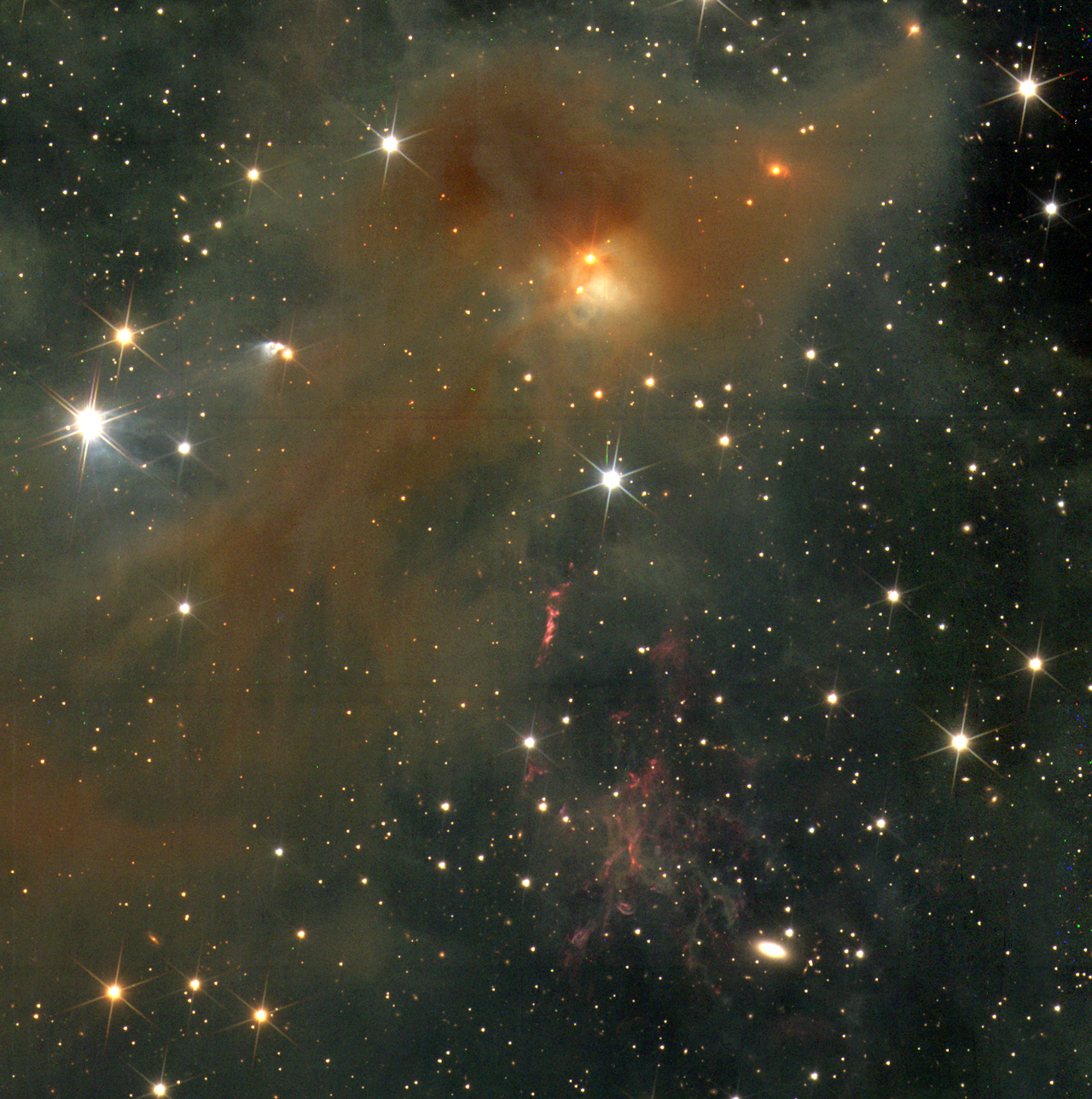
Barnard 30 is a dark cloud situated north of the star Lambda Orionis, also known as Meissa, within the Lambda Orionis ring. Located roughly 1,300 light-years from Earth, it is one of several areas in the ring—alongside the Lambda Orionis cluster and Barnard 35—where young stars are densely gathered. This cloud hosts a mix of stellar objects, including Herbig-Haro objects, young stars, brown dwarfs, and multiple T Tauri stars. Among its notable members are HK Orionis, a Herbig Ae/Be star, and HI Orionis, a T Tauri star.
The stellar population in Barnard 30 is about 2 to 3 million years old, making it significantly younger than the central Lambda Orionis cluster. The cloud’s shape and star-forming activity are likely influenced by the massive star Meissa, which may have triggered star formation here. An additional possible trigger is a supernova that occurred roughly 1 million years ago, which may have created the Lambda Orionis ring. The region also contains a reflection nebula.
Observations of Barnard 30 are challenging because its associated emission region has low surface brightness and covers a large area of the sky. Since it lies in the same constellation as the famous Orion Nebula, it is rarely imaged.
Quick Facts
- Epoch
- J2000.0
- Ra
- 05 · 30 · 18.0
- Dec
- +12 · 46 · 00
- Dist Ly
- 1300
- Dist Pc
- 400
- Constellation
- Orion (constellation)
- Names
- Barnard 30
Facts from the source article.
Lore & Background
Barnard 30 is a dark cloud situated in the Lambda Orionis ring, north of the star Meissa. The region is approximately 1300 light years from Earth. It is one of several areas in the ring where young stars are concentrated, alongside the Lambda Orionis cluster and Barnard 35. The cloud contains Herbig-Haro objects, young stars, brown dwarfs, and multiple T Tauri stars, including the Herbig Ae/Be star HK Orionis and the T Tauri star HI Orionis.
The stellar population in Barnard 30 is about 2-3 million years old, significantly younger than the central Lambda Orionis cluster. The cloud is likely shaped by the massive star Meissa, which is also responsible for triggering star formation in this cloud. A possible supernova that occurred about 1 million years ago, which may have formed the Lambda Orionis ring, could be an additional trigger for star formation in this region. The region also contains a reflection nebula.
Reader's Guide
Barnard 30 is significant as a site of ongoing star formation within the Lambda Orionis ring, offering a younger stellar population compared to the central cluster. Its proximity to the massive star Meissa and the potential influence of a past supernova highlight the complex interplay of stellar feedback in shaping star-forming regions. The presence of Herbig-Haro objects, T Tauri stars, and brown dwarfs makes it a valuable target for studying low-mass star formation and early stellar evolution. Despite its scientific interest, Barnard 30 is rarely imaged because it shares the same constellation as the famous Orion Nebula, which draws more attention. The emission region associated with the cloud has a low surface brightness and covers a large area of the sky, further contributing to its relative obscurity. Its legacy lies in providing insights into triggered star formation and the dynamics of the Lambda Orionis ring.
Did You Know?
- Barnard 30 is located about 1300 light years from Earth.
- A possible supernova 1 million years ago may have triggered star formation in this region.
Discovery & Early Cataloguing
The Horsehead Nebula first entered the astronomical record in 1888, when Scottish astronomer Williamina Fleming identified it on a photographic plate taken at the Harvard College Observatory. This photographic detection represented an important early step in documenting dark nebulae, a class of objects that are difficult to observe visually because they block rather than emit light. Shortly after Fleming's discovery, E. E. Barnard composed one of the first descriptions of the object, characterizing it as a dark mass approximately four arcminutes across, situated along a nebulous strip extending southward from zeta Orionis. Barnard then catalogued the dark nebula under the designation Barnard 33, a name that endures alongside the object's far more widely recognized popular title. The fact that the nebula was found on a photographic plate rather than through direct visual observation underscores the limitations of the naked eye and early telescopes when it comes to detecting regions of interstellar darkness. The 1888 discovery places the Horsehead among the earliest dark nebulae to be formally recorded in the astronomical literature.
Structure & Star Formation
The Horsehead Nebula's most striking feature is its unmistakable silhouette, which closely resembles the head and neck of a horse. This shape is produced by heavy concentrations of interstellar dust that create alternating patches of near-total opacity and transparency within the surrounding gas. The darkness we perceive is not an absence of material but rather a thick veil of dust that blocks the light of stars positioned behind the cloud. The lower portion of the horse's neck in particular casts a pronounced shadow to its left, adding depth to the overall profile. Beyond its visual appeal, the nebula is an active site of low-mass star formation. Bright spots visible at the base of the Horsehead represent young stars just in the process of forming, embedded within the dense material that is giving rise to them. The entire dark cloud sits within the broader Orion molecular cloud complex, a vast region where the conditions for stellar birth are continuously being met.
Position within the Orion Complex
Located roughly 1,375 light-years (422 parsecs) from Earth, the Horsehead Nebula occupies a well-defined position in the constellation of Orion, just to the south of Alnitak, the easternmost of the three stars that form Orion's Belt. It is not an isolated object but rather a component of the much larger Orion molecular cloud complex. Within that complex, the Horsehead sits in the southern portion of the dense dust cloud designated Lynds 1630, while also lying along the outer edge of IC 434, a vast and active H II region where ongoing star formation is reshaping the surrounding gas. The nebula's placement at the boundary between these two structures gives it a distinctive appearance: a dark silhouette set against a luminous backdrop of ionised gas. For observers on Earth, the constellation of Orion is prominent in the winter evening sky of the Northern Hemisphere and in the summer evening sky of the Southern Hemisphere, meaning the Horsehead is visible to skywatchers in both hemispheres during the appropriate season.
Visual Identity & Cultural Presence
The Horsehead Nebula is one of the most instantly recognizable objects in the night sky, owing to its unmistakable resemblance to the head of a horse. Colour images of the nebula reveal a deep red hue that originates not from the dark dust itself but from ionised hydrogen gas, specifically the H-alpha emission, predominantly located behind the nebula. This glow is driven by the nearby bright star Sigma Orionis. Magnetic fields play a visible role in the nebula's appearance, channeling the gas into distinct streams that show up as foreground streaks against the background glow. A luminous strip of hydrogen gas traces the outer edge of the enormous cloud, and the densities of nearby stars appear noticeably different on either side of the nebula. The Horsehead has also found its way into literature; in Isaac Asimov's 1951 novel The Stars, Like Dust, two characters debate the origin of its name, with one explaining the horse-head resemblance and the other insisting it was named after a person called Horace Hedd.
Gallery

Frequently Asked Questions
What exactly is Barnard 30?
Barnard 30 is a dark nebula—a dense pocket of gas and dust—located in the constellation Orion. It sits just north of the bright star Meissa (Lambda Orionis) and is one of several star-forming regions embedded within the larger Lambda Orionis ring.
How far away is Barnard 30 from Earth?
It lies roughly 1,300 light-years from our planet, placing it comfortably within our local galactic neighborhood.
What kinds of stars and objects can be found inside Barnard 30?
The cloud cradles a young stellar population that includes T Tauri stars, brown dwarfs, Herbig-Haro protostellar jets, and Herbig Ae/Be stars. Two well-known residents are HK Orionis and HI Orionis.
How old are the stars in Barnard 30?
The stellar population is estimated at around 2 to 3 million years, making it one of the youngest star-forming regions we can study in Orion.
Why do astronomers and space fans care about Barnard 30?
Because it sits alongside the Lambda Orionis cluster and Barnard 35 as one of the densest nurseries of infant stars in the ring, it offers a close-up view of how young stars, brown dwarfs, and protostellar jets develop in a crowded environment.
More in Nebulae, Part 2 1-24
Spotted an error? Know more?
Reader corrections go straight into our review queue. Suggest an edit · How this site is sourced