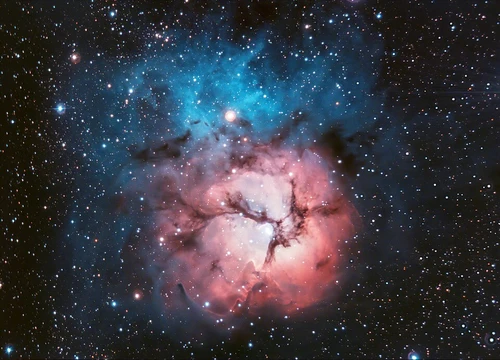
Camelopardalis dark region
A dark, star-forming complex in the outer Orion Arm.

The Camelopardalis dark region is a collection of molecular clouds and dark nebulae found toward the southern part of the Camelopardalis constellation. This system of clouds and young stars sits within the Orion Arm, roughly 1,000 parsecs (3,300 light-years) from the Solar System. It occupies the same galactic area as the Cassiopeia OB6 association and lies farther out than the star-forming complexes in Perseus and Taurus. The region wasn't studied in detail until the late 20th century, when surveys began examining the dark patches that block the Milky Way in this area. In the 1990s, astronomers discovered that active star formation is happening here, shown by numerous young stellar objects and the OB association called Camelopardalis OB1, which includes several bright O- and B-class stars along with dozens of A-class stars. The most distant objects visible in this part of the sky belong to the Cygnus Arm (the Outer Arm), where the Cam OB3 association and some associated H II regions lie.
Visually, this stretch of the Milky Way is extremely obscured—it's the faintest and least showy section of the galactic band across the entire sky. On the darkest, clearest nights, it appears as a very dim, frayed halo. The star fields here are sparse. With binoculars, you can spot a few weak, loosely concentrated star clusters, but most stars are scattered and seem unrelated. The region is easy to find because of the bright star Mirfak (Alpha Persei), the brightest in Perseus, which sits at the center of the Alpha Persei Cluster (Mel 20)—a bright group of blue stars that forms the core of the Perseus OB3 association. The dark region of Camelopardalis lies just north of this cluster. The nebular complex has a strongly northern declination, averaging 56°N, so it's best observed from the Northern Hemisphere, where it's circumpolar down to lower temperate latitudes. From the Southern Hemisphere, it's only visible from tropical and subtropical zones, hugging the northern horizon. The best evening viewing period is during boreal autumn and winter, from late October through March. The southern part of Camelopardalis reaches the zenith over northern Europe, Canada, and central-southern Russia.
Quick Facts
- Epoch
- J2000
- Constellation
- Camelopardalis
- Dist Ly
- 3300
- Dist Pc
- 1000
- Notes
- Complex of dark clouds associated with the Cam OB1 association
- Ra
- 03 · 50
- Dec
- 56
Facts from the source article.
Lore & Background
The region was not the subject of particular studies until the end of the 20th century, when some surveys were conducted on the dark regions that obscure the Milky Way in this stretch; in the 1990s it was discovered that active star formation phenomena are present here, as evidenced by the presence of a large number of young stellar objects and the OB association catalogued as Camelopardalis OB1, composed of some bright stars of spectral class O and B, plus several dozen stars of class A. The most distant objects observable in this direction belong to the Cygnus Arm (Outer Arm), in which the Cam OB3 association and some H II regions associated with it extend.
The galactic region in the direction of Camelopardalis appears visually very obscured: it can be observed as a very faint clear halo with a very frayed appearance only on the darkest and clearest nights. The region is easy to locate thanks to the bright star Mirfak (α Persei), located at the center of the Alpha Persei Cluster (Mel 20), which represents the center of the Perseus OB3 association. The area of sky north of this association corresponds to the dark region of Camelopardalis. The declination of the nebular complex is strongly northern, with an average of 56°N, making it circumpolar up to lower temperate latitudes in the Northern Hemisphere.
The Camelopardalis region is physically located in the outermost part of the Orion Arm. The line of sight between the Sun and the region is affected by strong obscurations caused by masses of gas and interstellar dust. The Cam OB1 association, centered on the dark nebulae region, appears on the edge of the spiral arm and is connected with emission nebulae Sh2-202 and Sh2-205. One of the densest dark nebulae near Sh2-202 contains the massive stellar object GL 490. A large complex of dark clouds, including TGU 942, TGU 994, TGU 1003, TGU 1036, TGU 1041, TGU 1027, TGU 1014, TGU 1006, and TGU 989, forms a ring structure in the southern part of the region.
Reader's Guide
The Camelopardalis dark region is significant as a site of ongoing star formation in a relatively obscure part of the Milky Way, where the galactic plane appears faint and frayed. Its discovery in the 1990s revealed active star formation phenomena, evidenced by numerous young stellar objects and the OB association Cam OB1. The region contains several H II regions, such as Sh2-202 and Sh2-205, which host T Tauri stars and protostellar cocoons. Notable infrared sources include IRAS 03134+5958, associated with the T Tauri star HBC 336, and IRAS 04376+5413, which underwent a sudden increase in luminosity, suggesting it may be an EX Lupi or FU Orionis star. The region also contains dense dark clouds like LDN 1400, LDN 1389, and LDN 1439, each associated with protostellar nuclei. The complex lies in the outermost part of the Orion Arm, with more distant objects belonging to the Perseus Arm and Outer Arm. Its legacy lies in providing a laboratory for studying star formation in a heavily obscured environment, where the interplay of dark nebulae, young stars, and multiple spiral arms can be observed.
Did You Know?
- The Camelopardalis dark region is the least luminous and showy stretch of the Milky Way trail in the entire celestial vault.
- Active star formation in the region was not discovered until the 1990s.
- The region contains the OB association Camelopardalis OB1, composed of bright stars of spectral class O and B plus several dozen class A stars.
- The infrared source IRAS 04376+5413 underwent a notable increase in luminosity, similar to EX Lupi or FU Orionis stars.
Galactic Position and Layered Structure
The Camelopardalis dark region occupies the outermost edge of the Orion Arm, the secondary spiral arm of the Milky Way that also contains our Solar System. At roughly 1000 parsecs (about 3300 light-years) from the Sun, it sits well beyond the more familiar star-forming complexes of Perseus and Taurus, sharing its galactic neighborhood with Cassiopeia OB6. The line of sight from Earth to this region passes through multiple layers of interstellar material. Closest is the Per OB3 association, centered on the bright star Mirfak, at only 200 to 250 parsecs. Beyond that lies the Lindblad Ring at around 300 parsecs, home to the Perseus Cloud at high galactic latitude. Further still, the Cam OB1 association marks the true edge of the spiral arm, associated with emission nebulae Sh2-202 and Sh2-205. Even more distant objects visible in the same sky direction—such as the Cam OB3 association and several H II regions—actually belong to the Cygnus Arm, also called the Outer Arm, while others lie in the far reaches of the Perseus Arm. This layered arrangement means a single patch of sky reveals structures spanning thousands of light-years.
Late Recognition and the 1990s Breakthrough
For most of astronomical history, the dark region in the direction of southern Camelopardalis attracted little dedicated research. It was not until the late twentieth century that systematic surveys began examining the obscuring material that dims the Milky Way in this particular stretch of sky. A pivotal shift came in the 1990s, when astronomers confirmed that active star formation was underway within these clouds. The evidence was compelling: a large population of young stellar objects was identified, and a formal OB association—catalogued as Camelopardalis OB1—was recognized. This association comprises a handful of luminous O- and B-class stars alongside several dozen A-class members, marking a genuine stellar nursery rather than a mere dust screen. The discovery elevated the region from a visually unremarkable gap in the galactic band to a scientifically significant site of ongoing stellar birth, prompting further investigation into the molecular cloud complex and its embedded young stars.
A Faint Halo in the Northern Sky
Of all the stretches of the Milky Way visible from Earth, the segment passing through Camelopardalis is the dimmest and least spectacular. On the darkest, clearest nights, it manifests only as a faint, frayed halo of diffuse light, with a notably sparse stellar field. Binoculars reveal a few weak, poorly concentrated star groupings, but most stars appear scattered and seemingly unrelated. Locating the region is nonetheless straightforward: the brilliant star Mirfak (α Persei), anchor of the Alpha Persei Cluster (Mel 20) and center of the Perseus OB3 association, provides a clear landmark, with the dark region lying just north of this bright blue-star group. The complex's average declination of 56°N makes it a Northern Hemisphere target, appearing circumpolar down to lower temperate latitudes. From the Southern Hemisphere, it is visible only from tropical and subtropical zones, skimming the northern horizon. Evening viewing is best from late October through March, and the southern part of the region reaches the zenith at latitudes spanning Northern Europe, Canada, and central-southern Russia.
Molecular Clouds, Dark Nebulae, and Young Stars
The physical substance of the Camelopardalis region is a dense tangle of molecular clouds and dark nebulae. Among the most prominent emission nebulae are Sh2-202 and Sh2-205, both linked to the Cam OB1 association. Within Sh2-202, the infrared source IRAS 03134+5958 coincides with HBC 336, a T Tauri star exhibiting strong Hα emission, situated in the open cluster Stock 23—whose reality as a true cluster is questioned, as its members may simply appear aligned by perspective. A dozen additional Hα-emitting stars have been identified in the vicinity. The dark nebulae are equally remarkable: one of the densest in this galactic sector, lying near Sh2-202, harbors the massive object GL 490. A vast complex of dark clouds—designated TGU 942, 994, 1003, 1036, 1041, 1027, 1014, 1006, and 989—arranges itself into a ring structure in the southern portion of the region, pointing toward μ Persei. Reflection nebulae vdB 14 and vdB 15, associated with two fourth-magnitude stars, and additional dark complexes west of Sh2-202, belong to the more remote reaches of the Orion Arm near the Perseus Arm.
Frequently Asked Questions
What is the Camelopardalis dark region?
It is a sprawling complex of molecular clouds and dark nebulae located in the southern portion of the Camelopardalis constellation. The whole structure sits in the outermost stretch of the Orion Arm and hosts both young stars and dense gas that blocks background Milky Way light.
How far away is the Camelopardalis dark region from Earth?
The region lies roughly 1,000 parsecs, or about 3,300 light-years, from the Solar System. That places it well beyond the nearer Perseus and Taurus star-forming complexes but still within our own spiral arm.
Which emission nebulae and infrared sources are notable in the Camelopardalis dark region?
Catalogued emission nebulae include Sh2-202 and Sh2-205, while several bright infrared sources such as IRAS 03134+5958, IRAS 04005+5647, IRAS 04559+5200, and IRAS 04376+5413 have been identified within the cloud complex. These infrared objects typically mark deeply embedded protostars or young massive stars still shrouded in dust.
When did astronomers begin studying the Camelopardalis dark region in detail?
Serious investigation only picked up in the late 20th century, when wide-field sky surveys started mapping the dark patches that dim the Milky Way in that part of the sky. Before those surveys, the region was essentially a vague smudge on star charts rather than a well-characterized object.
What OB associations and neighboring structures are linked to the Camelopardalis dark region?
The cloud complex is associated with the Camelopardalis OB1 and Cam OB3 young-star groups, and it occupies the same broader galactic zone as the Cassiopeia OB6 association. Together these structures form part of the outer Orion Arm's extended star-forming network.
More in Nebulae, Part 2 1-24
Spotted an error? Know more?
Reader corrections go straight into our review queue. Suggest an edit · How this site is sourced