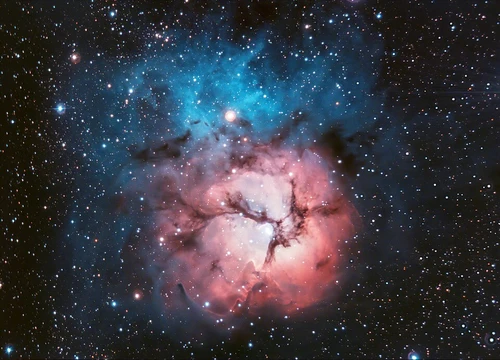
Barnard 203
Dark nebula in Perseus with multiple protostars and outflows.

Barnard College · Public domain
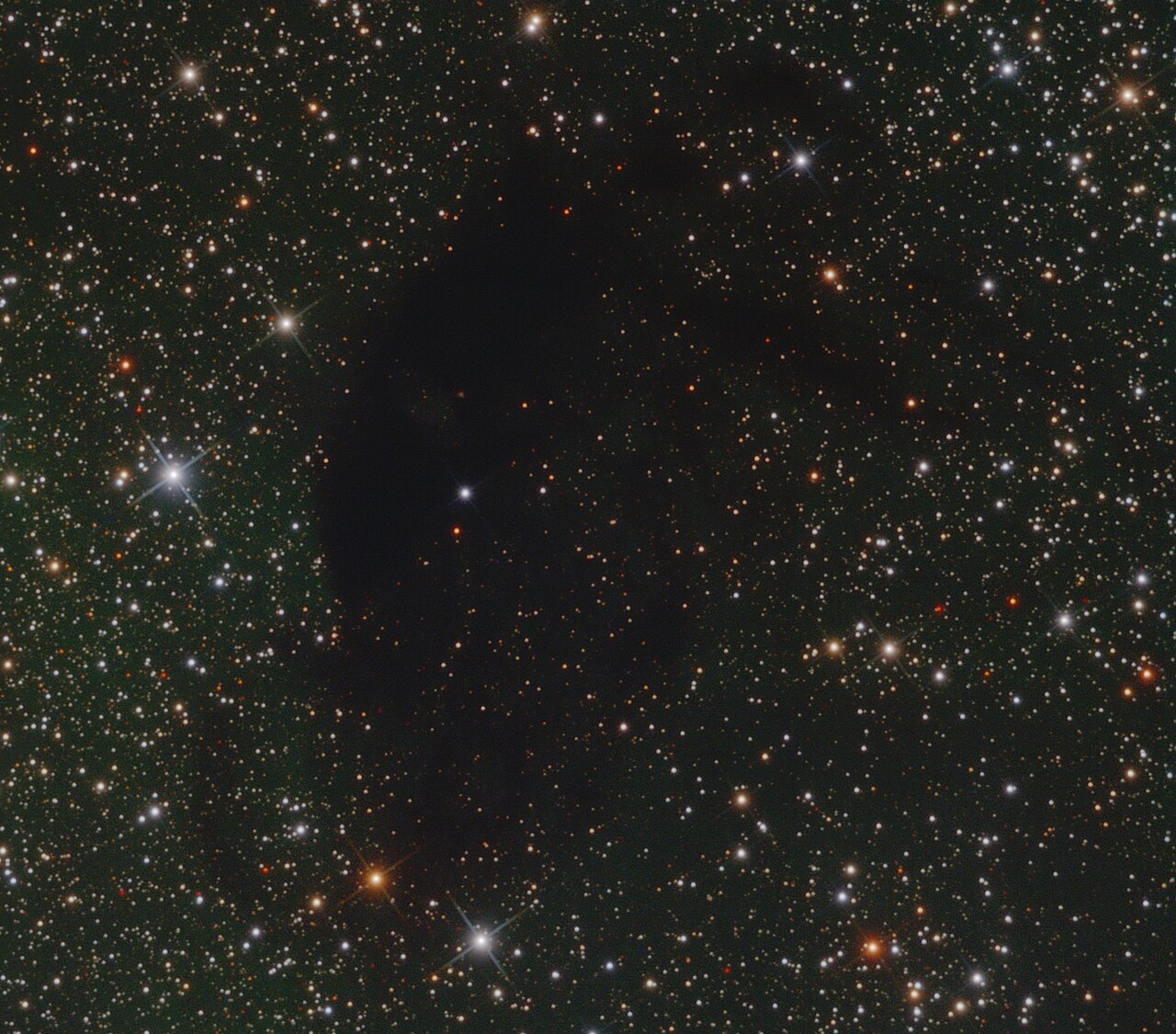
Barnard 203, also known as Lynds 1448, is a dark nebula located in the Perseus molecular cloud, approximately 800 light-years away. It is notable for containing a rich population of young stellar objects and protostars, including multiple infrared sources and Herbig-Haro objects.
Quick Facts
- Epoch
- J2000.0
- Ra
- 03 · 22 · 30.0
- Dec
- +30 · 35 · 00
- Dist Ly
- 800
- Dist Pc
- 250
- Constellation
- Perseus
- Names
- Barnard 203, LDN 1448
Facts from the source article.
Lore & Background
The region contains three infrared sources detected by IRAS: IRS 1, IRS 2, and IRS 3. IRS 1 is a class I young stellar object and a binary, more evolved than most protostars in the area and less well-studied. IRS 2 is a very young class 0 binary surrounded by a rotating disk, showing a bipolar outflow signature and an hourglass-shaped magnetic field aligned with the outflow. To the east lies IRS 2E, a source between a pre-stellar core and a protostar.
IRS 3B has been studied the most; ALMA revealed it is a triple protostar system with one star forming via disk fragmentation. The two outer stars are separated by 61 and 183 astronomical units from the central star, and all three are surrounded by a circumstellar disk with spiral arms. IRS 3B is a class 0 object possibly younger than 150,000 years. The two central protostars have a mass of about 1 M☉ each, the outer protostar about 0.085 M☉, and the surrounding disk has an estimated mass of about 0.30 M☉. IRS 3A, B, and C show molecular outflows; IRS 3 is also called L1448N.
Another well-studied source, L1448-mm or L1448C, is a class 0 young stellar object driving a highly collimated flow detected in carbon monoxide, silicon monoxide, and water.
Reader's Guide
Barnard 203 is significant as a laboratory for studying multiple stages of star formation within a single dark nebula. The region hosts a range of young stellar objects from class 0 protostars like IRS 2 and IRS 3B to the more evolved class I source IRS 1, allowing comparison of evolutionary states. The discovery of a triple protostar system in IRS 3B via ALMA, with one star formed by disk fragmentation, provides direct evidence of a specific formation mechanism. The presence of Herbig-Haro objects HH 193–197, driven by protostars, and the highly collimated outflow from L1448-mm, traced in multiple molecules, illustrate the energetic feedback from these young stars. The hourglass-shaped magnetic field aligned with the bipolar outflow in IRS 2 offers insight into magnetic field roles in star formation. The region's legacy lies in its detailed multi-wavelength studies that reveal the complexity of protostellar systems and their environments.
Did You Know?
- Barnard 203 is also known as Lynds 1448.
- IRS 3B is a triple protostar system with one star formed via disk fragmentation.
- The source IRS 2 has an hourglass-shaped magnetic field aligned with its bipolar outflow.
Physical Structure and Celestial Placement
Barnard's Loop, catalogued as Sh 2-276, is an emission nebula that traces a sweeping arc across the constellation Orion. This arc is centered roughly on two of the constellation's most recognizable features: the dark Horsehead nebula and the brilliant Orion Nebula. The stars within the Orion Nebula are believed to be the source of the ionization that makes the loop glow. The structure is not an isolated object but rather a component of the larger Orion–Eridanus Superbubble, which in turn belongs to the vast Orion molecular cloud complex. As viewed from Earth, the loop spans approximately 10 degrees of sky, a stretch that covers a substantial portion of Orion. Its physical dimensions are equally impressive: the arc measures roughly 110 parsecs, or about 360 light-years, in length and sits at a distance of approximately 440 parsecs, roughly 1,400 light-years, from our solar system.
A Supernova's Ancient Legacy
The prevailing theory for the loop's formation points to a catastrophic supernova explosion that occurred roughly two million years ago. This single violent event is thought to have shaped the gaseous arc we observe today. The blast is also believed to have produced several runaway stars now scattered across the sky, including AE Aurigae, Mu Columbae, and 53 Arietis. These stars are thought to have once belonged together as a multiple star system, from which one component underwent supernova detonation, ejecting its companions into high-velocity trajectories. The connection between the loop and these fast-moving stars suggests that a single stellar death event, millions of years before the present, left behind both the glowing arc and a small family of displaced suns still racing through interstellar space.
Catching a Faint Glow
Despite its enormous physical scale, Barnard's Loop presents a significant challenge to the human eye. The nebula is quite faint, and under typical observing conditions it simply does not register visually. Long-exposure astrophotography remains the most reliable method for capturing the full arc, allowing accumulated light to reveal the sweeping curve against the starfield of Orion. That said, observers fortunate enough to be under exceptionally dark skies, far from any light pollution, may be able to discern the loop with unaided vision, though this remains a difficult and rare achievement. The faintness of the emission, combined with the loop's broad, diffuse nature spread over roughly 10 degrees of sky, means the light per square degree is low, making it far less conspicuous than the dense, bright core of the Orion Nebula at its center.
Named for a Pioneering Photographer
Although earlier astronomers certainly detected this faint nebula in the skies of Orion, the structure bears the name of Edward Emerson Barnard, a pioneering figure in astrophotography. In 1894, Barnard captured photographs of the loop and published a formal description of it, an act that cemented his association with the object in the astronomical record. His work represented a significant step in the emerging field of photographic astronomy, where the camera's ability to integrate faint light over time revealed structures invisible to the naked eye. The naming convention honors his contribution to documenting and describing the nebula, even though the phenomenon itself had been glimpsed by predecessors. Barnard's 1894 publication thus stands as a milestone in the transition from purely visual astronomy to the photographic methods that would later transform our understanding of the night sky.
Gallery
Frequently Asked Questions
What is Barnard 203?
Barnard 203 (also catalogued as Lynds 1448) is a dark nebula sitting inside the Perseus molecular cloud, roughly 800 light-years from Earth. It's a dense, cold patch of gas and dust that blocks background starlight, which is what makes it visible as a dark silhouette against the brighter Perseus region.
Where exactly is Barnard 203 in the sky?
You'll find it about one degree southwest of the well-known NGC 1333 complex, embedded within the larger Perseus molecular cloud. At roughly 800 light-years away, it is one of the closer star-forming regions we can study in real detail.
What protostars and young stellar objects live inside Barnard 203?
The region hosts a dense cluster of very young objects, including the infrared sources IRS 1 (a class I binary), IRS 2 (a class 0 binary), and IRS 3B (a class 0 triple system), along with the protostar L1448-mm. All of them are still wrapped in their natal dust envelopes, making them some of the earliest stellar stages we can observe.
What Herbig-Haro objects are associated with Barnard 203?
Astronomers have identified Herbig-Haro objects numbered HH 193 through HH 197 in or near this region. These are glowing shock fronts produced when fast jets of material ejected by the protostars slam into the surrounding cloud gas.
Why do astronomers care so much about Barnard 203?
Because it packs multiple evolutionary stages—class 0, class I, and binary or triple systems—into one compact dark cloud, it acts as a natural laboratory for tracking how stars form and evolve. The coexistence of several protostars and their outflows in such a small area gives researchers a rare, layered snapshot of star formation caught in progress.
More in Nebulae, Part 2 1-24
Spotted an error? Know more?
Reader corrections go straight into our review queue. Suggest an edit · How this site is sourced