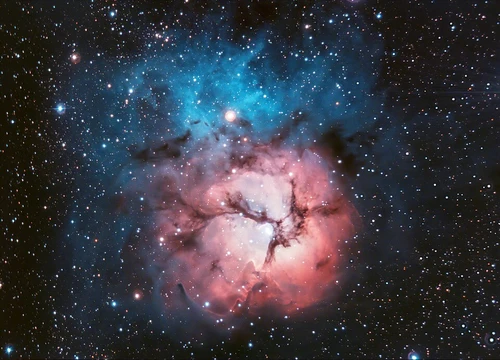
Barnard 335
A Bok globule with a young protostar and episodic accretion.

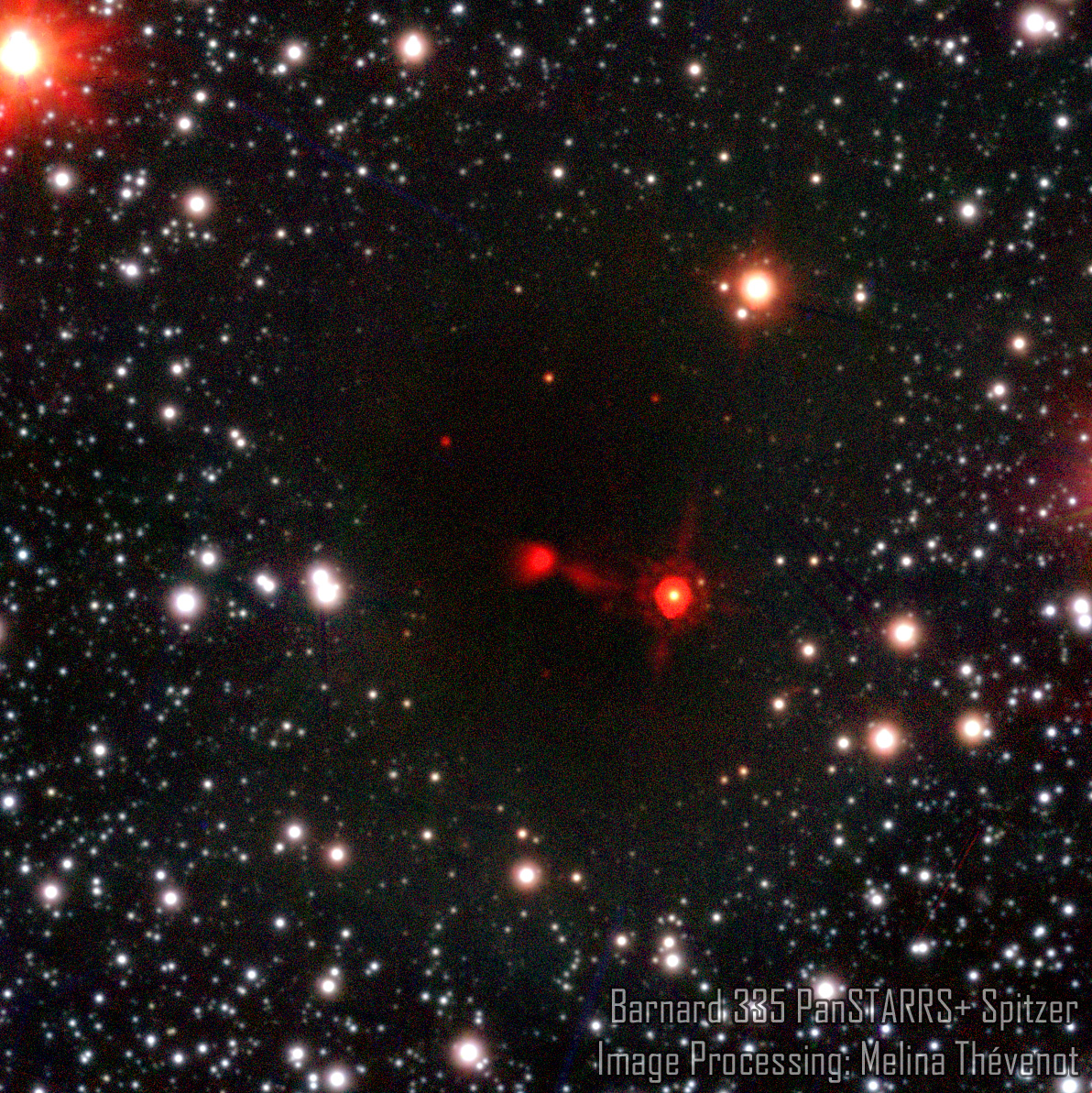
PanSTARRS & NASA/JPL Spitzer Space Telescope Melina Thévenot · CC BY-SA 4.0
Barnard 335 (also known as B335 or Lynds 663) is a Bok globule containing a single very young low-mass protostar. It is notable for its well-studied protostar, which exhibits episodic accretion, a bipolar outflow, and a rotating infalling envelope, making it a key object for understanding early star formation.
Quick Facts
- Epoch
- J2000
- Ra
- 19 · 36 · 55.0
- Dec
- +07 · 34 · 24
- Dist Ly
- 536.5
- Dist Pc
- 164.5
- Appdia
- 24.0'
- Constellation
- Aquila
- Names
- LDN 663, [CB88] 199
Facts from the source article.
Lore & Background
Barnard 335 was discovered in 1927 by Barnard et al. A range of distances were used in the past. In 2009 it was first noted that the south-west of the nebula is bright in the U-band. One possible explanation was that HD 184982 has a similar distance and causes a glow in the form of a reflection nebula, but this was dismissed at the time. Later it was demonstrated that HD 184982 is surrounded by a reflection nebula apparently related to the Bok globule Barnard 335. This star is located 164.5 parsec from the Solar System and Barnard 335 must lie at a similar distance. The molecular core of Barnard 335 is the densest part of a larger cometary globule, suggesting that external wind shaped the globule and triggered the formation of a single star inside it.
The protostar was discovered with NASA IRTF and the Kuiper Airborne Observatory, later detected with IRAS and sometimes named IRAS 19345+0727. It is classified as a class 0 protostar. A bipolar outflow was discovered in CO emission with the Nobeyama Radio Observatory. Observations with ALMA found infalling material towards the central source, detected via HCN and HCO+ emission lines, used to determine an age between 30,000 and 40,000 years. The protostar consists of a rotating infalling envelope, outflow cavities, a very small disk, and a pseudo-disk. It is variable and shows episodic accretion. The disk is in the process of forming, with material infalling from the north and south, with material exceeding free-fall velocities close to the protostar. ALMA detected a range of complex organic molecules within 10s of AU of the protostar. The magnetic field changes from ordered to pinched to more complicated structures within the inner 100 AU scale.
Reader's Guide
Barnard 335 holds significance as a nearby laboratory for studying the earliest stages of low-mass star formation. The protostar's classification as a class 0 object, its episodic accretion, and the detection of complex organic molecules within tens of AU provide direct insights into the chemical and physical processes during star birth. The discovery of a molecular bullet likely ejected around 2015, linked to an outburst observed by WISE between 2015 and 2022, illustrates the dynamic, episodic nature of accretion. JWST observations further refined the shock structures, showing low proper motion shocks at the periphery with bow shocks pointing toward the protostar, and high proper motion shocks at the central axis pointing away. The association with the star HD 184982 and the reflection nebula clarifies the distance and environment. The legacy of Barnard 335 lies in its role as a benchmark for models of protostellar evolution, infall, outflow, and magnetic field behavior, as detailed by multiple observatories over decades.
Did You Know?
- The protostar is classified as a class 0 protostar and has an age between 30,000 and 40,000 years.
- A molecular bullet was likely ejected from the protostar around 2015, associated with a recent accretion event.
- JWST showed that low proper motion shocks at the periphery of the outflow have bow shocks pointing towards the protostar.
Discovery and the Puzzle of Distance
Barnard 335, also catalogued as B335 or Lynds 663, is a dark nebula first identified in 1927 by Edward Barnard and colleagues. For decades, astronomers struggled to pin down how far away this compact object actually sat, with a wide spread of distance estimates circulating in the literature. A turning point came in 2009, when researchers noticed that the south-western edge of the nebula glowed in the ultraviolet U-band. One hypothesis linked this emission to the nearby star HD 184982, which could have been illuminating the dust as a reflection nebula. That explanation was initially set aside, and the team reported a distance of 90 to 120 parsec. Later work, however, confirmed that HD 184982 is indeed wrapped in a reflection nebula physically associated with Barnard 335. Because that star sits 164.5 parsec from the Solar System, Barnard 335 must occupy a comparable distance, resolving the long-standing ambiguity that had plagued the object since its discovery.
A Newborn Star in Its Cradle
At the heart of Barnard 335 lies a single, extremely young, low-mass protostar that was first detected using NASA's Infrared Telescope Facility and the Kuiper Airborne Observatory. It was subsequently picked up by the IRAS satellite and is sometimes referred to by that designation, IRAS 19345+0727. Classified as a class 0 protostar, it is estimated to be only 30,000 to 40,000 years old, an age derived from ALMA observations of infalling material traced by HCN and HCO+ emission lines. The object is variable and undergoes episodic accretion events. Its architecture includes a rotating infalling envelope, outflow cavities, a very small disk that is still in the process of forming, and a pseudo-disk. Material is falling in from both the north and south, and close to the protostar it exceeds free-fall velocities. Mass estimates vary: one team derived 0.03 to 0.07 solar masses, roughly 31 to 71 Jupiter masses, from hydrocarbon velocity structure, while another study found 0.25 solar masses. Within the inner 100 AU, the magnetic field transitions from ordered to pinched to more complex configurations.
Shocks, Outflows, and a Molecular Bullet
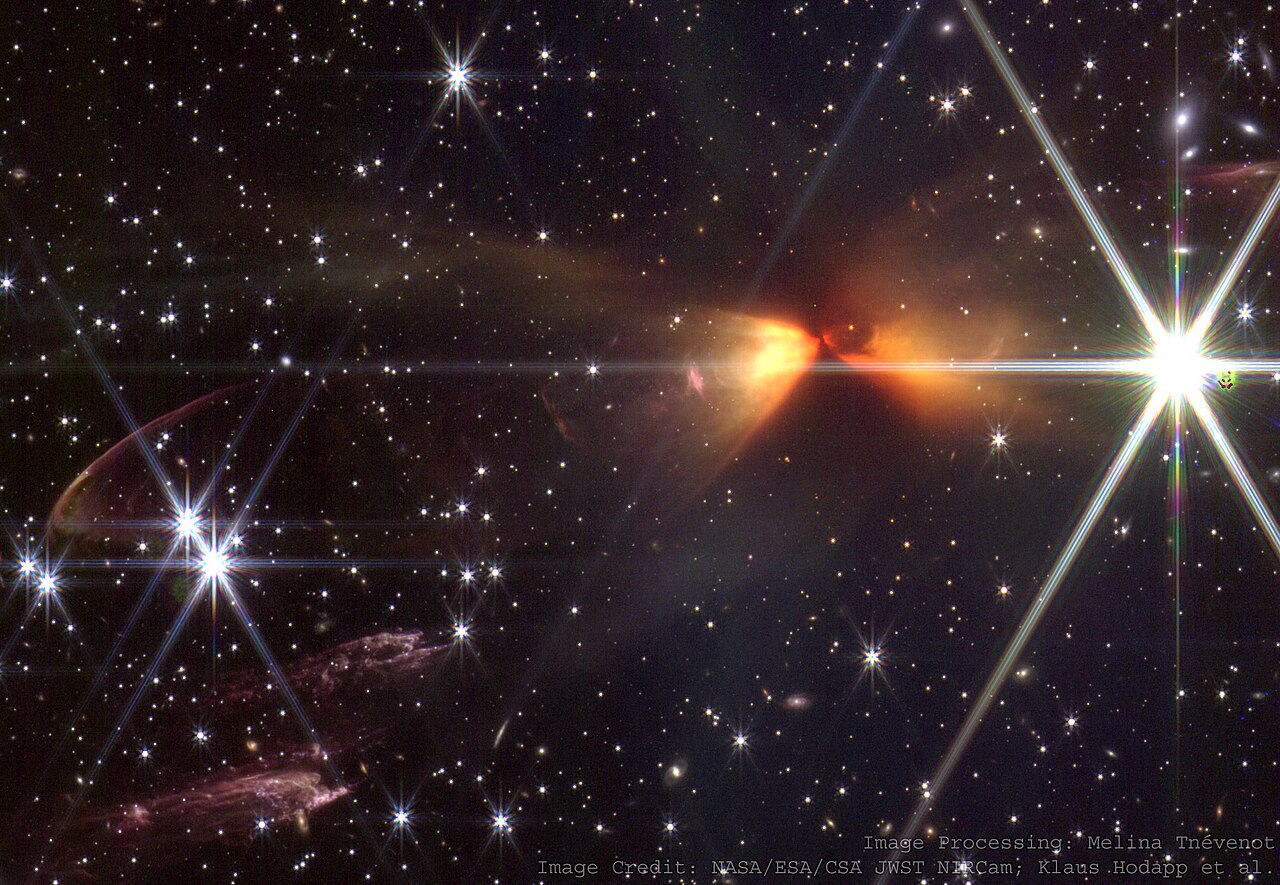
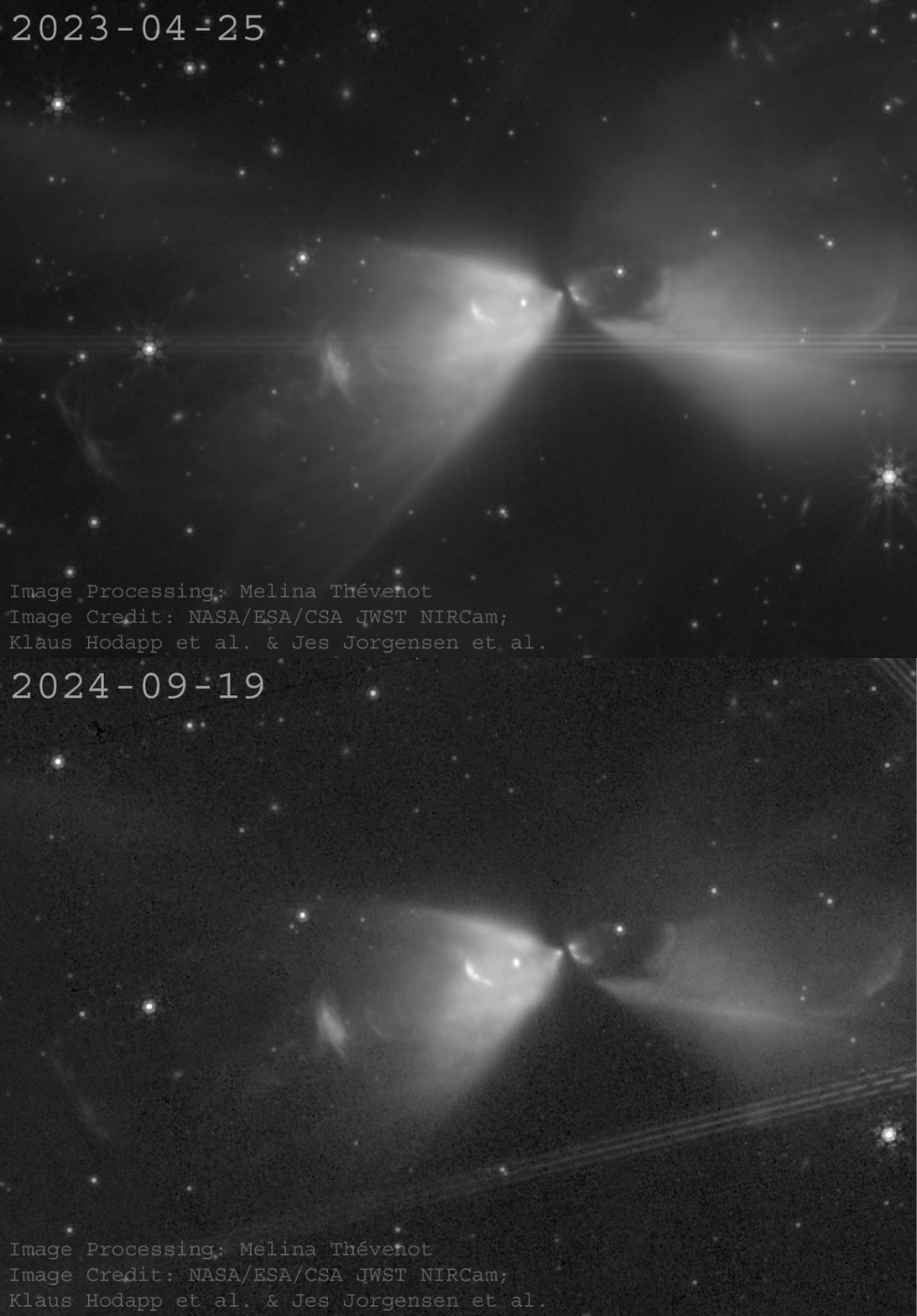
The protostar in Barnard 335 drives a bi-polar outflow first identified in carbon monoxide emission at the Nobeyama Radio Observatory. Herbig-Haro objects associated with this outflow were initially observed in Hα with the NOFS instrument and designated HH119 A through C, while infrared counterparts of the H2 shock fronts received labels HH119 IR1 through IR5. Additional shocks were later found with various telescopes. JWST's NIRCam imaging revealed a striking geometric detail: low proper-motion shocks at the outflow's periphery display bow shocks pointing back toward the protostar, whereas high proper-motion shocks along the central axis show bow shocks pointing away. Around 2015, a molecular bullet was likely ejected from the protostar in connection with a recent accretion event. WISE observations confirmed an outburst between 2015 and 2022, and both phenomena are linked. JWST data suggest the dim shock 2E was launched in March 2015, while the brighter shock 3E, launched in 2010, better matches the light curve. The innermost shocks emit in carbon monoxide and molecular hydrogen, older shocks show only H2, and the youngest shock was ejected in August 2022.
Chemistry and the Wind-Sculpted Globule
Barnard 335 is not merely a dark smudge in the sky; it is a cometary globule whose densest region, the molecular core, houses the protostar. The cometary shape strongly suggests that an external wind sculpted the globule and, in doing so, triggered the collapse that produced a single star inside it. ALMA observations have detected a range of complex organic molecules within just tens of astronomical units of the protostar, revealing the rich chemistry present in this nascent system. The infalling material, traced by HCN and HCO+ emission lines, is falling in from both the north and south, and close to the protostar it exceeds free-fall velocities. The protostar's episodic accretion and variability underscore that this is a dynamic, still-forming system. The magnetic field within the inner 100 AU shifts from ordered to pinched to more complicated structures, underscoring the intricate interplay between magnetic fields, gas dynamics, and the ongoing birth of a low-mass star within a wind-carved cocoon of dust and gas.
Gallery

Frequently Asked Questions
What is Barnard 335?
Barnard 335 (also called B335 or Lynds 663) is a compact Bok globule—a dense knot of cold gas and dust—that cradles a single, extremely young, low-mass protostar. It was first identified in 1927 by Edward Barnard and his collaborators.
How far away is Barnard 335?
Early distance estimates placed the globule somewhere between 90 and 120 parsecs, but later, more precise measurements pushed that figure to about 164.5 parsecs. Either way, it sits well within our galactic neighborhood.
What makes the protostar inside Barnard 335 stand out?
The protostar displays all three hallmark signatures of a star still being assembled: burst-like (episodic) accretion, a bipolar outflow launching gas from its poles, and a rotating envelope of material spiraling inward. Finding all three features in one well-resolved object is rare, which is why it has become a go-to reference in star-formation studies.
How old and massive is the protostar in Barnard 335?
Current estimates put its age at roughly 30,000 to 40,000 years and its mass between 0.03 and 0.07 times that of the Sun. In other words, it is a very small, very young star that is still actively pulling in material from its surrounding envelope.
Why is Barnard 335 considered important for understanding star formation?
Because it bundles several textbook processes—episodic accretion, polar outflows, and rotating infall—into a single, well-studied system, it gives astronomers a natural laboratory for testing how the tiniest stars actually form. Its relatively close distance and clear structure make it far easier to model than many more distant protostars.
More in Nebulae, Part 2 1-24
Spotted an error? Know more?
Reader corrections go straight into our review queue. Suggest an edit · How this site is sourced