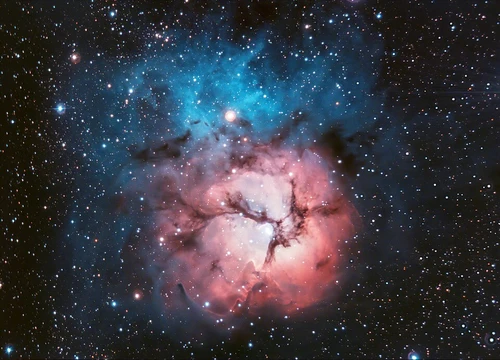
CG 4
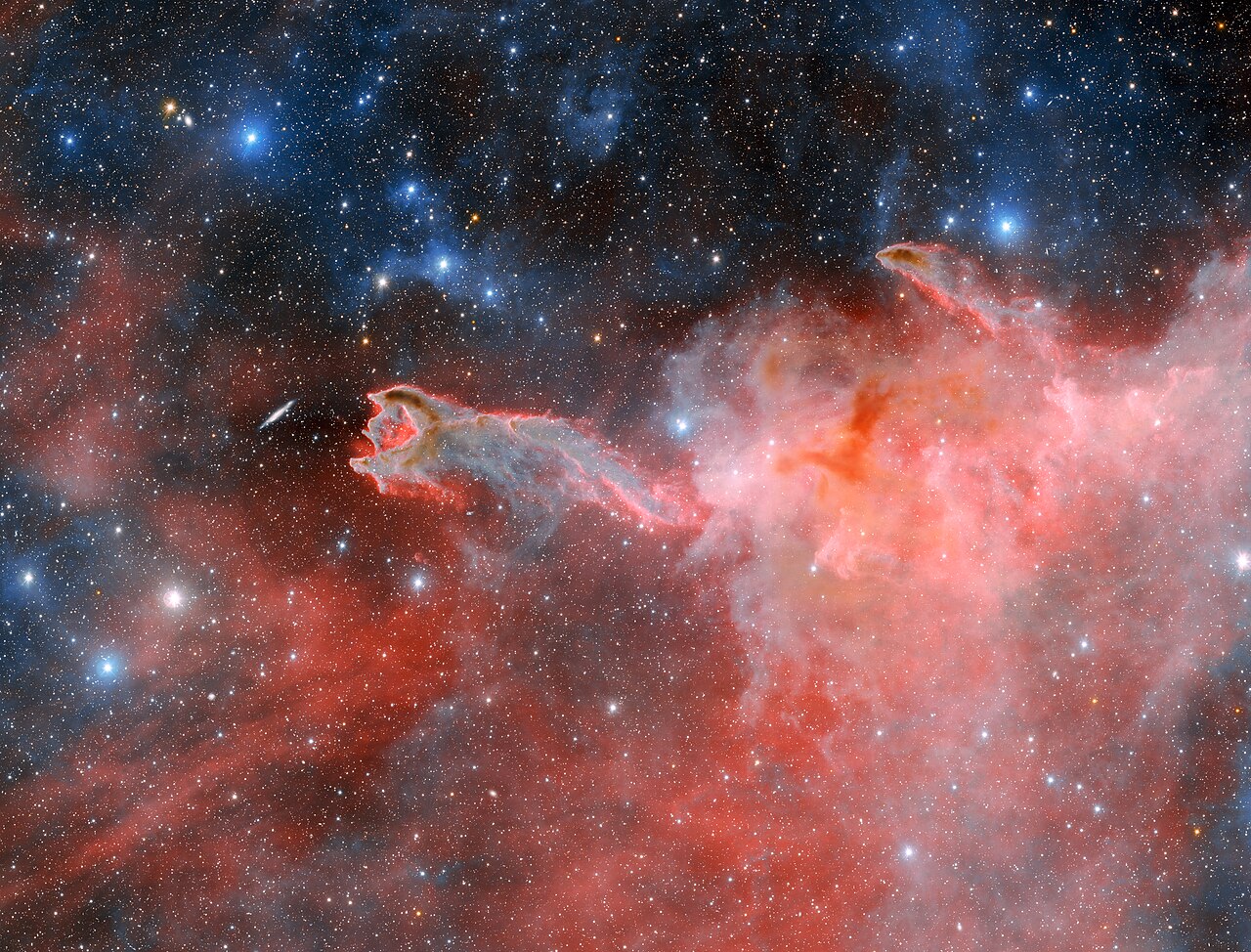
A cometary globule with a dusty head and faint tail.

European Southern Observatory · CC BY 4.0
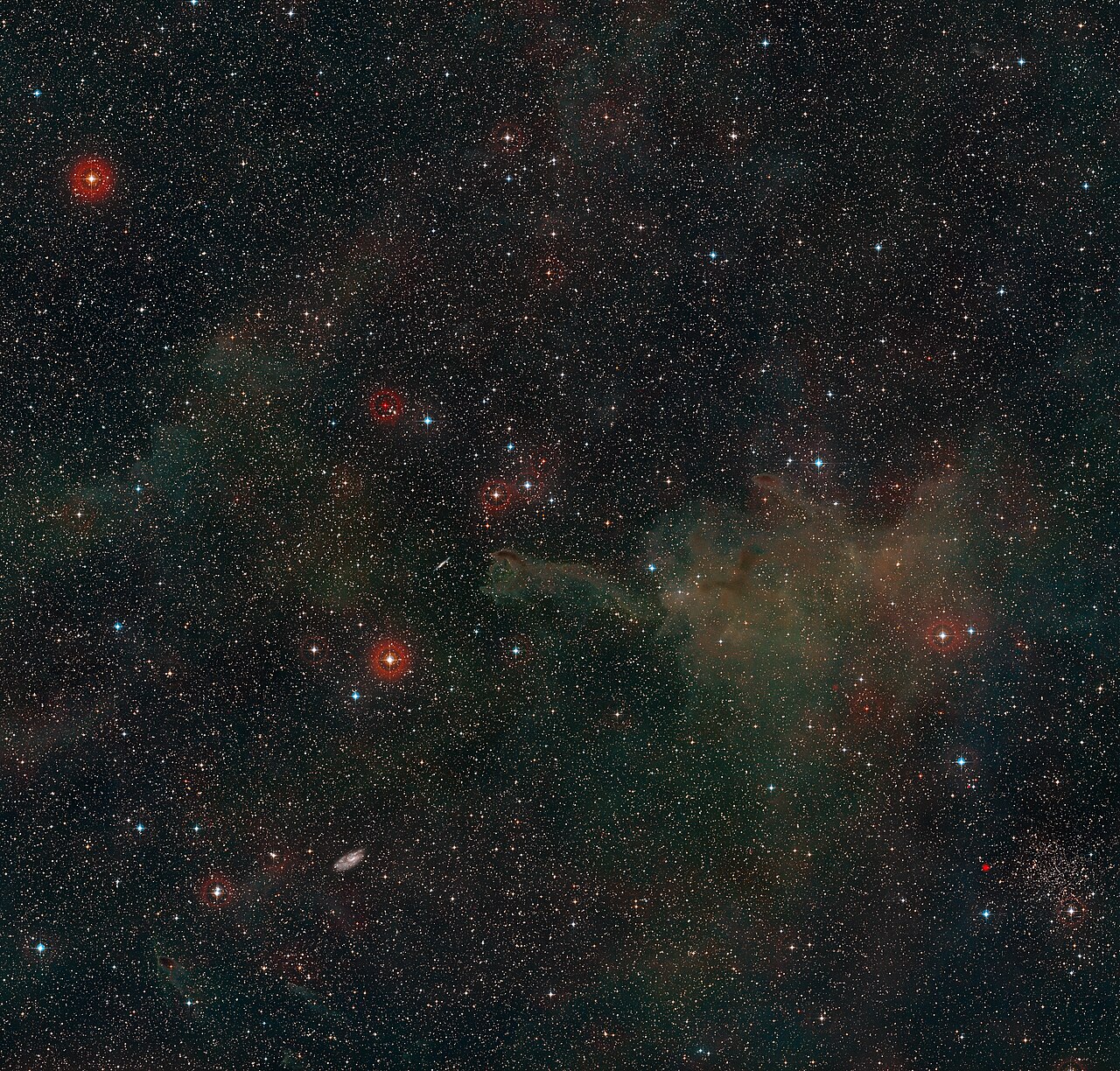
CG 4, also called God's Hand, is a star-forming region in the constellation Puppis, roughly 1,300 light-years away. It belongs to a class of objects known as cometary globules, named for their resemblance to comets. The globule has a dense head of gas and dust about 1.5 light-years across, and a faint, elongated tail stretching roughly 8 light-years. Like other nearby cometary globules, CG 4 points away from the Vela Supernova Remnant, which sits at the center of the Gum Nebula.
The globule was first spotted in 1976 on photographs from the UK Schmidt Telescope, operated by the Australian Astronomical Observatory. Those images revealed several comet-like objects in the Gum Nebula, each with a dense, dark, ruptured head and a long tail pointing away from the Vela Supernova Remnant. In January 2015, the European Southern Observatory released an image of CG 4’s head as part of its Cosmic Gems program.
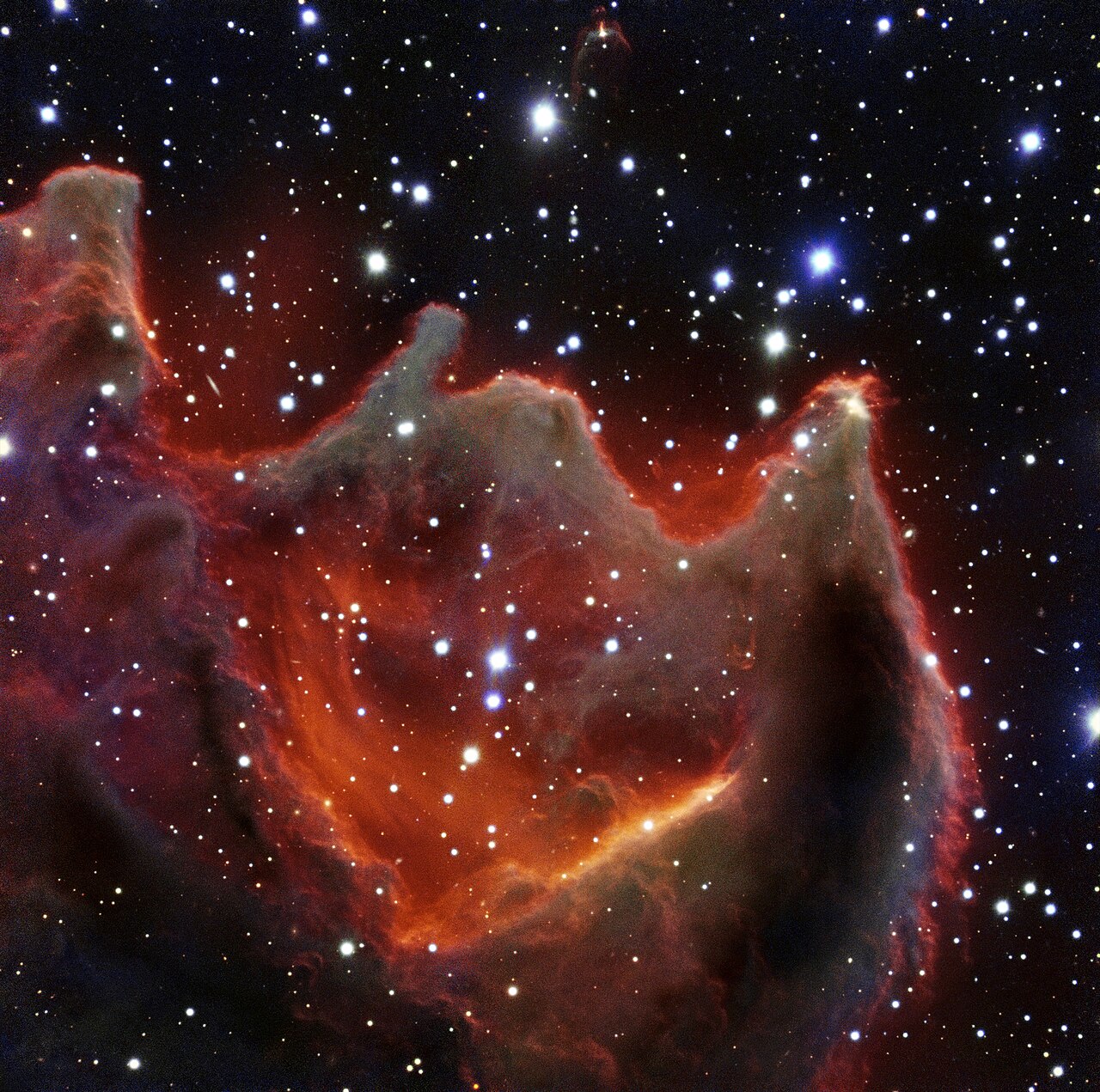
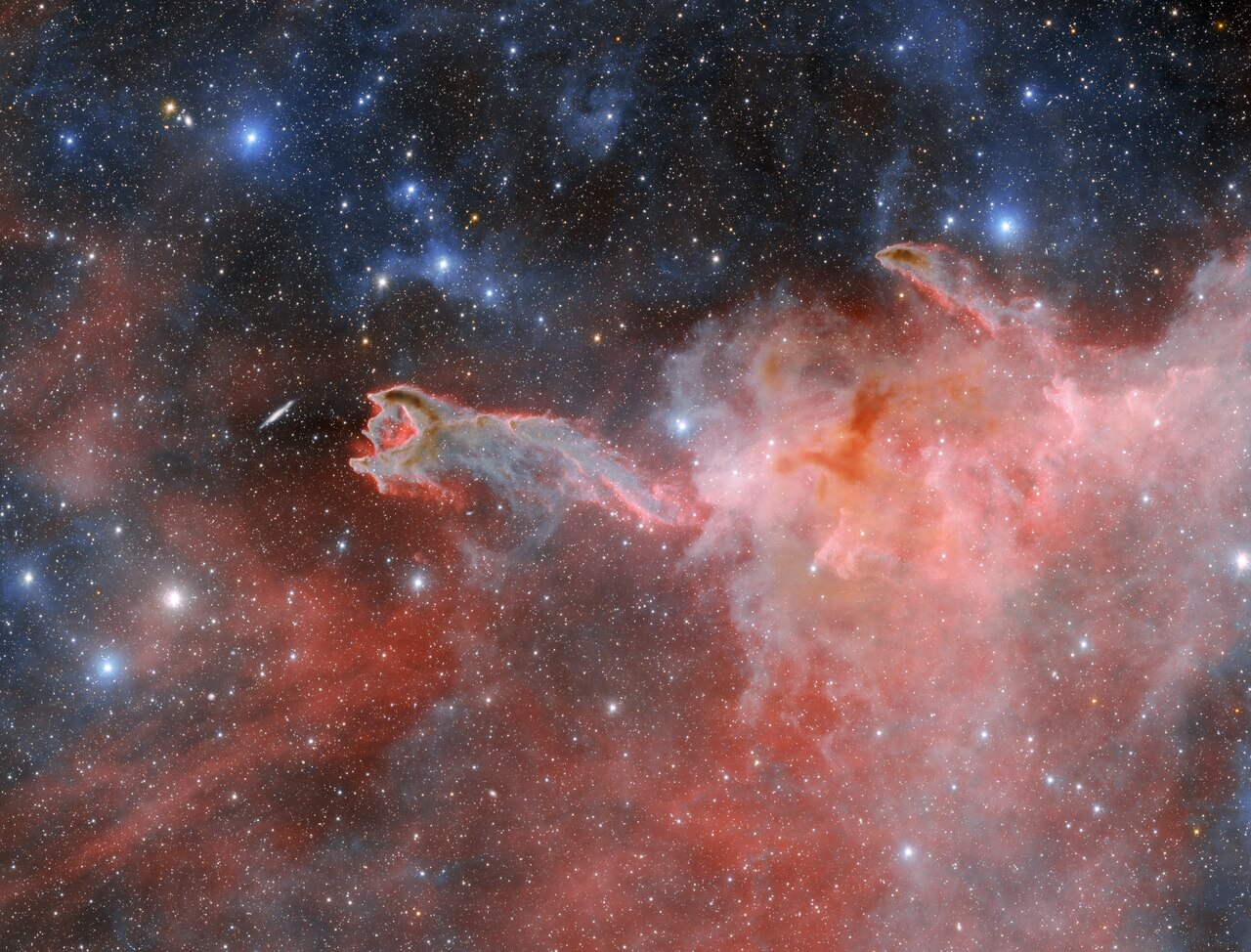
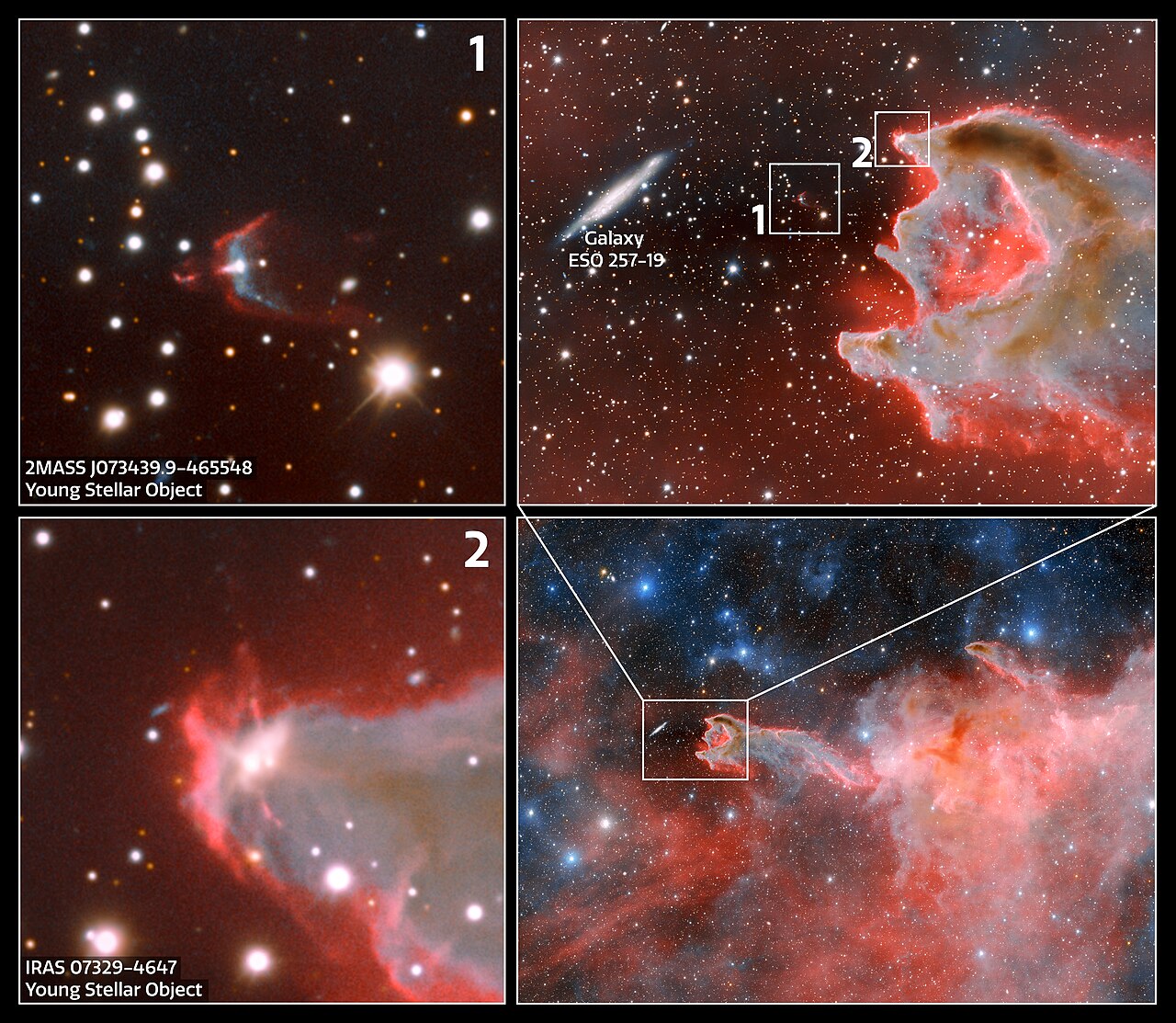
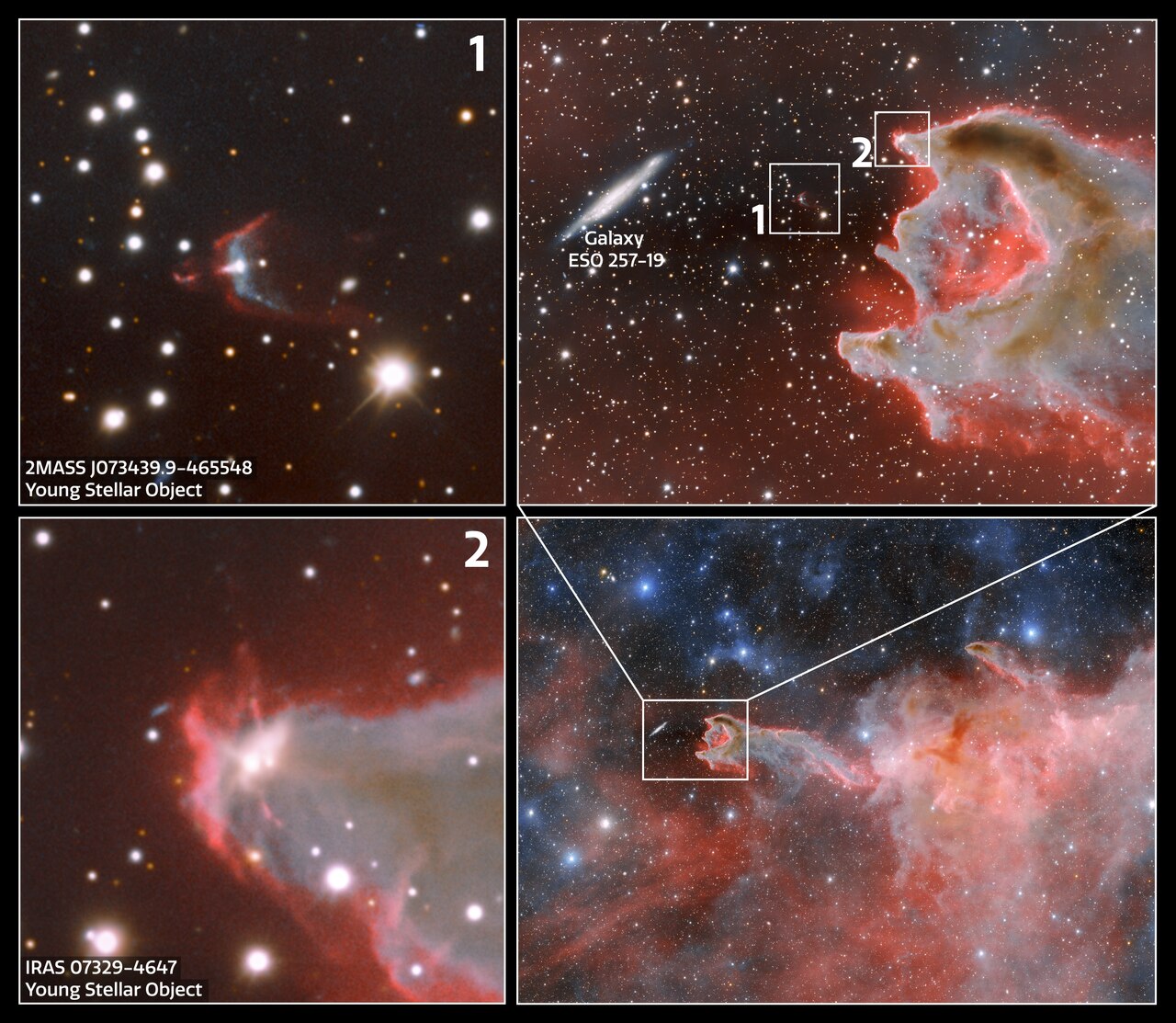
The head of CG 4 looks like a comet with a dusty, cavernous mouth, as captured by the Very Large Telescope in 2015. Made of relatively dense, dark matter, it is an opaque structure lit by a nearby star. A faint red glow along its edge may come from ionized hydrogen. The globule’s mouth appears ready to swallow the edge-on spiral galaxy ESO 257-19, though in reality that galaxy lies more than a hundred million light-years beyond.
Quick Facts
- Epoch
- J2000
- Ra
- 07 · 34 · 09.0
- Dec
- -46 · 54 · 18
- Dist Ly
- 1,300
- Dist Pc
- 400
- Constellation
- Puppis
- Dimensions
- 1.5 xx
- Names
- BHR 21, DCld 259.4-12.7, FEST 2-30, Sandqvist 103
Facts from the source article.
Lore & Background
CG 4 was discovered in 1976 through photographs from the UK Schmidt Telescope, operated by the Australian Astronomical Observatory. These images showed several comet-like objects in the Gum Nebula, an emission nebula, which came to be known as cometary globules. Each globule has a dense, dark, ruptured head and a very long tail, with the tail pointing away from the Vela Supernova Remnant, located at the center of the Gum Nebula.
The head of CG 4 resembles a comet with a dusty cavernous mouth, as photographed by the European Southern Observatory's Very Large Telescope in 2015 as part of the ESO Cosmic Gems program. Composed of relatively dense, dark matter, it is an opaque structure illuminated by the glow of a nearby star. An obscure red glow limbing the globule is possibly caused by emission from ionized hydrogen.
The mouth of the globule appears ready to consume the edge-on spiral galaxy ESO 257-19, but in reality the galaxy is over a hundred million light-years further away from the globule.
Reader's Guide
CG 4 is significant as a prominent example of a cometary globule, a class of objects first identified in 1976 from UK Schmidt Telescope photographs. Its distinctive shape, with a dense head and elongated tail, points away from the Vela Supernova Remnant, suggesting a physical relationship with that supernova event. The globule's head, imaged by the Very Large Telescope in 2015, reveals a dusty cavernous mouth and an obscure red glow possibly from ionized hydrogen, highlighting its role as a star-forming region. The apparent proximity of the galaxy ESO 257-19 in the image is an optical illusion, underscoring the depth of the field. As part of the ESO Cosmic Gems program, the released image of CG 4 has contributed to public awareness of these structures. The globule's location in the Gum Nebula and its alignment with other cometary globules provide context for studying the effects of supernova remnants on nearby interstellar material.
Did You Know?
- CG 4 is about 1,300 light-years from Earth in the Puppis constellation.
- Its head is 1.5 light-years in diameter, and its tail is about 8 light-years long.
- The galaxy ESO 257-19 appears near the globule's mouth but is over a hundred million light-years farther away.
Physical Form and Stellar Nursery
CG 4, widely known by its evocative nickname God's Hand, is a star-forming region nestled within the constellation Puppis, roughly 1,300 light-years (about 400 parsecs) from our solar system. Its most striking feature is a dense, spherical head composed of gas and dust, measuring approximately 1.5 light-years (0.46 parsecs) across. Trailing behind this compact core stretches an elongated, faint tail extending roughly 8 light-years (2.5 parsecs), giving the entire structure an unmistakably comet-like silhouette. The head itself is an opaque mass of relatively dense, dark material that blocks the light passing behind it, while a nearby star's glow illuminates its outer edges. A subtle red rim traces the boundary of the globule, likely produced by emission from ionized hydrogen gas. When the European Southern Observatory's Very Large Telescope captured the object in 2015, the head revealed a cavernous, dusty opening that has led observers to describe it as a gaping maw.
Discovery and the Birth of a Category
The cometary globules first entered the astronomical record in 1976, when plates taken with the UK Schmidt Telescope, operated by the Australian Astronomical Observatory, revealed a handful of odd, comet-shaped smudges embedded in the Gum Nebula. Their unusual morphology—each possessing a dense, dark, somewhat ruptured head paired with a remarkably long trailing tail—prompted astronomers to coin the term cometary globules to describe the entire family. CG 4 became one of the most recognizable members of this group. Decades later, in January 2015, the European Southern Observatory included a striking image of CG 4's head in its Cosmic Gems public outreach program, bringing the object to a wider audience. That same year, the VLT produced a detailed photograph highlighting the cavernous, dust-filled opening at the globule's core, cementing its reputation as one of the most visually arresting examples of its kind.
The Vela Connection and the Globule Family
CG 4 does not exist in isolation; it belongs to a small cluster of cometary globules scattered through the Gum Nebula, a large emission nebula in Puppis. What makes this grouping particularly intriguing is a shared directional pattern: the tails of CG 4 and its neighboring globules all generally point away from the Vela Supernova Remnant, which sits at the heart of the Gum Nebula. This consistent orientation suggests a common external influence—likely the blast wave or radiation from the ancient supernova that created the remnant—shaping the globules' elongated forms. The Vela Remnant thus acts as a kind of cosmic sculptor, its energy pushing material outward and carving the characteristic comet-like silhouettes that define this family. Understanding CG 4 therefore requires situating it within this broader neighborhood, where the interplay between a young star-forming clump and the lingering effects of a stellar explosion produces some of the most distinctive structures in the nearby Milky Way.
A Cosmic Munching Illusion
One of the most celebrated aspects of CG 4's 2015 VLT image is the apparent mouth of the globule, which seems poised to devour the edge-on spiral galaxy ESO 257-19 visible just beyond its rim. The alignment is purely a matter of line of sight: ESO 257-19 lies more than a hundred million light-years farther away than the globule itself, making the dramatic foreground-and-background pairing a remarkable coincidence of perspective rather than any physical interaction. The globule's head, composed of dense, opaque dark material, simply happens to frame the distant galaxy in a way that evokes a creature about to swallow its prey. Meanwhile, the faint red glow tracing the globule's outer edge is thought to arise from ionized hydrogen emitting light, while the overall illumination of the structure comes from the glow of a nearby star. Together, these visual elements transform a cold cloud of gas and dust into what many observers describe as a living, hungry face in the sky.
Gallery
Frequently Asked Questions
What is CG 4?
CG 4, nicknamed "God's Hand," is a cometary globule—a dense clump of gas and dust with a comet-like tail—located in the constellation Puppis about 1,300 light-years from Earth. It sits roughly 400 parsecs away and is one of several nearby objects in this distinctive class.
How big is CG 4's head and tail?
The globule's dense, dusty head spans roughly 1.5 light-years (about 0.46 pc) in diameter, while its faint, elongated tail stretches approximately 8 light-years (2.5 pc) behind it. That tail-to-head ratio is what gives cometary globules their characteristic comet-like silhouette in photographs.
What is CG 4's tail pointing away from?
CG 4's tail extends in the direction opposite the Vela Supernova Remnant, which lies at the heart of the Gum Nebula. Astronomers believe the shock wave from that ancient supernova is what sculpts the tails of nearby cometary globules, pushing material outward and carving their elongated shapes.
When and how was CG 4 first identified?
CG 4 was first spotted in 1976 on wide-field photographs taken with the UK Schmidt Telescope, operated by the Australian Astronomical Observatory. Its distinctive head-and-tail morphology made it stand out among the background star field, leading to its cataloguing as a cometary globule.
Why do fans and astronomers find CG 4 interesting?
Its dramatic 8-light-year tail, sculpted by the Vela supernova's blast wave, makes it a vivid natural illustration of how stellar explosions shape surrounding gas and dust. Combined with its accessible distance and striking "God's Hand" appearance in images, it has become a favorite target for both professional surveys and amateur astrophotographers.
More in Nebulae, Part 2 1-24
Spotted an error? Know more?
Reader corrections go straight into our review queue. Suggest an edit · How this site is sourced