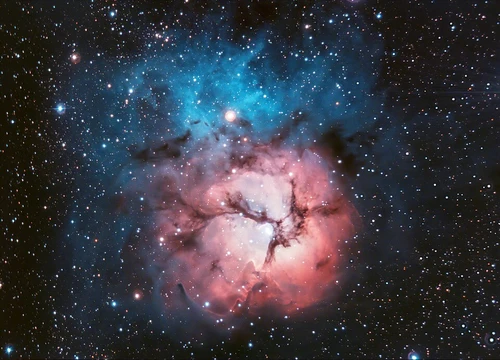
Barnard 175
A cometary Bok globule with a supernova remnant and Herbig-Haro object.

Barnard College · Public domain
Barnard 175 (B175) is a Bok globule shaped like a comet, situated roughly 400 parsecs away in the constellation Cepheus. It lies inside the Cepheus Flare shell, a vast assembly of molecular clouds. Its southern edge is lit by the star BD+69 1231, a B9.5V-type star, which creates Ced 201—a bright reflection nebula within B175.
Inside the globule, the only known Herbig-Haro object is HH 450, found within Ced 201. A feature once labeled HH 450X was first thought to be a knot but later identified as a background galaxy. The infrared source IRAS 22129+7000 also resides in Barnard 175.
The globule also hosts a supernova remnant called SN G110.3+11.3. This remnant is filamentary, with two red streaks named filament A and filament B. It is expected to soon collide head-on with the outflows from HH 450. The remnant moves at roughly 300 km/s, while the outflows travel at about 100 km/s, meaning the collision should occur in around 1,000 years. When they meet, a fast radiative shock will envelop them, causing indentations in the remnant due to its lower density. Eventually, the remnant will push toward Barnard 175. Computer simulations suggest this event will dramatically change the globule’s shape and structure, potentially sparking new star formation.
Quick Facts
- Ra
- 22’ 13’ 33.3
- Dec
- +70 15’ 25’’
- Dist Pc
- 400
- Names
- B175
- Epoch
- J2000
Facts from the source article.
Lore & Background
Barnard 175 is a cometary-shaped Bok globule located about 400 parsecs away in Cepheus, embedded within the Cepheus Flare shell. Its southern edge is illuminated by the B9.5V-type star BD+69 1231, which produces the reflection nebula Ced 201. Within Ced 201 lies the only known Herbig-Haro object in Barnard 175, designated HH 450. Another object, HH 450X, was initially classified as a knot but later reclassified as a background galaxy. The globule also contains the infrared source IRAS 22129+7000 and the supernova remnant SN G110.3+11.3.
Reader's Guide
The supernova remnant SN G110.3+11.3 is filamentous, with two red streaks named filament A and filament B. This remnant is traveling at a speed of around 300 km/s, while the outflows from HH 450 travel at around 100 km/s. The remnant will likely begin a frontal collision with the outflows of HH 450 in about 1000 years. When they collide, a fast radiative shock will wrap around them, leading to indentations in the remnant due to its lower density. However, the remnant will eventually make its way towards Barnard 175. Numerical simulations show that this collision will drastically alter the appearance and structure of Barnard 175, possibly triggering star formation. The significance of Barnard 175 lies in this impending dynamic interaction, which offers a rare opportunity to study shock-driven star formation and structural changes in a Bok globule.
Did You Know?
- Barnard 175 is located around 400 parsecs from Earth in the constellation Cepheus.
- The only known Herbig-Haro object in Barnard 175 is HH 450, located in the reflection nebula Ced 201.
Structure and Scale
Barnard's Loop, also catalogued as Sh 2-276, is an emission nebula that stretches across a remarkable portion of the constellation Orion. Rather than appearing as a compact cloud, it takes the shape of a vast arc whose center sits roughly over the dark silhouette of the Horsehead Nebula and the brilliant Orion Nebula. From Earth, this sweeping curve spans approximately ten degrees of sky, a width that covers a substantial fraction of Orion's visible area. The loop's physical dimensions are equally impressive: it measures roughly 110 parsecs, or about 360 light-years, in length, and it lies at a distance of approximately 440 parsecs, or 1,400 light-years, from our solar system. Despite its enormous size, the nebula is faint. It is most readily captured through long-exposure astrophotography, though under exceptionally dark, light-pollution-free conditions, a keen observer might discern its ghostly glow with the unaided eye.
A Supernova's Legacy
The most dramatic explanation for Barnard's Loop traces back to a cataclysmic event roughly two million years ago. Astronomers believe a supernova explosion gave birth to the expanding shell of gas we now observe as the loop. The blast did not merely sculpt the nebula; it is also thought to have set several stars hurtling through space at high velocity. Among these so-called runaway stars are AE Aurigae, Mu Columbae, and 53 Arietis. The prevailing theory holds that these three were once members of a single multiple star system. When one component of that system detonated as a supernova, the gravitational bonds that had held the group together were severed, flinging the surviving stars outward on their own independent trajectories. In this reading, Barnard's Loop is simultaneously a tombstone marking the death of one star and a record of the violent dispersal of its former companions.
Cosmic Neighborhood and Ionization
Barnard's Loop does not exist in isolation; it occupies a specific place within a nested hierarchy of cosmic structures. The loop forms part of the Orion-Eridanus Superbubble. That superbubble, in turn, belongs to the even larger Orion molecular cloud complex. This layered arrangement—loop inside superbubble inside molecular cloud complex—places the nebula at a unique intersection of scales. The loop's glow as an emission nebula is attributed to the radiation from the stars in the nearby Orion Nebula. Those stars are believed to be responsible for ionizing the gas that makes up the arc, causing it to emit light and become visible. In this way, the loop functions as a kind of halo, its luminosity a direct consequence of the energetic output of a neighboring stellar region. The interplay between the stars of the Orion Nebula and the ancient shell created by the supernova that formed the loop illustrates how different epochs of stellar evolution can coexist in the same patch of sky. The nebula's membership in both the superbubble and the molecular cloud complex reminds us that even a single visible arc is embedded in a far more intricate web of interstellar material.
Discovery and the Name of Barnard
Although the faint glow of this nebula was certainly noted by earlier astronomers, it was the pioneering astrophotographer E. E. Barnard who brought it to wider attention. In 1894, Barnard captured the loop on photographic plates and published a description of his findings. The nebula was subsequently named in his honor, and it carries the catalogue designation Sh 2-276 in modern references. Barnard's work exemplifies the transformative role that photography played in late-nineteenth-century astronomy: features too dim for the human eye to register reliably could be accumulated over long exposures and rendered visible on a photographic plate. The fact that the loop is still best observed through long-exposure photographs today, more than a century after Barnard's original capture, underscores how his method remains the most effective way to reveal this particular object. His 1894 observation stands as a milestone in the broader transition from purely visual astronomy to the photographic techniques that would come to define the field. That a single faint arc in Orion should bear the name of the man who first committed it to a plate speaks to the lasting impact of his work.
Gallery

Frequently Asked Questions
What is Barnard 175 and where can I find it in the sky?
Barnard 175 is a cometary-shaped Bok globule sitting roughly 400 parsecs away in the constellation Cepheus. It is embedded within the much larger Cepheus Flare shell, a vast assembly of molecular clouds.
What star lights up Barnard 175 and what does it produce?
The B9.5V-type star BD+69 1231 illuminates the southern edge of the globule. That illumination gives rise to Ced 201, a bright reflection nebula that exists inside Barnard 175 itself.
What young stellar objects or sources are known to be inside Barnard 175?
The only confirmed Herbig-Haro object in the globule is HH 450, which is found within the Ced 201 reflection nebula. An infrared source catalogued as IRAS 22129+7000 also resides in the region.
What is the HH 450X feature and why was it reclassified?
HH 450X was originally catalogued as a knot associated with the HH 450 outflow. Subsequent observations showed it is actually a background galaxy that merely appears along the same line of sight.
Why is Barnard 175 interesting to astronomers studying star formation?
At only about 400 parsecs it offers a relatively close view of a cometary Bok globule that hosts both a Herbig-Haro object and an embedded infrared source. Its location inside the Cepheus Flare shell also makes it a useful case for examining how smaller cloud structures interact with their larger surroundings.
More in Nebulae, Part 2 1-24
Spotted an error? Know more?
Reader corrections go straight into our review queue. Suggest an edit · How this site is sourced