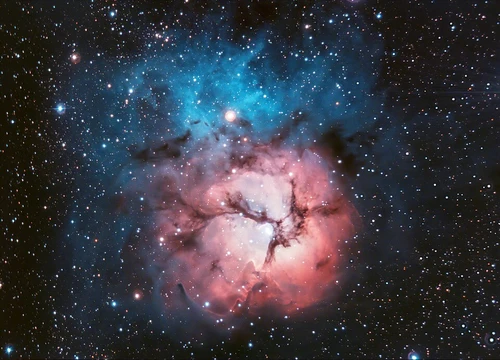
Cone Nebula
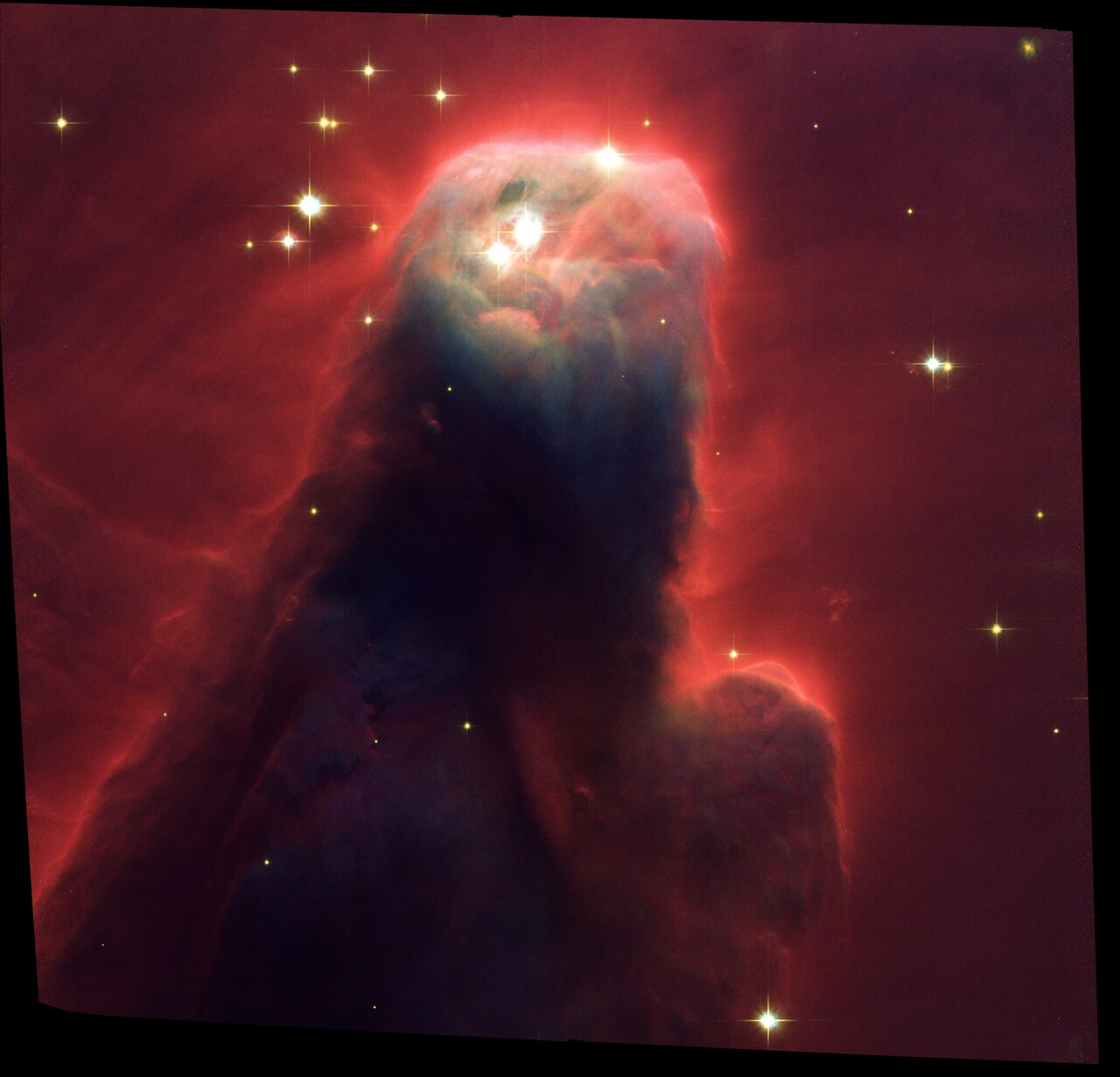
A dark absorption nebula in front of a faint emission nebula.

NASA , H. Ford (JHU), G. Illingworth (UCSC/LO), M.Clampin ( STScI ), G. Hartig ( · Public domain
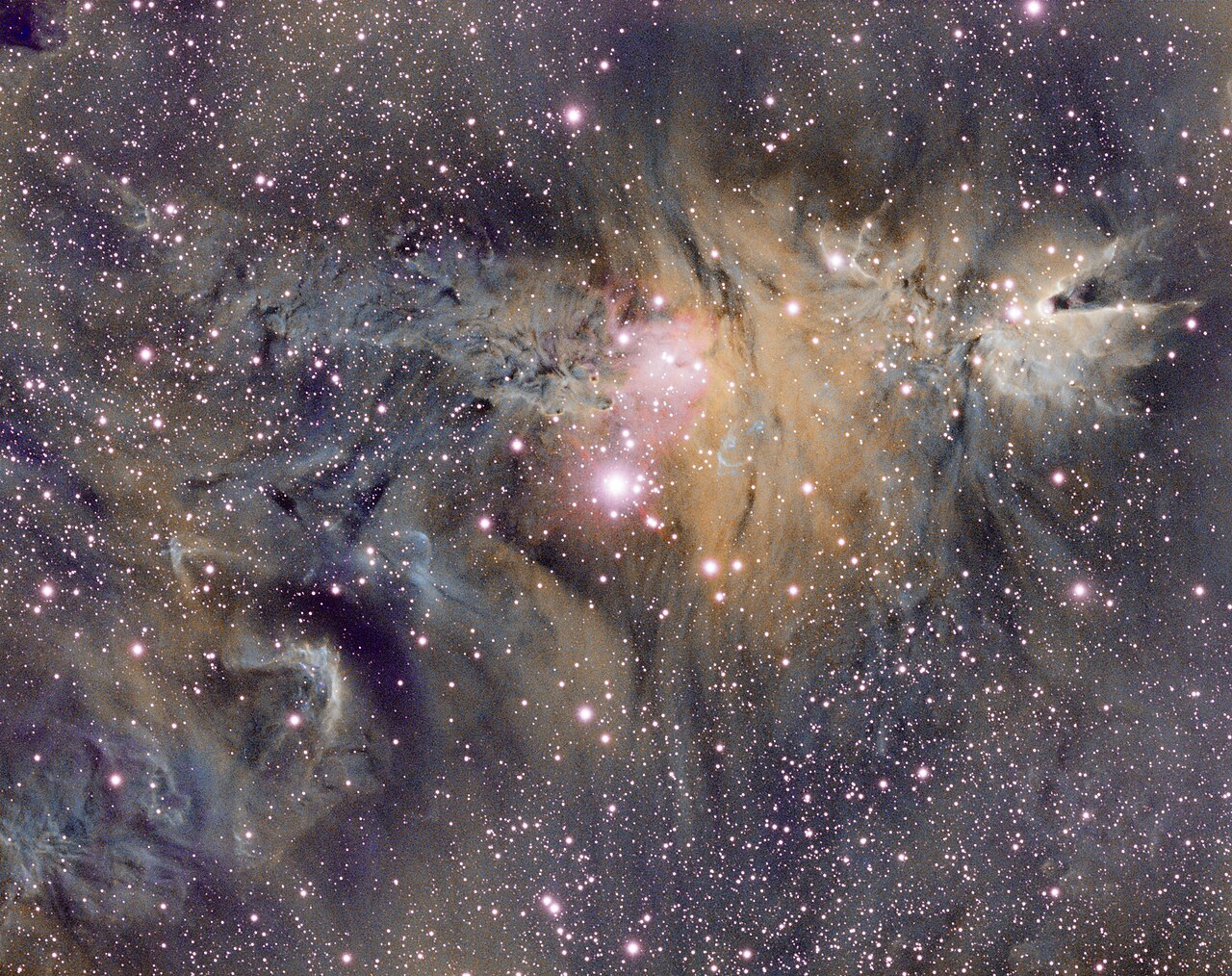
The Cone Nebula is an H II region in the constellation of Monoceros, notable for its apparent conical shape. It forms part of the nebulosity surrounding the Christmas Tree Cluster and is associated with the designation NGC 2264, which refers to both the nebula and the cluster.
Quick Facts
- Epoch
- J2000.0
- Ra
- 06 · 41 · 15
- Dec
- +09 · 21
- Dist Ly
- 2,700
- Constellation
- Monoceros
- Radius Ly
- 4
- Notes
- Christmas Tree Cluster
- Names
- NGC 2264 (portion)
Facts from the source article.
Lore & Background
The Cone Nebula was discovered by William Herschel on December 26, 1785, at which time he designated it H V.27. It lies in the southern part of NGC 2264, the northern part being the magnitude-3.9 Christmas Tree Cluster. The nebula is located in the northern part of Monoceros, just north of the midpoint of a line from Procyon to Betelgeuse.
The cone's shape comes from a dark absorption nebula consisting of cold molecular hydrogen and dust in front of a faint emission nebula containing hydrogen ionized by S Monocerotis, the brightest star of NGC 2264. The faint nebula is approximately seven light-years long, with an apparent length of 10 arcminutes, and is 2,700 light-years from Earth.
The nebula is part of a much larger star-forming complex—the Hubble Space Telescope was used to capture images of forming stars in 1997.
Reader's Guide
The Cone Nebula is significant as a prominent example of a dark absorption nebula silhouetted against a faint emission nebula, illustrating the interplay of cold molecular material and ionized hydrogen. Its discovery by William Herschel in 1785 places it among the early cataloged deep-sky objects, and its inclusion in the New General Catalogue as part of NGC 2264 links it to the Christmas Tree Cluster. The nebula's location in Monoceros, near the line from Procyon to Betelgeuse, makes it a recognizable target for amateur astronomers. Its role as part of a larger star-forming complex is underscored by Hubble Space Telescope images of forming stars captured in 1997, highlighting its importance in studies of stellar birth. The nebula's distinctive conical shape, resulting from foreground dark material, has made it a subject of public interest, including features on Astronomy Picture of the Day. The designation NGC 2264 refers to both the Cone Nebula and the Christmas Tree Cluster, not the nebula alone, a nuance important for accurate astronomical referencing.
Did You Know?
- The nebula is approximately seven light-years long and 2,700 light-years from Earth.
- The Hubble Space Telescope captured images of forming stars in the nebula in 1997.
Discovery & Catalogue Identity
The Cone Nebula first entered the astronomical record on December 26, 1785, when William Herschel observed it and assigned it the designation H V.27 in his personal catalogue. Nearly two centuries later, the object received the broader catalogue number NGC 2264 in the New General Catalogue, though this designation is important to understand correctly: it does not refer to the nebula in isolation. Rather, NGC 2264 encompasses both the diffuse Cone Nebula and the nearby Christmas Tree Cluster as a single combined entry. This dual designation reflects the fact that the two objects are physically intertwined, forming a single nebulosity complex in the night sky. The Cone Nebula occupies the southern portion of this combined region, while the Christmas Tree Cluster, a magnitude-3.9 stellar grouping, sits to the north. Herschel's original observation in 1785 thus marks the beginning of a long catalogue history in which the nebula has been identified not as a standalone object but as one half of a larger, visually unified structure in the constellation Monoceros.
Anatomy of the Cone
The distinctive conical silhouette that gives this nebula its common name is not a single uniform cloud. It is actually a layered optical effect produced by two different types of nebular material superimposed along our line of sight. In the foreground sits a dark absorption nebula composed of cold molecular hydrogen and fine dust particles. Behind this obscuring screen lies a much fainter emission nebula, whose glow is generated by hydrogen gas that has been ionized by the radiation of S Monocerotis, the brightest star within the NGC 2264 complex. The interplay between the dark foreground material and the luminous background gas creates the illusion of a solid, tapering cone. The faint emission component stretches roughly seven light-years in physical length, corresponding to an apparent angular span of about ten arcminutes as seen from Earth. The entire structure resides approximately 830 parsecs, or 2,700 light-years, from our vantage point.
Position in Monoceros & the Christmas Tree Pairing
The Cone Nebula occupies the northern part of the constellation Monoceros, a region of the sky that can be located by finding the midpoint of the line connecting Procyon and Betelgeuse and looking just north of that point. Within the broader NGC 2264 complex, the nebula forms the southern component, while the northern portion is dominated by the Christmas Tree Cluster, a stellar grouping that shines at magnitude 3.9. The two objects are so closely associated that they share a single catalogue entry, and the nebulosity of the Cone Nebula effectively surrounds the cluster. This pairing makes the region a visually distinctive patch in Monoceros, where a bright cluster sits embedded in a field of faint glow, with the dark cone shape cutting through the emission like a shadow cast across a lantern. The spatial relationship between the cluster and the nebula is not merely coincidental; the brightest star in the cluster, S Monocerotis, is the very source of the radiation that ionizes the hydrogen gas responsible for the nebula's faint emission.
Star-Forming Complex & Modern Imaging
The Cone Nebula is not an isolated curiosity but one element of a much larger star-forming complex. In 1997, the Hubble Space Telescope was pointed at this region and captured detailed images revealing stars in the process of formation, confirming that the nebula sits within an active environment of new stellar birth. This observation added a layer of depth to what had previously been understood primarily through ground-based observations, showing individual forming stars embedded within the broader nebulosity. The region's role as a stellar nursery, combined with its striking visual appearance and its long catalogue history stretching back to Herschel's 1785 discovery, has made the Cone Nebula a subject of continued interest in both professional astronomy and public outreach. NASA's Astronomy Picture of the Day featured the nebula on January 7, 2002, under the title "The Mysterious Cone Nebula," and ESA-Hubble has published dedicated image galleries of the object. These modern observations ensure that the nebula's conical silhouette remains one of the most recognizable shapes in the deep-sky catalogue, bridging the gap between Herschel's original 1785 designation and contemporary space-based imaging.
Gallery
Frequently Asked Questions
What is the Cone Nebula?
The Cone Nebula is an H II region in the constellation Monoceros, easily recognized by its striking conical silhouette. It sits within the broader nebulosity that wraps around the Christmas Tree Cluster.
Who discovered the Cone Nebula and when?
William Herschel first catalogued it on December 26, 1785, assigning it his personal designation H V.27. It later received the more widely used NGC 2264 identifier shared with the nearby star cluster.
How far is the Cone Nebula from Earth?
It lies roughly 830 parsecs, or about 2,700 light-years, away from our Solar System. At that range, its apparent length of 10 arcminutes corresponds to a physical span of approximately 7 light-years.
What does the Cone Nebula actually look like?
It presents as a dark absorption nebula silhouetted against a fainter background emission nebula, giving it that distinctive cone or pillar shape. The foreground dust and gas block starlight, carving out the sharp conical profile visible through telescopes.
What is the relationship between the Cone Nebula and the Christmas Tree Cluster?
Both share the NGC 2264 designation because the cluster of young stars and the surrounding gas form a single astrophysical complex. The cluster's radiation ionizes the gas, producing the emission glow seen behind the dark cone.
More in Nebulae, Part 2 1-24
Spotted an error? Know more?
Reader corrections go straight into our review queue. Suggest an edit · How this site is sourced