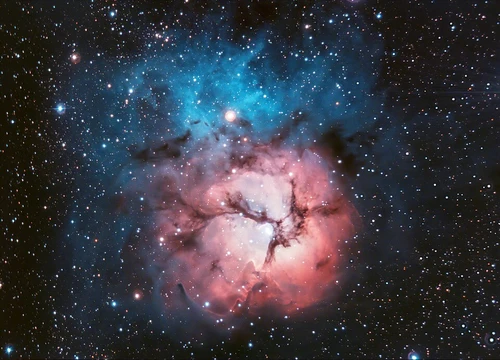
Barnard 68
A dark nebula on the verge of gravitational collapse into a star.

Internet Archive Book Images · No restrictions
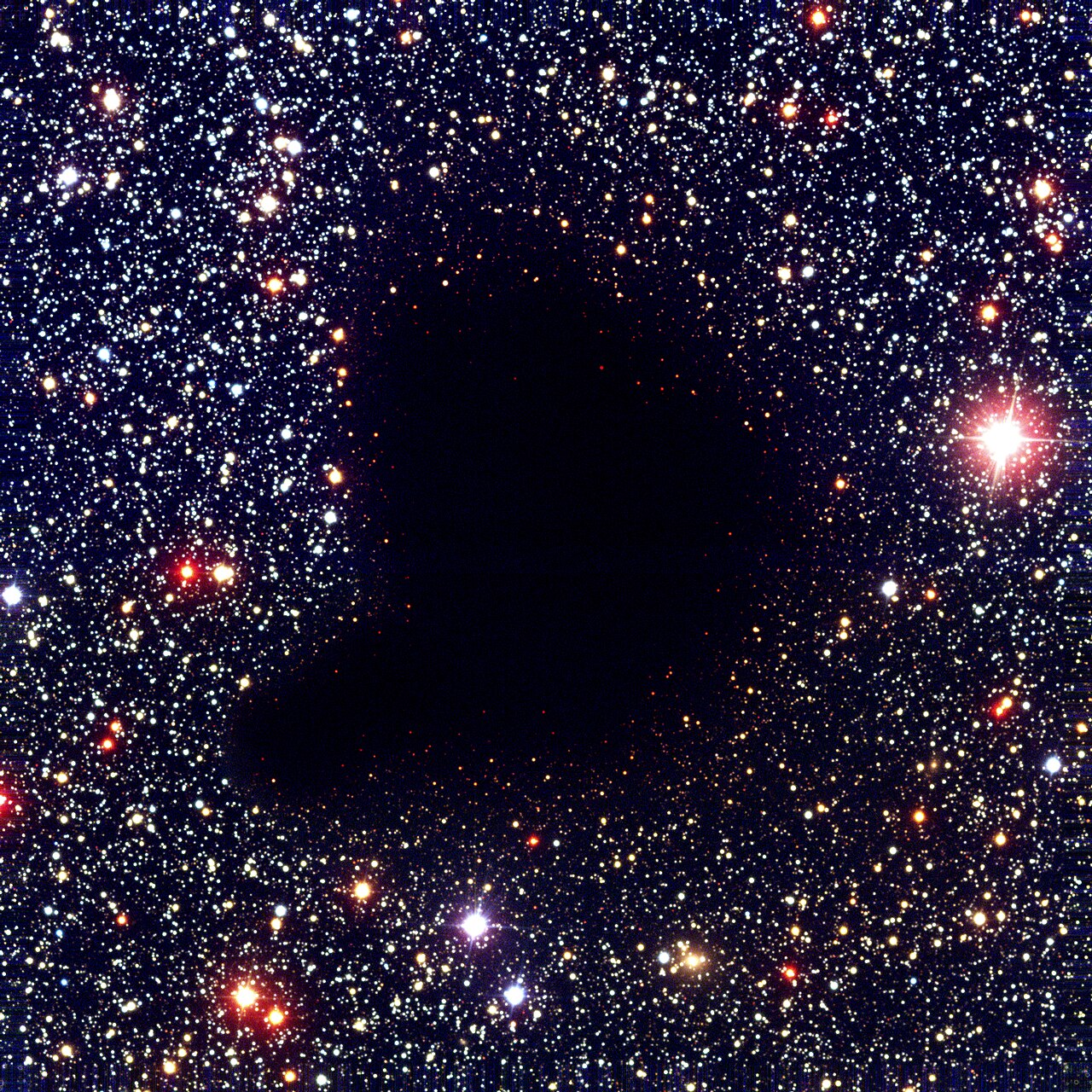
Barnard 68 is a molecular cloud, specifically a dark absorption nebula or Bok globule, situated in the southern constellation Ophiuchus. It lies well within the Milky Way, roughly 125 parsecs (407 light-years) from Earth. The cloud is dense and close enough that it completely blocks the view of stars behind it from our planet. American astronomer Edward Emerson Barnard added this object to his catalog of dark nebulae in 1919; when the catalog was published in 1927, it contained about 350 objects. Because of its opacity, the interior of Barnard 68 is extremely cold, with a temperature around 16 K (−257 °C/−431 °F). Its mass is about twice that of the Sun, and it spans roughly half a light-year across.
Although invisible at visible-light wavelengths, observations using the Very Large Telescope at Cerro Paranal have revealed about 3,700 background Milky Way stars hidden behind the cloud, roughly 1,000 of which are detectable only in infrared light. Precise measurements of how much these stars are obscured have produced a detailed map of the dust distribution within the cloud. Data from the Herschel Space Observatory further refined the dust’s distribution and temperature. Because this dark cloud is relatively nearby, it is easier to observe and study. If left undisturbed by external forces, a dust cloud’s stability depends on a delicate balance between outward pressure from the heat or pressure of its contents and inward gravitational forces from the same particles (a concept related to Jeans instability and the Bonnor–Ebert mass). This balance causes the cloud to wobble or oscillate, similar to a large soap bubble or a water-filled balloon being jiggled. For the cloud to form a star, gravity must overcome this balance long enough to trigger collapse, raising temperature and density until nuclear fusion can begin. At that point, the star’s much smaller size reflects a new equilibrium between stronger gravity and radiation pressure. Barnard 68’s well-defined edges and other features indicate it is on the verge of gravitational collapse, likely to become a star within the next 200,000 years or so.
The cloud is often mistaken for the Boötes Void, though the two are unrelated. Pictures of Barnard 68 are frequently used incorrectly to illustrate articles about the Boötes Void.
Quick Facts
- Epoch
- J2000.0
- Ra
- 17 · 22 · 38.2
- Dec
- -23 · 49 · 34
- Constellation
- Ophiuchus
- Radius Ly
- 0.25
- Names
- Barnard 68, LDN 57
- Dist Pc
- 125
Facts from the source article.
Lore & Background
American astronomer Edward Emerson Barnard added this nebula to his catalog of dark nebulae in 1919. His catalog was published in 1927, at which stage it included some 350 objects. Because of its opacity, its interior is extremely cold, its temperature being about 16 K (−257 °C/−431 °F). Its mass is about twice that of the Sun, and it measures about half a light-year across.
Despite being opaque at visible-light wavelengths, use of the Very Large Telescope at Cerro Paranal has revealed the presence of about 3,700 obscured background Milky Way stars, some 1,000 of which are only visible at infrared wavelengths. Careful measurements of the degree of obscuration resulted in a finely sampled and accurate mapping of the dust distribution inside the cloud. Observations obtained with the Herschel Space Observatory were able to constrain the distribution of the dust component and its temperature even more. Having a dark cloud in the solar neighborhood greatly facilitates observation and measurement.
If not disrupted by external forces, the stability of dust clouds is a fine balance between outward pressure caused by the heat or pressure of the cloud's contents, and inward gravitational forces generated by the same particles. This causes the cloud to wobble or oscillate in a manner like that of a large soap bubble or a water-filled balloon which is jiggled. In order for the cloud to become a star, gravity must gain the upper hand long enough to cause the cloud to collapse and reach a temperature and density where fusion can be sustained. Barnard 68's well-defined edges and other features show that it is on the verge of gravitational collapse, followed by becoming a star within the next 200,000 years or so.
Reader's Guide
Barnard 68's significance lies in its role as a nearby, dense dark nebula that provides a natural laboratory for studying interstellar dust and the early stages of star formation. Its opacity at visible wavelengths, combined with infrared observations from the Very Large Telescope and Herschel Space Observatory, has allowed astronomers to map the dust distribution and temperature with high precision. The cloud's well-defined edges and measured mass (about twice that of the Sun) and size (about half a light-year across) indicate it is on the verge of gravitational collapse, expected to form a star within roughly 200,000 years. This makes it a key object for understanding the Jeans instability and Bonnor–Ebert mass balance that governs cloud collapse. The cloud is often confused with the Boötes Void, though they have nothing in common, and pictures of Barnard 68 are frequently misused to illustrate articles about the Boötes Void. Its proximity to Earth greatly facilitates detailed observation and measurement, contributing to models of how dark clouds evolve into stars.
Did You Know?
- Barnard 68 is about 125 parsecs (407 light-years) away from Earth.
- Its interior temperature is about 16 K (−257 °C/−431 °F).
- The Very Large Telescope revealed about 3,700 obscured background Milky Way stars behind it.
Origins in Astrophotography
Barnard 68 is a dark nebula that owes its identification to the pioneering work of Edward Emerson Barnard, an American astronomer widely recognized as a gifted observational scientist. Working from the University of Chicago, where he held a professorship of astronomy beginning in 1895, Barnard had access to the 40-inch telescope at Yerkes Observatory, an instrument that proved essential to his systematic photographic surveys of the Milky Way. His approach was fundamentally photographic rather than purely visual: he captured images of the galactic sky and studied the faint, shadowy patches that appeared against the starlight. In collaboration with Max Wolf, he reached a crucial conclusion about these dark regions—they were not empty voids but rather dense clouds of gas and dust positioned between the observer and the more distant stars behind them. This insight transformed the understanding of what had long appeared as mere darkness in the sky, revealing a complex three-dimensional structure of interstellar material. Barnard 68 stands as one entry within this broader catalogue of such obscuring features.
The Barnard Catalogue
Barnard 68 carries its designation as part of a systematic catalogue of dark nebulae that Edward Barnard compiled over many years of photographic observation. The full collection, known collectively as the Barnard objects, spans from Barnard 1 through Barnard 370, giving each dark patch a numerical identifier in a manner comparable to the famous Messier catalogue of deep-sky objects. Barnard first published his initial list in a 1919 paper in the Astrophysical Journal, titled "On the Dark Markings of the Sky with a Catalogue of 182 such Objects," which laid the groundwork for the expanded catalogue that eventually reached 370 entries. The numbering scheme allowed astronomers to reference specific dark regions unambiguously, and Barnard 68 occupies its place within this sequence. The catalogue was not a single overnight achievement but the accumulated product of Barnard's long career as a photographic astronomer, supported in his later years by his niece Mary R. Calvert, who served as his assistant and computer beginning in 1905.
Physical Nature and Astrophysical Significance
Barnard 68, like all Barnard objects, is a cloud of interstellar gas and dust that manifests visually as a dark marking against the glow of the Milky Way. Its defining characteristic is not the emission of light but the absorption and scattering of starlight from more distant stars behind it, creating a silhouette effect that early astronomers could detect on photographic plates. Barnard and Max Wolf established this interpretation, showing that what had long been regarded as mere gaps or empty spaces in the galactic sky were in fact physical structures—dense, obscuring material suspended in interstellar space. This was a significant conceptual shift: the darkness was not an absence but a presence. Because Barnard's work was photographic rather than purely visual, these faint dark nebulae could be recorded and studied with a precision that naked-eye observation could not achieve. Barnard 68 thus represents a window into the dusty, complex medium through which starlight must travel before reaching Earth, and it remains a reference point for understanding the distribution of interstellar matter in our galaxy.
Legacy and the Photographic Atlas
The story of Barnard 68 extends well beyond the life of its discoverer. Edward Barnard passed away on February 6, 1923, in Williams Bay, Wisconsin, but his extraordinary collection of astronomical photographs outlived him. In 1927, four years after his death, many of these images were published as A Photographic Atlas of Selected Regions of the Milky Way, a work completed by his niece Mary R. Calvert and Edwin B. Frost, then director of Yerkes Observatory. This atlas preserved the visual record of the dark nebulae that Barnard had spent decades photographing, including objects like Barnard 68. The Barnard catalogue itself has endured as a standard reference in astronomy, with its numerical designations still in use today. The objects it lists are recognized as a distinct category in astronomical literature, and Barnard 68 continues to be cited in the context of dark nebulae and interstellar dust. In this way, a single entry in a 1919 paper became a permanent fixture of the astronomical record, a testament to the lasting power of careful photographic observation.
Gallery

Frequently Asked Questions
What is Barnard 68?
Barnard 68 is a dense molecular cloud classified as a dark absorption nebula, also known as a Bok globule. It sits in the southern constellation Ophiuchus and is opaque enough to fully obscure the stars behind it as seen from Earth.
Who catalogued Barnard 68 and when?
American astronomer Edward Emerson Barnard added this object to his catalog of dark nebulae in 1919. The full catalog, containing roughly 350 dark objects, was published in 1927.
How far is Barnard 68 from Earth?
It lies about 125 parsecs, or roughly 407 light-years, from our planet. That distance places it comfortably within the disk of the Milky Way.
How cold is the interior of Barnard 68?
Because the cloud is so optically thick, very little external radiation penetrates it, keeping the interior at approximately 16 kelvins (about −257 °C or −431 °F). That makes it one of the coldest natural objects we can observe.
Why is Barnard 68 considered important in astronomy?
It is a textbook example of a Bok globule sitting right on the edge of gravitational collapse, meaning it may soon begin forming a new star. That makes it a valuable natural laboratory for studying the earliest stages of stellar birth.
More in Nebulae, Part 2 1-24
Spotted an error? Know more?
Reader corrections go straight into our review queue. Suggest an edit · How this site is sourced