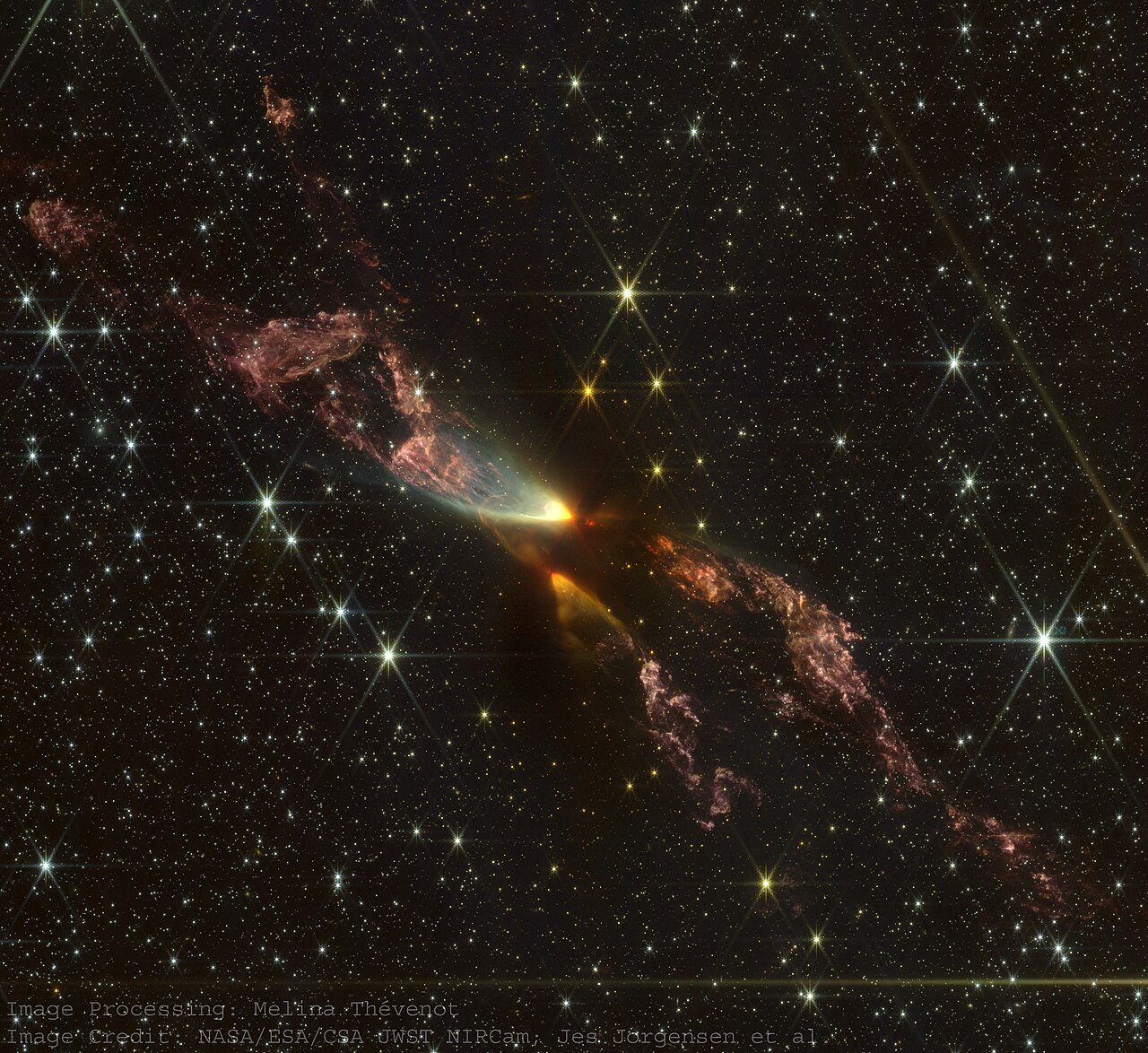
BHR 71
A Bok globule with a binary protostar and colliding outflows.

NASA/ESA/CSA JWST NIRCam; Jes Jorgensen et al. & Melina Thévenot · CC BY-SA 4.0
BHR 71, also cataloged as Sandqvist 136, is a small dark nebula and Bok globule in the constellation Musca, about 600 light-years from the Solar System. It spans roughly one light-year in diameter, has a mass of 40 solar masses, and a kinetic temperature of 11 Kelvin.
The object was first identified in 1977 by A. Sandqvist using the ESO B Atlas. In 1995, it was included in a catalog of small molecular clouds compiled by T. L. Bourke, A. R. Hyland, and G. Robinson, which led to the acronym BHR derived from their surnames.
At the globule’s center lies a binary protostar system. In 1997, a highly collimated bipolar outflow was detected, originating from a Class 0 protostar known as IRAS 11590-6452. Follow-up near-infrared and carbon monoxide observations in 2001, using the Anglo-Australian Telescope and the Swedish-ESO Submillimetre Telescope, revealed that the source actually consists of two individual protostars, designated IRS 1 and IRS 2. They are separated by about 17 arcseconds (or 3400 AU). Each protostar drives its own molecular outflow, with IRS 1 being more massive and producing the larger outflow. Observations with the Australian Telescope Compact Array and the Spitzer Space Telescope suggested the binary formed through rotational fragmentation of a single collapsing core, but later ALMA data indicated it formed via turbulent fragmentation of the core.
ALMA dust observations found compact objects without clear Keplerian motion, implying that potential disks are not detected, likely because they remain deeply embedded in an envelope. Upper mass limits were set: IRS 1 at 0.46 solar masses and IRS 2 at 0.26 solar masses.
In 1997, the Herbig-Haro objects HH 320 and HH 321 were discovered in BHR 71 using sulfur [S II] imaging, though their positions were later corrected. ALMA studies revealed that two of the outflows partially collide, with CO images showing increased brightness, velocity dispersion, and a change in orientation at the collision site. These observations also placed IRS 2 closer to us than IRS 1. The jet from IRS 1 exhibits a double-helical structure, indicating angular momentum removal, while IRS 2’s jet is highly collimated with knots, suggesting episodic accretion.
Quick Facts
- Ra
- 12 · 01 · 37.0
- Dec
- -65 · 08 · 48
- Dist Ly
- 600
- Constellation
- Musca
- Radius Ly
- 1
- Names
- BHR 71, Sandqvist 136
Facts from the source article.
Lore & Background
BHR 71 was discovered in 1977 by A. Sandqvist using the ESO B Atlas. In 1995 it was included in a catalogue by T. L. Bourke, A. R. Hyland and G. Robinson, which listed small molecular clouds called globules; these objects later received the acronym BHR. In 1997 a study discovered a highly collimated bipolar outflow in the center of the Bok globule, originating from a class 0 protostar called IRAS 11590-6452. In 2001 new near-infrared observations with the Anglo-Australian Telescope and carbon monoxide observations with the Swedish-ESO Submillimetre Telescope found that the source was actually two individual protostars, IRS 1 and IRS 2, separated by about 17 arcseconds (or 3400 AU). Each protostar drives its own molecular outflow, with IRS 1 driving the larger outflow and being more massive. The binary's formation was initially attributed to rotational fragmentation of a single collapsing protostellar core, but a later study using ALMA found it formed via turbulent fragmentation of the core. Dust observations with ALMA found compact objects with no clear Keplerian motion, meaning potential disks are not detected, likely deeply embedded in an envelope; upper mass limits were set at 0.46 M☉ for IRS 1 and 0.26 M☉ for IRS 2.
Reader's Guide
BHR 71's significance lies in its binary protostar system and the associated outflows, which offer a natural laboratory for studying star formation and fragmentation. The discovery of two protostars driving separate outflows, with one outflow partially colliding with another, provides direct evidence of interactions in a forming multiple-star system. The double-helical structure of IRS 1's jet indicates removal of angular momentum, while the highly collimated, knotty jet of IRS 2 suggests episodic accretion. The uncertainty over whether the binary formed via rotational or turbulent fragmentation highlights ongoing debates in star formation theory. The upper mass limits for the protostars constrain models of early stellar evolution. The globule's low kinetic temperature of 11 Kelvin and mass of 40 M☉ characterize it as a typical Bok globule, a site of low-mass star formation. The correction of the positions of Herbig-Haro objects 320 and 321 underscores the iterative nature of astronomical discovery.
Did You Know?
- The globule has a kinetic temperature of 11 Kelvin and a mass of 40 M☉.
- The binary protostars IRS 1 and IRS 2 are separated by about 3400 AU.
- The jet of IRS 1 shows a double-helical structure, evidence of angular momentum removal.
Origins & the Long Road to a Name
Musca traces its formal existence to the early Dutch maritime age. The constellation was established by Petrus Plancius, drawing on observations made by Pieter Dirkszoon Keyser and Frederick de Houtman during the Eerste Schipvaart, the first Dutch trading voyage to the East Indies. De Houtman listed it under the Dutch name De Vlieghe in his 1598 southern star catalogue, assigning four stars: Beta as the head, Gamma as the body, and Alpha and Delta as the left and right wings. The constellation first appeared, though unnamed, on a 35-centimeter celestial globe published in Amsterdam in 1598 by Plancius and Jodocus Hondius. Johann Bayer's 1603 Uranometria provided the first atlas depiction, but he called it Apis, the Bee, a name that stuck for roughly two centuries. Nicolas Louis de Lacaille later Latinized the French la Mouche into Musca Australis in 1763 to distinguish it from the now-obsolete Musca Borealis and to avoid confusion with Apus. Today it simply bears the name Musca and stands as the only official constellation depicting an insect.
Stellar Content & Astrophysical Significance
A striking number of Musca's brighter stars belong to the Scorpius–Centaurus association, a loose gathering of hot blue-white stars that appear to share a common birthplace and drift together across the Milky Way. Members include Alpha, Beta, Gamma, Zeta2, and likely Eta Muscae. The constellation also hosts HD 100546, a blue-white Herbig Ae/Be star encircled by a complex debris disk that harbors a large planet or brown dwarf and possibly a protoplanet. Two additional star systems within Musca have confirmed planets. For variable-star enthusiasts, two cepheid variables are visible to the unaided eye, while Theta Muscae is a triple system whose brightest component is a Wolf–Rayet star. Alpha Muscae itself, the constellation's brightest member at magnitude 2.7, is a B2IV-V star roughly 310 light-years distant, about eight times the Sun's mass and 4,520 times its luminosity, pulsating as a Beta Cephei variable with a 2.2-hour period. Gamma Muscae, marking the fly's tail, is a slowly pulsating B star varying between magnitudes 3.84 and 3.86 over 2.7 days.
Indigenous Sky Traditions
Long before European star charts, Aboriginal and Indigenous peoples of the southern hemisphere wove Musca's stars into rich cultural narratives. The Kalapalo people of Mato Grosso state in Brazil recognized Alpha and Beta Muscae, together with Beta and Kappa Crucis, as Kutsu anangagï, the Ornate Hawk-Eagle's double flutes. Among the Wardaman of Australia's Northern Territory, the main stars of Musca formed a ceremonial boomerang within the Central Arena, a sacred region surrounding Crux that depicts lightning creation beings teaching Wardaman customs. Alpha and Beta also signified a ceremonial headband, while Gamma and Delta represented two armbands. In central Australia, the Arrernte and Luritja peoples of the Hermannsburg mission divided the sky between them, with the eastern side of the Milky Way representing Arrernte camps and the western side Luritja camps. The stars of Musca, along with Fomalhaut, Alpha Pavonis, and Alpha and Beta Gruis, were all claimed by the Arrernte as belonging to their portion of the celestial landscape.
Physical Profile & Observability
Musca occupies a compact patch of the deep southern sky, spanning 138 square degrees and just 0.335 percent of the total night sky, placing it 77th among the 88 official constellations in area. Its borders, fixed by Belgian astronomer Eugène Delporte in 1930, are defined by a six-segment polygon. To the north it meets Crux, Carina lies to the west, Chamaeleon to the south, Apus and Circinus to the east, and Centaurus to the northeast. In equatorial coordinates, its right ascension stretches from 11 hours 19.3 minutes to 13 hours 51.1 minutes, while declination ranges from −64.64° to −75.68°. The entire constellation is visible only to observers south of 14° north latitude, meaning most Northern Hemisphere stargazers will never see it rise above the horizon. The International Astronomical Union adopted the three-letter abbreviation Mus in 1922. The pattern of its brightest stars loosely echoes the bowl-and-handle shape of Ursa Minor, a curious resemblance between a tiny southern insect and a much larger northern bear.
Gallery
Frequently Asked Questions
What is BHR 71?
BHR 71 is a compact dark nebula and Bok globule situated in the constellation Musca, roughly 600 light-years from the Solar System. It spans about one light-year in diameter and contains approximately 40 times the mass of our Sun.
How did BHR 71 get its name?
The designation comes from a 1995 catalog of small molecular clouds compiled by Bourke, Hyland, and Robinson, whose initials form the 'BHR' prefix. It was originally spotted in 1977 by A. Sandqvist using the ESO B Atlas, which is why it also carries the alternate catalog number Sandqvist 136.
What's at the heart of BHR 71?
A binary protostar system sits at the center of the globule, with its two young stars driving colliding outflows into the surrounding gas. These energetic jets carve through the dense material, making BHR 71 a natural laboratory for studying early stellar formation.
What are BHR 71's key physical properties?
The globule has a kinetic temperature of just 11 Kelvin, making it an extremely cold object. Despite its small size of roughly one light-year across, it packs a mass equivalent to 40 Sun-like stars.
Why do astronomers care about BHR 71?
As a Bok globule actively forming a binary star system, it offers a rare close-up view of how stars are born from collapsing gas. Its colliding outflows and compact structure make it a valuable case study for understanding the earliest stages of stellar evolution.
More in Nebulae, Part 2 1-24
Spotted an error? Know more?
Reader corrections go straight into our review queue. Suggest an edit · How this site is sourced