Sh 2-82
A compact star-forming nebula with emission and reflection components.

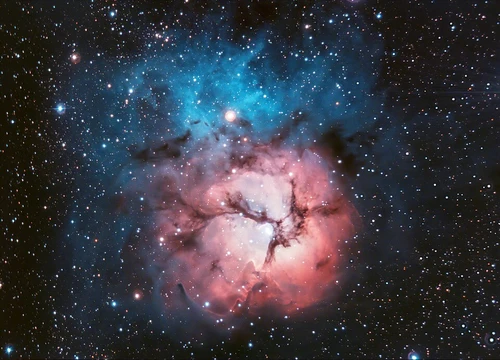
Sh 2-82 is a compact H II region and reflection nebula in the constellation Sagitta, sometimes called the Little Cocoon Nebula or Little Trifid Nebula. It sits within a dark nebula and is an active site of star formation. A hot young star ionizes the surrounding gas, producing a bright red emission nebula, while scattered starlight creates a hazy blue reflection component. The nebula’s small, cocoon-like shape, with a flared extension on one side, makes it a favorite subject for amateur observers and astrophotographers.
The nebula’s primary ionizing star is HD 231616, a blue giant of spectral type B0.5III. The surrounding reflection nebula forms when light from nearby stars scatters off dust grains in the foreground dark cloud LDN 727, giving it an asymmetrical, hazy halo that resembles a protective shell. This structure has earned it the nickname Little Cocoon Nebula, after the larger IC 5146 (Cocoon Nebula). The name Little Trifid Nebula comes from its tripartite appearance in deep-sky images, where emission, reflection, and dark nebula blend together, similar to the Trifid Nebula (M20). Sh 2-82 lies near the inner edge of the Vulpecula OB4 stellar association, a group of young, hot stars in the Milky Way’s Sagittarius arm, at a distance of about 3,500 light-years. Astrophotographers often use hydrogen-alpha and O-III narrowband filters to bring out the ionized gas structures, revealing intricate dust lanes and embedded young stellar objects.
Quick Facts
- Ra
- 19 · 30 · 14.90
- Dec
- +18 · 17 · 30.0
- Dist Ly
- 3,500
- Dist Pc
- 1,100
- Constellation
- Sagitta
- Names
- Sh 2-82, LBN 129, DG 159
Facts from the source article.
Lore & Background
The nebula has informal nicknames: Little Cocoon Nebula derives from its enveloping reflection component resembling a protective shell around the central emission core, similar to the Cocoon Nebula (IC 5146), while Little Trifid Nebula draws a comparison to the larger Trifid Nebula (M20) due to its tripartite appearance in deep-sky images blending emission, reflection, and dark nebula. Sharpless 2-82 is situated near the inner edge of the Vulpecula OB4 stellar association, a group of young, hot stars in the Milky Way's Sagittarius arm.
The primary ionizing source is the blue giant star HD 231616 (B0.5III), part of the OB association Vul OB4. Surrounding the emission nebula is a bluish reflection component, formed when light from nearby stars scatters off dust grains in the foreground dark cloud LDN 727. This creates a hazy halo that flares asymmetrically on one side, giving the cocoon appearance. Astrophotography often employs hydrogen-alpha and O-III narrowband imaging to highlight ionized gas structures, revealing intricate dust lanes and embedded young stellar objects (YSOs).
Reader's Guide
Sh 2-82 is notable as a small but active star-forming region that combines emission, reflection, and dark nebula components in a compact area, making it a popular target for amateur astronomers and astrophotographers. Its informal nicknames—Little Cocoon Nebula and Little Trifid Nebula—highlight its visual resemblance to larger, well-known nebulae, while its location near the Vulpecula OB4 stellar association places it within a broader context of young, hot stars in the Sagittarius arm. The nebula's structure, with a bright red emission core ionized by the blue giant HD 231616 and a hazy blue reflection halo from dust in LDN 727, offers a striking contrast. Astrophotographers often use hydrogen-alpha and O-III narrowband imaging to reveal intricate dust lanes and embedded young stellar objects, underscoring its value as a subject for deep-sky imaging and study of star formation.
Did You Know?
- Sh 2-82 is also known as the Little Cocoon Nebula or Little Trifid Nebula.
- It is located in the constellation Sagitta, approximately 3,500 light-years from Earth.
- The nebula is ionized by the blue giant star HD 231616 (B0.5III).
- Its reflection component is created by starlight scattering off dust in the foreground dark cloud LDN 727.
More in Nebulae, Part 2 1-24
Spotted an error? Know more?
Reader corrections go straight into our review queue. Suggest an edit · How this site is sourced