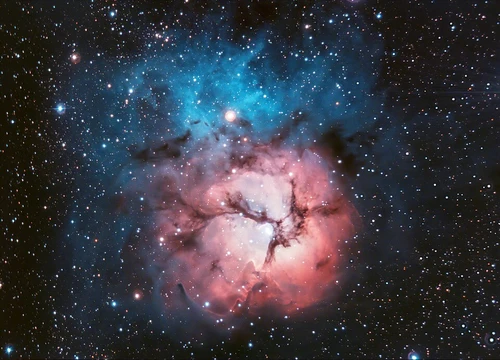
Rho Ophiuchi cloud complex
One of the closest star-forming regions to the Solar System.

The Rho Ophiuchi cloud complex is a grouping of interstellar clouds and nebulae, most notably a dark nebula located one degree south of the star ρ Ophiuchi in the constellation Ophiuchus. Roughly 140 parsecs (460 light-years) away, it ranks among the nearest star-forming regions to our Solar System.
Spanning 4.5° by 6.5° across the sky, the complex contains two main zones of dense gas and dust. One zone includes the star-forming cloud L1688 and two filaments, L1709 and L1755; the other holds the star-forming region L1689 and a filament designated L1712–L1729. These filaments stretch between 10 and 17.5 parsecs in length and can be as narrow as 0.24 parsecs. The broader extensions of the complex, known as the Dark River clouds or Rho Ophiuchi Streamers, are cataloged as Barnard 44 and 45. Some structures within the complex may have formed when a shock front from the nearby Sco OB2 association passed through the clouds.
Cloud temperatures range from 13 to 22 K, and the total mass of material amounts to about 3,000 times that of the Sun. More than half of this mass is concentrated in the L1688 cloud, which is also the most active site of star formation. Embedded infrared sources are abundant here: 425 have been detected near L1688, thought to be young stellar objects. Among them are 16 protostars, 123 T Tauri stars with dense circumstellar disks, and 77 weaker T Tauri stars with thinner disks. The latter two groups are estimated to be between 100,000 and one million years old.
The first brown dwarf identified in a star-forming region, Rho Oph J162349.8-242601, lies within this cloud. At the edge of the primary star-forming zone, an older object features a nearly edge-on circumstellar disk measuring 300 AU across and containing at least twice Jupiter’s mass. The million-year-old star at its center has a temperature of 3,000 K and shines with 0.4 times the Sun’s luminosity.
A 2023 image from the James Webb Space Telescope—released on the telescope’s first anniversary—captures young stars about the size of the Sun at the centers of circumstellar disks, representing planetary systems in the making within this stellar nursery. Because the image’s field of view is only 6.4 arc-minutes, it shows just a tiny portion of what appears in most wider photographs of the Rho Ophiuchi cloud complex.
Quick Facts
- Epoch
- J2000.0
- Ra
- 16 · 28 · 06
- Dec
- –24 · 32.5
- Dist Ly
- 460 ly (140 pc)
- Constellation
- Ophiuchus
- Names
- Ophiuchus molecular cloud, Integral 691, XSS J16271-2423
Facts from the source article.
Lore & Background
The cloud complex covers an angular area of 4.5° × 6.5° on the celestial sphere and consists of two major regions of dense gas and dust. The first contains a star-forming cloud (L1688) and two filaments (L1709 and L1755), while the second has a star-forming region (L1689) and a filament (L1712–L1729). These filaments extend up to 10–17.5 parsecs in length and can be as narrow as 0.24 parsecs in width. The large extensions of the complex are also called Dark River clouds (or Rho Ophiuchi Streamers) and are identified as Barnard 44 and 45. Some structures within the complex appear to be the result of a shock front passing through the clouds from the direction of the neighboring Sco OB2 association.
Temperatures of the clouds range from 13–22 K, and there is a total of about 3,000 times the mass of the Sun in the material. Over half of the mass is concentrated around the L1688 cloud, which is the most active star-forming region. A total of 425 infrared sources have been detected near L1688, presumed to be young stellar objects, including 16 protostars, 123 T Tauri stars with dense circumstellar disks, and 77 weaker T Tauri stars with thinner disks. The last two categories have estimated ages ranging from 100,000 to a million years.
The first brown dwarf to be identified in a star-forming region was Rho Oph J162349.8-242601, located in the Rho Ophiuchi cloud. One older object at the edge of the primary star-forming region is a circumstellar disk seen nearly edge-on, spanning 300 AU in diameter and containing at least twice the mass of Jupiter. The million-year-old star at its center has a temperature of 3,000 K and emits 0.4 times the luminosity of the Sun.
Reader's Guide
The Rho Ophiuchi cloud complex is significant as one of the closest star-forming regions to the Solar System, offering a detailed view of stellar birth. Its proximity allows for the study of young stellar objects, including protostars and T Tauri stars, with ages ranging from 100,000 to a million years. The complex contains over 3,000 solar masses of material, with more than half concentrated in the L1688 cloud, the most active star-forming area. The detection of 425 infrared sources near L1688, including 16 protostars, highlights ongoing star formation. The first brown dwarf identified in a star-forming region was found here, and an edge-on circumstellar disk with at least twice Jupiter's mass provides insight into planetary system formation. The 2023 James Webb Space Telescope image, released on the telescope's first anniversary, shows young stars roughly the size of the Sun at the center of circumstellar discs, representing future planetary systems in a stellar nursery. The complex's legacy includes its role in understanding star and planet formation, with its dark nebulae and filaments—such as Barnard 44 and 45—shaped by a shock front from the Sco OB2 association.
Did You Know?
- The Rho Ophiuchi cloud complex is one of the closest star-forming regions to the Solar System, at about 460 light years away.
- A circumstellar disk in the complex spans 300 AU and contains at least twice the mass of Jupiter.
- The 2023 James Webb Space Telescope image of the complex shows young stars at the center of circumstellar discs, representing future planetary systems.
More in Nebulae, Part 2 1-24
Spotted an error? Know more?
Reader corrections go straight into our review queue. Suggest an edit · How this site is sourced