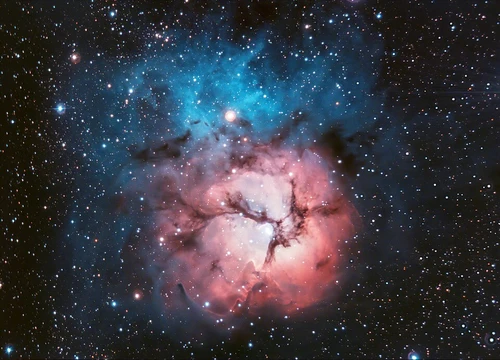
Orion Molecular Clouds
Star-forming filament cloud behind the Orion Nebula, divided into four regions.

The Orion Molecular Clouds (OMCs) are a group of star-forming regions that together form a filament-shaped cloud. They sit behind the Orion Nebula, appearing as dark patches between that nebula and the region Sh 2-279. This filament belongs to the larger Orion A molecular cloud, which itself is part of the Orion molecular cloud complex. The OMCs are split into four sections: OMC-1, OMC-2, OMC-3, and OMC-4. Because both the material in the OMCs and the foreground gas of the Orion Nebula block shorter wavelengths, astronomers typically study the OMCs using radio and infrared telescopes.
OMC-1 lies directly behind the Orion Nebula. Its most notable feature is the Kleinmann-Low (KL) nebula at its center. Although the KL nebula and the protostars in OMC-1’s core are only 90 arcseconds away from the Trapezium cluster, they are actually a few tenths of a parsec farther back. The cloud material shields these protostars from the Trapezium’s intense radiation. Using ALMA, scientists imaged the disks around 51 sources in OMC-1 and found that their sizes are similar to those of protostellar disks in the Orion Nebula Cluster. The KL nebula itself is thought to be the site of a likely collision between two protostellar systems. The release of gravitational energy—possibly from a merger of two stars—triggered an explosion, leaving behind a remnant with ejected material and sending stars flying in different directions. Two of these ejected stars are the massive protostars known as the Becklin-Neugebauer object and the radio source I.
OMC-2 is located north of OMC-1 and contains many protostars. First detected in 1990, the far-infrared sources FIR 1 through 6 are now linked to protostars. For instance, FIR 4 corresponds to the class 0 protostar HOPS 108, while FIR 3 is the class I protostar HOPS 370, which drives a large outflow. HOPS 370 is a well-studied intermediate-mass protostar (about 2.5 solar masses) surrounded by a nearly edge-on circumstellar disk roughly 100 astronomical units in radius. The disk’s rotation was detected using molecular emission lines.
OMC-3 lies north of OMC-1, between the Orion Nebula and Sh 2-279. Unlike the other OMCs, it is not oriented north-south but rather east-west. Its prominent protostars are the sources discovered in 1997, labeled MMS 1 through 10 (for Millimeter Source).
Quick Facts
- Epoch
- J2000
- Class
- star-forming region
- Ra
- 05 · 35 · 27.0
- Dec
- -05 · 10 · 06
- Dist Ly
- 392 pc
- Dist Pc
- 392
- Constellation
- Orion
- Names
- OMC-1, OMC-2, OMC-3, OMC-4
Facts from the source article.
Lore & Background
The Orion Molecular Clouds are a filament cloud located behind the Orion Nebula, appearing as dark clouds between the Orion Nebula and Sh 2-279. They are part of the larger Orion A molecular cloud, which itself belongs to the Orion molecular cloud complex. The OMCs are divided into four parts: OMC-1, OMC-2, OMC-3, and OMC-4. Observations at shorter wavelengths are blocked by material in the OMCs and foreground material from the Orion Nebula, so radio and infrared telescopes are commonly used.
OMC-1 lies behind the Orion Nebula and contains the Kleinmann-Low nebula (KL nebula) at its center. The KL nebula and protostars in the core of OMC-1 are located only 90 arcseconds from the Trapezium cluster, but OMC-1 is actually a few tenths of a parsec behind that cluster. The material of OMC-1 shields its protostars from the intense radiation of the Trapezium cluster. Scientists used ALMA to image disks around 51 sources in OMC-1, finding disk sizes similar to those of protostars in the Orion Nebula Cluster. The KL nebula is the site of a likely collision between two protostellar systems, releasing gravitational energy and possibly merging stars, producing an explosion remnant with ejected material and the ejection of stars, notably the Becklin-Neugebauer object and the radio source I.
OMC-2 is located north of OMC-1 and contains multiple protostars. The far-infrared sources FIR 1-6, discovered in 1990, are associated with protostars; FIR 4 is associated with the class 0 protostar HOPS 108, and FIR 3 is the class I protostar HOPS 370, which launches a large outflow. HOPS 370 is an intermediate-massive protostar (~2.5 M☉) surrounded by a near edge-on circumstellar disk with a radius of about 100 astronomical units, and its disk rotation was detected via molecular emission lines. OMC-3 is located north of OMC-1 between the Orion Nebula and Sh 2-279, with an east-to-west orientation. Its prominent protostars are the millimeter sources MMS 1–10, discovered in 1997; MMS 1–7 are surrounded by disk-like structures and show carbon monoxide outflows. OMC-4 lies south of OMC-1, has a dominating strong magnetic field unfavorable for star formation, fewer protostars than OMC-3, and appears more clumpy than the more filament-like OMC-3.
Reader's Guide
The Orion Molecular Clouds are notable as a star-forming filament cloud behind the Orion Nebula, divided into four distinct regions that each exhibit different characteristics. OMC-1 is particularly significant for containing the Kleinmann-Low nebula, where evidence suggests a collision between two protostellar systems released a large amount of energy, creating an explosion remnant and ejecting stars such as the Becklin-Neugebauer object and radio source I. ALMA observations of 51 sources in OMC-1 revealed that disk sizes there are similar to those in the Orion Nebula Cluster, indicating comparable formation conditions. OMC-2 hosts well-studied protostars like HOPS 370, an intermediate-massive protostar with a detected rotating disk, while OMC-3 contains millimeter sources with disk-like structures and outflows. OMC-4, with its strong magnetic field, appears less conducive to star formation. The OMCs are part of the larger Orion A molecular cloud and the Orion molecular cloud complex, and their study relies on radio and infrared telescopes due to obscuration by material in the clouds and the foreground Orion Nebula.
Did You Know?
- OMC-1 contains the Kleinmann-Low nebula, the site of a likely collision between two protostellar systems.
- HOPS 370 in OMC-2 is an intermediate-massive protostar of about 2.5 solar masses with a disk radius of around 100 astronomical units.
- OMC-3 has an east-to-west orientation, unlike the north-south orientation of the other OMCs.
More in Nebulae, Part 2 1-24
Spotted an error? Know more?
Reader corrections go straight into our review queue. Suggest an edit · How this site is sourced