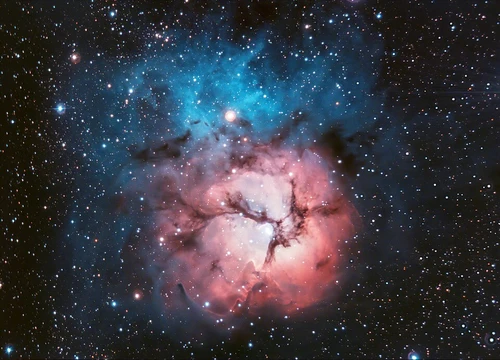
NGC 2080
A star-forming nebula with two ghostly white patches.

NGC 2080, called the Ghost Head Nebula, is a region where stars are born and an emission nebula. It lies south of the Tarantula Nebula (30 Doradus) in the southern constellation Dorado. This nebula is part of the Large Magellanic Cloud, a small galaxy orbiting the Milky Way, roughly 168,000 light-years away. John Frederick William Herschel first spotted it in 1834.
The nebula spans about 50 light-years across. Its nickname comes from two bright white patches that look like a ghost's eyes. The western patch, labeled A1, contains a bubble carved out by a young, massive star at its center. The eastern patch, A2, holds several young stars in a fresh cluster, but they remain hidden inside the dust cloud that formed them. Since neither dust cloud has been blown away by starlight, astronomers figure both sets of stars are less than 10,000 years old. These stars are already shaping the nebula, blowing out material—called stellar wind—that creates a bubble.
The stars also affect the nebula's colors. The western side glows green because a bright star on the edge energizes oxygen, producing a strong emission line. The outer parts of the nebula shine red from ionized hydrogen. In the central region, both hydrogen and oxygen are ionized, giving it a pale yellow hue. Where hydrogen gets enough energy to emit a second light wavelength, it appears blue—like the areas around A1 and A2.
NGC 2080 is not the same as the Ghost Nebula (Sh2-136) or the Little Ghost Nebula (NGC 6369).
Quick Facts
- Credit
- NASA/ESA
- Epoch
- J2000.0
- Ra
- 05 · 39 · 44.2
- Dec
- -69 · 38 · 44
- Dist Ly
- 160,000
- Constellation
- Dorado
- Names
- ESO 057-EN012, / h 2950, GC 1278
Facts from the source article.
Lore & Background
NGC 2080 was discovered by John Frederick William Herschel in 1834. It is named the Ghost Head Nebula for its two distinct white patches, called the 'eyes of the ghost.' The western patch, designated A1, contains a bubble in its center created by the young, massive star it hosts. The eastern patch, A2, contains several young stars in a newly formed cluster, but these stars remain obscured by their originating dust cloud. Because neither dust cloud has dissipated due to stellar radiation, astronomers have deduced that both sets of stars formed within the past 10,000 years. These stars together have begun to create a bubble in the nebula with their outpourings of material, called stellar wind.
The presence of stars greatly influences the color of the nebula. The western portion has a dominant oxygen emission line due to a powerful star on the nebula's outskirts, coloring it green. The rest of the nebula's outskirts have a red hue from the ionization of hydrogen. In the central region, where both hydrogen and oxygen are ionized, the nebula appears pale yellow. When hydrogen is energized enough to emit a second wavelength of light, it appears blue, as in the area surrounding A1 and A2.
NGC 2080 should not be confused with the Ghost Nebula (Sh2-136) or the Little Ghost Nebula (NGC 6369).
Reader's Guide
NGC 2080 is significant as a star-forming region within the Large Magellanic Cloud, providing insight into recent stellar birth. The nebula's two distinct patches, A1 and A2, contain stars that formed within the past 10,000 years, as deduced from the persistence of their surrounding dust clouds. The young, massive star in A1 has created a bubble in its center via stellar wind, while the stars in A2 remain partially hidden by dust. The nebula's varied colors—green from oxygen emission, red from hydrogen ionization, pale yellow from combined ionization, and blue from a second hydrogen emission line—illustrate how stellar radiation influences nebular appearance. Its legacy includes being a subject of Hubble Space Telescope imagery and a NASA Astronomy Picture of the Day feature, highlighting its visual and scientific interest as a nearby extragalactic star-forming site.
Did You Know?
- NGC 2080 is also called the Ghost Head Nebula because of its two white patches known as the 'eyes of the ghost.'
- The western patch A1 contains a bubble created by the young, massive star at its center.
- Both sets of stars in the nebula formed within the past 10,000 years, based on the undissipated dust clouds.
- The nebula's green color comes from a dominant oxygen emission line caused by a powerful star on its outskirts.
More in Nebulae, Part 2 1-24
Spotted an error? Know more?
Reader corrections go straight into our review queue. Suggest an edit · How this site is sourced