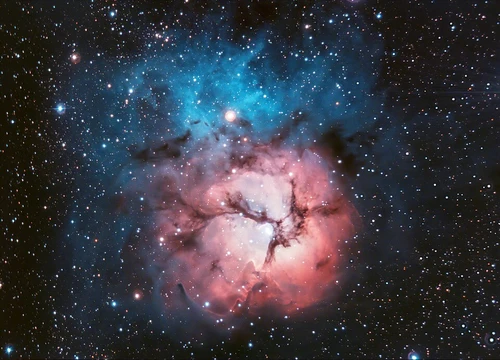
LDN 1641
A dark cloud in Orion with over a thousand young stellar objects.

LDN 1641 (Lynds 1641) is a dark cloud in the constellation Orion. It covers much of the Orion A molecular cloud, which is part of the Orion molecular cloud complex—the nearest giant molecular cloud to Earth. The northern end of LDN 1641 connects to the Orion Nebula, while its southern end connects to another dark cloud, LDN 1647. The cloud contains over a thousand young stellar objects (YSOs). Because it is a relatively low-density star-forming region and lacks massive O- or B-type stars, which would otherwise disturb star formation with ultraviolet radiation, researchers can examine star formation in an environment quite unlike that of the Orion Nebula.
Star formation in Lynds 1641 began about 2–3 million years ago. Roughly half of its YSOs have circumstellar disks, many of which have been directly imaged by ALMA. A large fraction—21%—of these YSOs have transitional disks, meaning disks with a gap. Many directly imaged disks seen in news coverage belong to much closer star-forming regions, such as the Scorpius-Centaurus association. Because Lynds 1641 is about four times farther away than such regions, its disks appear much smaller in ALMA images.
Lynds 1641 shows a strong distance gradient. According to VLBA observations, the southern part of the cloud lies at about 428±10 parsecs, while the Orion Nebula lies at 388±5 parsecs. Gaia data reveal that the stars of Orion A trend toward a closer distance at the northern part of the dark cloud: Gaia measured a distance of roughly 453 parsecs for the southern end of LDN 1641 and about 383 parsecs for its northern end.
Several other nebulae overlap with and are associated with Lynds 1641, including NGC 1999, IC 427/428, IC 429/430, HH34, and HH 1/2.
Quick Facts
- Epoch
- J2000.0
- Ra
- 05 · 39 · 00.0
- Dec
- -07 · 00 · 00
- Dist Ly
- 1249-1477
- Dist Pc
- 383-453
- Constellation
- Orion (constellation)
- Names
- Lynds 1641
Facts from the source article.
Lore & Background
LDN 1641 is a dark cloud that forms part of the Orion A molecular cloud. At its northern end it is connected to the Orion Nebula, and at its southern end it is connected to the dark cloud LDN 1647. The cloud contains more than a thousand young stellar objects (YSOs). It is a relatively low-density star-forming region without any massive O- or B-type stars that could disturb star formation with ultraviolet radiation, providing a contrasting environment to the Orion Nebula.
Star formation in Lynds 1641 began about 2-3 million years ago. About 50% of its YSOs have circumstellar disks, many of which were directly imaged with ALMA. Among these, a large fraction (21%) are transitional disks—disks with a gap. The disks appear much smaller in ALMA images than those in closer star-forming regions, such as the Scorpius-Centaurus association, because LDN 1641 is about four times more distant.
The cloud exhibits a strong distance gradient. VLBA observations place the southern part at around 428±10 parsecs and the Orion Nebula at 388±5 parsecs. Gaia data show a trend toward a closer distance at the northern part, with about 453 parsecs at the southern end and about 383 parsecs at the northern end. Other nebulae overlap with Lynds 1641, including NGC 1999, IC 427/428, IC 429/430, HH34, and HH 1/2.
Reader's Guide
LDN 1641 is significant as a nearby laboratory for studying star formation in a quiescent environment, free from the disruptive ultraviolet radiation of massive stars. Its large population of over a thousand young stellar objects, many with circumstellar disks, allows researchers to examine disk evolution and planet formation processes. The high fraction of transitional disks (21%) is particularly notable, as these gaps may indicate ongoing planet formation. The cloud's distance gradient, measured by both VLBA and Gaia, provides important constraints on the three-dimensional structure of the Orion A molecular cloud. Because the disks in LDN 1641 appear smaller in ALMA images compared to those in closer regions like Scorpius-Centaurus, observations here complement studies of nearer star-forming sites. The overlap with other nebulae such as NGC 1999 and Herbig-Haro objects further enriches the region as a target for multi-wavelength studies. Overall, LDN 1641 offers a unique perspective on star formation in a low-mass, undisturbed setting, contrasting with the more violent Orion Nebula.
Did You Know?
- About 50% of its young stellar objects have circumstellar disks, many imaged with ALMA.
- 21% of the disks are transitional disks, meaning they have a gap.
- The cloud has a strong distance gradient, from about 383 parsecs at the north to about 453 parsecs at the south.
More in Nebulae, Part 2 1-24
Spotted an error? Know more?
Reader corrections go straight into our review queue. Suggest an edit · How this site is sourced