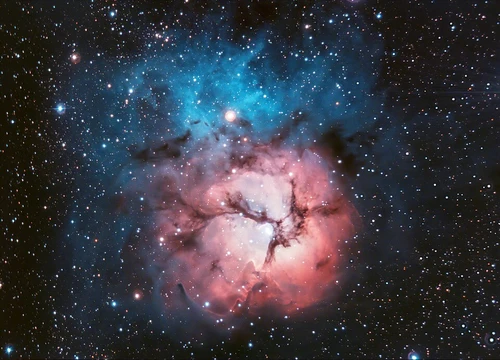
Kleinmann–Low Nebula
The brightest component of the OMC-1 Complex.

Deep inside the Orion Nebula, hidden behind thick clouds of dust that block visible light, lies the Kleinmann–Low Nebula (also called the Orion KL Nebula). This cluster of stars sits within a molecular cloud and is the most active star-forming region in the entire Orion Nebula. Because its surrounding dust is so dense, astronomers mainly study it using infrared light. The nebula was discovered in 1967 by Douglas Kleinmann and Frank J. Low, and between 1972 and 1973, detailed maps were made using telescopes at the Steward and Catalina Observatories.
The nebula shines with a luminosity of about 3.828×10³¹ watts—roughly 105 times the Sun’s brightness—making it the brightest part of the OMC-1 Complex. The surrounding dust has a temperature of around 70 Kelvin, and the nebula itself stays relatively cool at under 600 Kelvin, yet it is extremely active when observed in the far infrared. Inside, the brightest object is the Becklin-Neugebauer Object (BN object). The region is also rich in molecules such as HCOOCH₃, CH₃OCH₃, and deuterated methanol, and it teems with newborn stars and developing planetary systems.
About 550 years ago, an explosion occurred at the nebula’s center. Its remnant is known as the BN-KL complex. The BN object and a radio source called radio source I are moving away from the explosion’s center. The blast left behind iron "bullets" and molecular hydrogen "fingers"—structures that trace the bullets’ wakes. These fingers overlap with carbon monoxide streamers observed by ALMA, which travel at speeds up to 100 km/s. The explosion was on the scale of a nova or supernova, triggered by interactions between multiple stars. The energy came from the release of gravitational binding energy, possibly from the merger of two stars—most likely radio source I. The James Webb Space Telescope’s NIRCam has mapped these iron bullets and hydrogen fingers in greater detail. One ejected piece, the Herbig-Haro object HH 210, is bursting out of the BN-KL complex at 425 km/s and is the only bullet detected in soft X-rays by the Chandra observatory.
Quick Facts
- Credit
- NASA/ESA/CSA JWST NIRCam; Mark McCaughrean et al.
- Epoch
- J2000
- Ra
- 05 · 35 · 14.16
- Dec
- -05 · 22 · 21.5
- Constellation
- Orion
Facts from the source article.
Lore & Background
The Kleinmann–Low Nebula was discovered in 1967 by Douglas Kleinmann and Frank J. Low. Between 1972 and 1973, a large amount of maps were secured using telescopes at the Steward and Catalina Observatories. The nebula is rich in the molecules HCOOCH3, CH3OCH3, and deuterated methanol, and is abundant with nascent stars and planetary systems. Hot stellar winds circulate off large, young stars in Orion's nebula and heat the surrounding gas, causing an explosion that has a finger-like intrusion look.
A remnant of a past explosion is called the BN-KL complex or BN-KL region. The BN object and radio source I are moving away from the center of this explosion, which took place around 550 years ago. The nebula shows so-called iron 'bullets' and molecular hydrogen 'fingers' that trace the wake of these bullets. These 'fingers' overlap with carbon monoxide streamers from ALMA observations, which move with up to 100 km/s. The explosion was on the scale of a nova or supernova, caused by the interaction of multiple stars, with energy provided by the release of gravitational binding energy and possibly the merger of two stars, most likely radio source I. JWST NIRCam also observed the explosion remnant, mapping both iron 'bullets' and hydrogen 'fingers' in more detail. Material ejected from the explosion includes the Herbig-Haro object HH 210, which is bursting out of the BN-KL complex and moving at 425 km/s; it is the only bullet detected in soft x-rays with Chandra.
Reader's Guide
The Kleinmann–Low Nebula is significant as the most active star-forming region within the Orion Nebula and the brightest component of the OMC-1 Complex. Its luminosity, roughly 105 times that of the Sun, underscores its energetic nature. The nebula's past explosion event, occurring around 550 years ago, is a key feature, with remnants including iron 'bullets' and molecular hydrogen 'fingers' that have been mapped in detail by JWST NIRCam and ALMA. The explosion, on the scale of a nova or supernova, was likely caused by stellar interactions and possibly a merger of two stars, providing insight into violent stellar dynamics. The detection of the Herbig-Haro object HH 210 moving at 425 km/s, and its detection in soft x-rays by Chandra, further highlights the nebula's role in studying high-energy phenomena. The nebula's richness in complex molecules and nascent stars makes it a valuable laboratory for understanding star and planetary system formation.
Did You Know?
- The Kleinmann–Low Nebula is also known as the Orion KL Nebula.
- Its luminosity is approximately 3.828×10^31 W, or roughly 105 times that of the Sun.
- The past explosion in the nebula took place around 550 years ago.
More in Nebulae, Part 2 1-24
Spotted an error? Know more?
Reader corrections go straight into our review queue. Suggest an edit · How this site is sourced