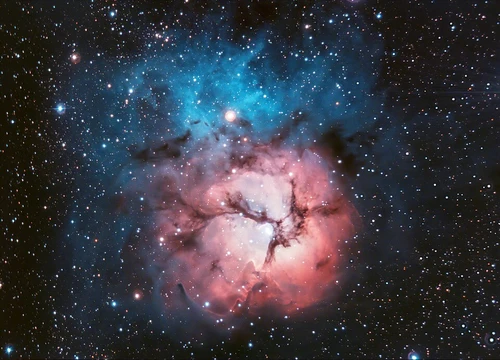
IC 5146
A stellar nursery with a dark nebula tail in Cygnus.

IC 5146, also known as the Cocoon Nebula, is a reflection/emission nebula and Caldwell object in the constellation Cygnus. It is notable as a stellar nursery where star formation is ongoing, with hundreds of young stellar objects identified by the Spitzer Space Telescope and the Chandra X-ray Observatory. The nebula is inseparable from the dark nebula Barnard 168, which forms a dark lane surrounding the cluster and projecting westward like a trail.
Quick Facts
- Epoch
- J2000
- Ra
- 21 · 53 · 28.7
- Dec
- +47 · 16 · 01
- Dist Ly
- 2500±100
- Dist Pc
- 780±30
- Appmag V
- +7.2
- Constellation
- Cygnus
- Radius Ly
- 7.5
- Names
- Cocoon Nebula, Caldwell 19, Sh 2-125, Cr 470
Facts from the source article.
Lore & Background
IC 5146 is described in the NGC description as a cluster of 9.5 magnitude stars involved in a bright and dark nebula. The cluster is also known as Collinder 470. It is located near the naked-eye star Pi Cygni, the open cluster NGC 7209 in Lacerta, and the bright open cluster M39. The central star that lights the nebula formed about 100,000 years ago. The nebula spans about 12 arcmins, equivalent to 15 light years. When viewing IC 5146, the dark nebula Barnard 168 is an inseparable part of the experience, forming a dark lane that surrounds the cluster and projects westward, appearing as a trail behind the Cocoon.
Reader's Guide
IC 5146 is significant as a reflection/emission nebula and Caldwell object that serves as an active stellar nursery. Observations by the Spitzer Space Telescope and the Chandra X-ray Observatory have collectively identified hundreds of young stellar objects within the region. Young stars are seen both in the emission nebula, where gas has been ionized by massive young stars, and in the infrared-dark molecular cloud that forms the tail. One of the most massive stars in the region is BD +46 3474, a class B1 star estimated at 14±4 times the mass of the sun. Another interesting star is BD +46 3471, an example of a HAeBe star, an intermediate-mass star with strong emission lines. The nebula's legacy lies in its role as a nearby laboratory for studying star formation processes, with its dark nebula component Barnard 168 providing a striking visual context. The Cocoon Nebula is also referenced alongside the Little Cocoon Nebula.
Did You Know?
- The central star that lights IC 5146 formed about 100,000 years ago.
- The nebula is about 12 arcmins across, equivalent to 15 light years.
- BD +46 3474 is a class B1 star estimated at 14±4 solar masses.
- The dark nebula Barnard 168 forms a trail-like dark lane behind the Cocoon.
More in Nebulae, Part 2 1-24
Spotted an error? Know more?
Reader corrections go straight into our review queue. Suggest an edit · How this site is sourced