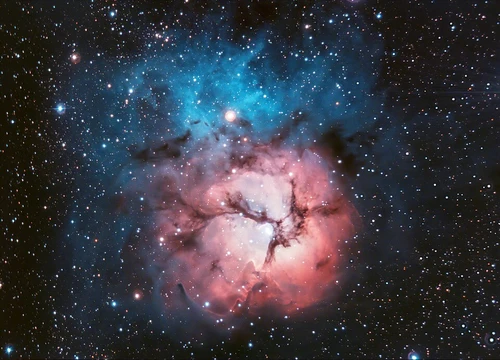
IC 434
Emission nebula in Orion, silhouetting the Horsehead Nebula.

IC 434 is a bright emission nebula in the equatorial constellation of Orion. It is an H II region ionized by ultraviolet radiation from the nearby Sigma Orionis multi-star system, with additional illumination from half a dozen other stars. The nebula is notable for being one of the youngest H II regions to form around members of the Orion OB1 association of hot stars, and for silhouetting the famous Horsehead Nebula, a dark nebula protruding from the Orion B molecular cloud.
Quick Facts
- Epoch
- J2000
- Subtype
- H II region
- Constellation
- Orion
- Ra
- 05 · 40.9
- Dec
- −02 · 27
- Dist Ly
- 385 pc
- Appmag V
- 4.5
Facts from the source article.
Lore & Background
IC 434 was discovered on February 1, 1786, by German-British astronomer William Herschel. It is located at a distance of approximately 1,260 ly (385 pc) from the Sun and spans the interior of a neutral hydrogen shell with an angular size of 2° × 4°, corresponding to a projected size of 42 ly × 85 ly (13 pc × 26 pc).
The nebula is an H II region being ionized by ultraviolet radiation from the nearby Sigma Orionis (σ Ori) multi-star system, with an additional half dozen stars providing further illumination. It is one of the youngest H II regions to form around members of the Orion OB1 association of hot stars. The region has a radius of about 13 ly (4 pc) and a mass of around ~ 100 M☉, while the mass displaced by its advancing ionization front is estimated at 104 M☉. The nebula includes dust with an estimated mass of 2.3 M☉.
IC 434 is surrounded by a shell of neutral hydrogen gas with the identifier GS206-17+13, whose primary driving energy was likely supplied by the blue supergiant Epsilon Orionis. The Horsehead Nebula is a dark nebula silhouetted against the diffuse background of IC 434, protruding from the Orion B molecular cloud, which is part of the Orion molecular cloud complex.
Reader's Guide
IC 434 is significant as a bright emission nebula that provides the backdrop for the iconic Horsehead Nebula, a dark nebula silhouetted against its diffuse glow. Its status as one of the youngest H II regions in the Orion OB1 association makes it a key object for studying early stages of star formation and the interaction of ionizing radiation with surrounding gas and dust. The nebula's ionization by the Sigma Orionis multi-star system and additional stars highlights the role of multiple stellar sources in shaping H II regions. The surrounding neutral hydrogen shell, GS206-17+13, likely driven by the blue supergiant Epsilon Orionis, adds to the understanding of large-scale feedback from massive stars. The nebula's measured mass of ~100 M☉ and dust mass of 2.3 M☉, along with the estimated 104 M☉ of displaced mass by its ionization front, provide quantitative data for models of nebular evolution. Its discovery by William Herschel in 1786 places it within the historical catalog of deep-sky objects, and its location in the Orion molecular cloud complex connects it to a broader region of active star formation.
Did You Know?
- The nebula is ionized by ultraviolet radiation from the Sigma Orionis multi-star system.
- The nebula has a dust mass estimated at 2.3 M☉.
More in Nebulae, Part 2 1-24
Spotted an error? Know more?
Reader corrections go straight into our review queue. Suggest an edit · How this site is sourced