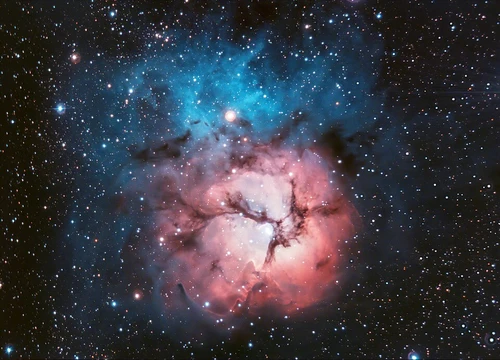
IC 2944
An open cluster with emission nebula featuring Bok globules.

IC 2944 is an open cluster and emission nebula in the constellation Centaurus, located near the star Lambda Centauri. It goes by several nicknames, including the Running Chicken Nebula and the Lambda Centauri Nebula. The region contains Bok globules—dense clouds of gas and dust often linked to star formation—but none of the globules in IC 2944 show signs of active star formation. The cluster and nebula are also cataloged as RCW 62, G40, and G42.
The most famous features within IC 2944 are Thackeray's Globules, a set of Bok globules first identified by astronomer A. David Thackeray in 1950. A close-up image taken by the ESO Very Large Telescope shows these globules, and data from the 2MASS survey reveals six stars inside the largest one. The visible nebulosity in modern images actually combines IC 2944 with IC 2948 and the fainter IC 2872. IC 2948 is the brightest emission and reflection nebula toward the southeast, while IC 2944 is the star cluster and surrounding gas stretching toward Lambda Centauri. The star Lambda Centauri itself lies just outside IC 2944. The nebula's "Running Chicken" nickname comes from a pattern of stars that resembles a chicken in motion. IC 2944 is located about 6,500 light-years from Earth.
Quick Facts
- Epoch
- J2000.0
- Ra
- 11 · 36 · 36.0
- Dec
- -63 · 02 · 00
- Dist Ly
- 6500
- Appmag V
- 4.5
- Radius Ly
- 71
- Constellation
- Centaurus
- Notes
- open cluster with nebulosity, Bok globules
- Names
- IC 2944, RCW 62 / Running Chicken Nebula, / Lambda Cen Nebula, Caldwell 100.
Facts from the source article.
Lore & Background
The region of nebulosity visible in modern images includes both IC 2944 and IC 2948, as well as the fainter IC 2872 nearby. IC 2948 is the brightest emission and reflection nebulae towards the southeast, while IC 2944 is the cluster of stars and surrounding nebulosity stretching towards λ Centauri. The star Lambda Centauri lies just outside IC 2944. The nebula gets its nickname 'Running Chicken Nebula' from a group of stars that resemble a running chicken. A close-up image taken by the ESO Very Large Telescope shows a set of Bok globules discovered in IC 2944 by astronomer A. David Thackeray in 1950, now known as Thackeray's Globules. In 2MASS images, six stars are visible within the largest globule.
Reader's Guide
IC 2944 is significant as an example of an open cluster associated with an emission nebula, containing Bok globules that are typically sites of active star formation. However, the absence of star formation evidence in its globules makes it a notable exception, prompting further study of these dark clouds. The globules, discovered by A. David Thackeray in 1950 and imaged by the ESO Very Large Telescope, are a key feature for understanding the conditions within such structures. The nebula's nickname, the Running Chicken Nebula, derived from a star pattern, adds to its recognition. Its location near the bright star Lambda Centauri and its inclusion in multiple catalogues (IC, RCW, G) highlight its importance in astronomical surveys. The presence of six stars within the largest globule, as seen in 2MASS images, provides data on embedded stellar objects. The region's complexity, blending IC 2944, IC 2948, and IC 2872, underscores the layered nature of nebulae in this part of Centaurus.
Did You Know?
- IC 2944 is also known as the Running Chicken Nebula, the Lambda Centauri Nebula, or the λ Centauri Nebula.
- The Bok globules in IC 2944 were discovered by astronomer A. David Thackeray in 1950 and are called Thackeray's Globules.
- No evidence for star formation has been found in any of the globules in IC 2944.
More in Nebulae, Part 2 1-24
Spotted an error? Know more?
Reader corrections go straight into our review queue. Suggest an edit · How this site is sourced