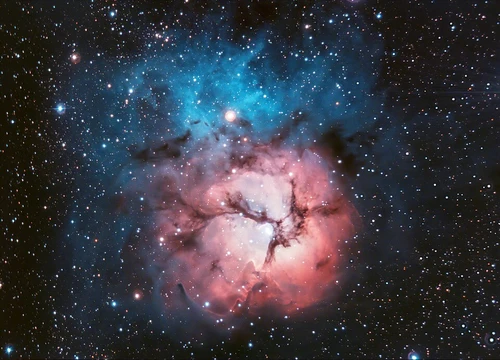
IC 2118
A faint blue reflection nebula shaped like a witch's head.

IC 2118, often called the Witch Head Nebula for its distinctive profile, is a very dim reflection nebula. It is thought to be either an old supernova remnant or a gas cloud lit up by Rigel, a supergiant star in Orion. The nebula is located in the constellation Eridanus, roughly 900 light-years away. Its blue tint comes from dust grains that scatter blue light more efficiently than red. Radio observations have detected significant carbon monoxide emissions across parts of IC 2118, pointing to molecular clouds and ongoing star formation. Within the nebula, astronomers have identified candidate pre-main-sequence stars and several classic T Tauri stars. The molecular clouds in IC 2118 likely sit near the outer edge of the Orion-Eridanus bubble, a huge supershell of molecular hydrogen created by the massive stars of the Orion OB1 association. As this supershell expands into interstellar space, it creates conditions favorable for star birth, and IC 2118 lies in one such region. The nebula’s wind-swept, cometary appearance strongly suggests a link to the bright, high-mass stars of Orion OB1. The fact that the heads of these cometary clouds point northeast, toward the association, reinforces that connection.
Quick Facts
- Epoch
- J2000
- Constellation
- Eridanus
Facts from the source article.
Lore & Background
IC 2118 is an extremely faint reflection nebula whose shape resembles a witch's head, illuminated by the supergiant star Rigel in the constellation Orion. The nebula lies in the constellation Eridanus, about 900 light-years from Earth. Its blue color is due to dust particles that reflect blue light more efficiently than red. Radio observations have detected substantial carbon monoxide emission throughout parts of IC 2118, indicating the presence of molecular clouds and star formation. Candidates for pre-main sequence stars and some classic T Tauri stars have been found deep within the nebula.
Reader's Guide
The molecular clouds of IC 2118 are probably juxtaposed to the outer boundaries of the vast Orion-Eridanus bubble, a giant supershell of molecular hydrogen blown by the high-mass stars of the Orion OB1 association. As the supershell expands into the interstellar medium, favorable circumstances for star formation occur, and IC 2118 is located in one such area. The wind-blown appearance and cometary shape of the bright reflection nebula strongly suggest an association with the high-mass luminous stars of Orion OB1. The fact that the heads of the cometary clouds of IC 2118 point northeast toward that association is strong support of that relationship. The nebula's significance lies in its role as a site of ongoing star formation and its connection to the larger dynamics of the Orion-Eridanus supershell.
Did You Know?
- IC 2118 is also known as the Witch Head Nebula due to its shape.
- The nebula lies about 900 light-years from Earth in the constellation Eridanus.
- Candidates for pre-main sequence stars and classic T Tauri stars have been found deep within IC 2118.
More in Nebulae, Part 2 1-24
Spotted an error? Know more?
Reader corrections go straight into our review queue. Suggest an edit · How this site is sourced