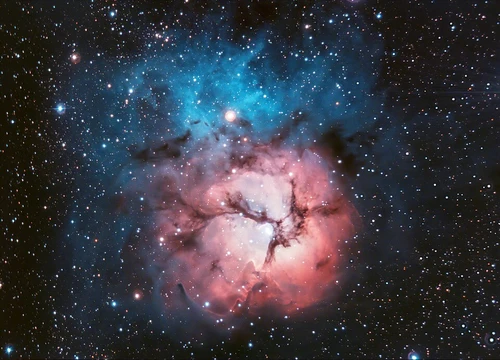
IC 1396
Emission nebula in Cepheus, illuminated by massive star HD 206267.

IC 1396 is a vast emission nebula—a cloud of ionized gas—situated roughly 2,400 light-years away in the constellation Cepheus. Its glow is driven by HD 206267, an extremely bright and massive multiple star at the nebula’s core, whose intense ultraviolet radiation ionizes the surrounding gas. However, certain dense globules within the nebula manage to shield themselves from this harsh light. HD 206267 is a hierarchical triple system: two of its members form a spectroscopic binary, circling each other every 3.7 days, while a third star orbits farther out—though it remains uncertain whether this outer star is truly gravitationally bound to the pair. The system also generates a stellar wind racing at an extraordinary 3,225 km/s, among the fastest ever recorded for stars of its type.
Protruding from the nebula’s edge is IC 1396A, better known as the Elephant’s Trunk Nebula—a dark, dense globule with a bright, winding rim lit by HD 206267. At the nebula’s boundary lies Mu Cephei, a red supergiant or hypergiant famous for being one of the largest known stars.
Quick Facts
- Dist Ly
- 2,400
- Constellation
- Cepheus
Facts from the source article.
Lore & Background
IC 1396 is a large emission nebula, a region of ionized gas, located in the constellation Cepheus about 2,400 light years away from Earth. It is illuminated and ionized by a very bright, massive multiple star HD 206267 at its center, except for dense globules that can protect themselves from the star's harsh ultraviolet rays. This hierarchical triple star system has two members that form a spectroscopic binary that orbit each other with a period of 3.7 days, while a third member lies further away—it is unclear whether this third member is gravitationally bound to the pair. The system is emitting a stellar wind that reaches an exceptional velocity of 3,225 km/s, among the highest measured for stars of this type.
Reader's Guide
IC 1396 is significant as a large emission nebula whose central star, HD 206267, drives its ionization and illumination. The star's exceptional stellar wind velocity of 3,225 km/s is among the highest measured for stars of its type, highlighting the extreme physical conditions within the nebula. The presence of dense globules that resist the star's ultraviolet rays, such as IC 1396A (the Elephant's Trunk Nebula), demonstrates the interplay between radiation and interstellar matter. Additionally, the red supergiant or hypergiant Mu Cephei, one of the largest known stars, lies at the nebula's edge, adding to the region's astrophysical interest. The uncertainty regarding the gravitational binding of the third member of HD 206267 underscores the complexity of multiple star systems within nebulae.
Did You Know?
- IC 1396 is about 2,400 light years away from Earth in the constellation Cepheus.
- The central star HD 206267 is a hierarchical triple star system with a spectroscopic binary pair orbiting every 3.7 days.
- The stellar wind from HD 206267 reaches an exceptional velocity of 3,225 km/s.
More in Nebulae, Part 2 1-24
Spotted an error? Know more?
Reader corrections go straight into our review queue. Suggest an edit · How this site is sourced