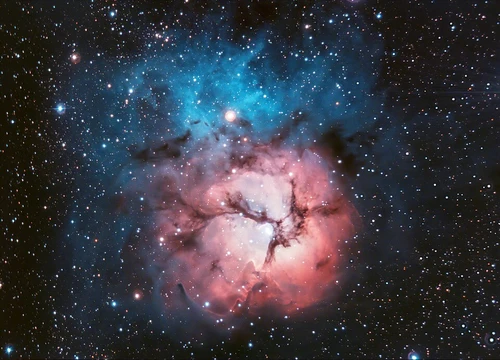
Horsehead Nebula
A dark nebula shaped like a horse's head in Orion.

The Horsehead Nebula, cataloged as Barnard 33 or B33, is a compact dark nebula roughly 1,375 light-years away in the constellation Orion. It sits just south of Alnitak, the easternmost star in Orion’s Belt, and belongs to the larger Orion molecular cloud complex. Within the dense dust cloud Lynds 1630, it lies along the edge of IC 434, a vast, active star-forming H II region. Its fame comes from its striking silhouette, which resembles a horse’s head.
Scottish astronomer Williamina Fleming discovered the nebula in 1888 on a photographic plate taken at Harvard College Observatory. E. E. Barnard later described it as a “dark mass, diam. 4′, on nebulous strip extending south from ζ Orionis,” cataloging it as Barnard 33.
The shape is unmistakable: a horse’s head formed by heavy dust concentrations. In this region and the neighboring Orion Nebula, interstellar clouds create alternating patches of near-total opacity and transparency. The nebula appears dark because thick dust blocks light from stars behind it; the lower part of the neck casts a shadow to the left. This dark cloud, emerging from a gaseous complex, is an active site where low-mass stars are forming. Bright spots at its base are young stars just beginning to form. The cloud is part of the Orion molecular cloud complex, a star-forming region prominent in the winter evening sky of the Northern Hemisphere and the summer evening sky of the Southern Hemisphere.
In color images, the nebula glows red from ionized hydrogen gas (Hα) mostly behind it, caused by the nearby bright star Sigma Orionis. Magnetic fields channel gases into streams that appear as foreground streaks against the background glow. A glowing strip of hydrogen gas marks the edge of the enormous cloud, and the densities of nearby stars differ noticeably on either side.
In Isaac Asimov’s 1951 novel *The Stars, Like Dust*, two characters argue over the nebula’s name. One, who studied on Earth, says it was named for its horse-head shape. The other, raised on another planet, insists it was named after Horace Hedd, the first person to enter it.
Quick Facts
- Epoch
- J2000.0
- Ra
- 05 / h / 40 / m / 59.0 / s
- Dec
- −02° 27′ 30.0"
- Dist Pc
- 422 · 17
- Appmag V
- 6.8
- Constellation
- Orion
- Radius Ly
- 3.5
- Names
- Barnard 33, LDN 1630, IC 434
Facts from the source article.
Lore & Background
The nebula was discovered by Scottish astronomer Williamina Fleming in 1888 on a photographic plate taken at the Harvard College Observatory. One of the first descriptions was made by E. E. Barnard, describing it as: 'Dark mass, diam. 4′, on nebulous strip extending south from ζ Orionis', cataloguing the dark nebula as Barnard 33.
The Horsehead Nebula is located just to the south of Alnitak, the easternmost star of Orion's Belt, and is part of the much larger Orion molecular cloud complex. It appears within the southern region of the dense dust cloud known as Lynds 1630, along the edge of the much larger, active star-forming H II region called IC 434. Heavy concentrations of dust in the region are localized into interstellar clouds resulting in alternating sections of nearly complete opacity and transparency. The darkness of the Horsehead is caused mostly by thick dust blocking the light of stars behind it. The lower part of the Horsehead's neck casts a shadow to the left. The visible dark nebula emerging from the gaseous complex is an active site of the formation of 'low-mass' stars. Bright spots in the Horsehead Nebula's base are young stars just in the process of forming.
Colour images reveal a red colour that originates from ionised hydrogen gas (Hα) predominantly behind the nebula, and caused by the nearby bright star Sigma Orionis. Magnetic fields channel the gases, leaving the nebula into streams, shown as foreground streaks against the background glow. A glowing strip of hydrogen gas marks the edge of the enormous cloud, and the densities of nearby stars are noticeably different on either side.
Reader's Guide
The Horsehead Nebula is notable as one of the most identifiable nebulae due to its distinctive shape resembling a horse's head. It was discovered in 1888 by Williamina Fleming, a Scottish astronomer working at the Harvard College Observatory, and later catalogued by E. E. Barnard as Barnard 33. The nebula is a small dark nebula located about 1,375 light-years from Earth in the constellation of Orion, just south of Alnitak, and is part of the larger Orion molecular cloud complex. Its darkness is caused by thick dust blocking starlight, and it lies along the edge of the active star-forming H II region IC 434. The nebula is an active site of low-mass star formation, with bright spots at its base indicating young stars in formation. Colour images show a red glow from ionised hydrogen gas behind the nebula, caused by the star Sigma Orionis, and magnetic fields channel gases into foreground streaks. In popular culture, Isaac Asimov's 1951 novel The Stars, Like Dust features a dispute over the nebula's name: one character says it is named for its horse-head shape, while another believes it is named after Horace Hedd, the first man to enter it.
More in Nebulae, Part 2 1-24
Spotted an error? Know more?
Reader corrections go straight into our review queue. Suggest an edit · How this site is sourced