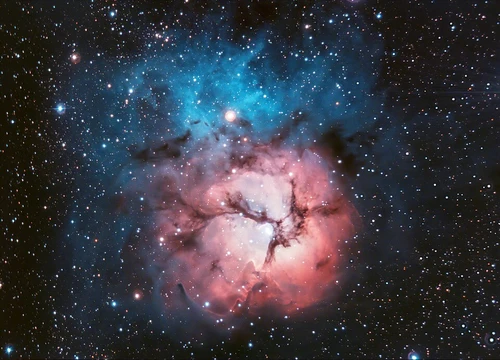
Gum Nebula
One of the largest known nebulae in the Milky Way.

The Gum Nebula, also cataloged as Gum 12, is an emission nebula spanning 36 degrees across the southern sky in the constellations Vela and Puppis, about 450 parsecs from Earth. Because it is so faint and hard to see, astronomers once thought it was the expanding remains of a supernova that exploded roughly a million years ago. More recent studies, however, suggest it might actually be an evolved H II region. Inside it lies the much younger Vela Supernova Remnant, which is about 11,000 years old, along with the Vela Pulsar.
The nebula sits between two bright, massive star systems: ζ Puppis (Naos) and γ² Velorum (Regor). Naos is about 330 parsecs away, near the edge of the cloud facing the Sun, while Regor is about 336 parsecs away, closer to the cloud’s center. To the southeast, along the same line of sight but between the Gum Nebula and our solar system, lies the Vela Nebula, another supernova remnant.
As one of the largest known nebulae in the Milky Way, the Gum Nebula is a key area for studying how supernova explosions create expanding bubbles and how those bubbles interact with surrounding molecular clouds. On the nebula’s edges, limited star formation is happening inside small, comet-shaped clouds called cometary globules. Near some of these globules, astronomers have found Herbig-Haro objects, including HH 47.
The nebula’s inner part was first spotted in 1939 by Otto Struve, but he didn’t realize what it was. It was later named after Colin Stanley Gum, an Australian astronomer who, in the early 1950s, re-imaged this region of the southern Milky Way in infrared light. He saw its true size: it covers the western part of Vela, brushes Carina to the south, extends through southeastern Puppis, and ends near the star π Puppis. Gum published his discovery in 1952 in *The Observatory*, using observations from the Commonwealth Observatory, and followed up with a full report in 1955 in a work titled *A study of diffuse southern H-alpha nebulae* (part of the Gum catalog).
Visually, the Gum Nebula appears as a vast, faint patch at the border of Puppis and Vela—so large it seems to be the biggest nebula in the sky. But it’s invisible to the naked eye and even to amateur telescopes because its filaments are extremely dim; most of its light is in infrared and H-alpha wavelengths.
Quick Facts
- Epoch
- J2000.0
- Constellation
- Vela, Puppis
- Ra
- 08 · 00
- Dec
- -43 · 00
- Dist Ly
- 1470
- Dist Pc
- 450
- Appmag V
- +12 (infrared only)
- Appdia
- 30°
- Absmag V
- 3.73 (infrared)
- Names
- Gum 12
Facts from the source article.
Lore & Background
The Gum Nebula was first identified in its innermost part in 1939 by Otto Struve, who did not perceive its true nature. It is named after the Australian astronomer Colin Stanley Gum (1924–1960), who in the early 1950s reimaged this region of the southern Milky Way in the infrared, discovering its true extent. He published the discovery in 1952 in the journal The Observatory, with observations made at the Commonwealth Observatory; a full report followed in 1955. The nebula appears as a vast and faint nebula covering the boundary between Puppis and Vela, and is not visible optically nor with an amateur telescope because its filaments are very faint; much of its emission is in the infrared and Hα bands. Its position is strongly southern, fully visible only from lower northern latitudes south of the 35th–36th parallel north, while beyond 50° N it becomes completely invisible. The Gum Nebula was photographed during Apollo 16 while the command module was in the double umbra of the Sun and Earth, using high-speed Kodak film.
Reader's Guide
The Gum Nebula was widely believed to be the greatly expanded remains of a supernova that took place about a million years ago, but more recent research suggests it may be an evolved H II region. It contains the 11,000-year-old Vela Supernova Remnant, along with the Vela Pulsar. The nebula is located between the bright massive star systems ζ Puppis (Naos) and γ2 Velorum (Regor), with the former closer to the edge of the cloud facing the Sun and the latter closer to the center. To its southeastern part lies the Vela Nebula, a supernova remnant between the Gum Nebula and the Solar System along the same line of sight. The nebula contains about 32 cometary globules, dense cloud cores subject to strong radiation from O-type stars, and associated with star formation. Notable objects include the Herbig-Haro object HH 46/47. The main ionizing sources are the Vela OB2 association, Zeta Puppis, and the OB association Trumpler 10. It is suggested that a few stars exploded in supernovae about 30 million years ago in the center of the Gum Nebula and triggered the formation of stars in the region. The shock wave from the nebula's expansion and intense ultraviolet radiation have eroded and compressed gas in surrounding clouds, promoting the birth of low- and intermediate-mass stars.
Did You Know?
- The Gum Nebula extends across 36° in the southern constellations Vela and Puppis.
- The nebula was photographed during Apollo 16 using high-speed Kodak film.
- It contains about 32 cometary globules, including CG22 with a tail extending over 8 parsecs.
More in Nebulae, Part 2 1-24
Spotted an error? Know more?
Reader corrections go straight into our review queue. Suggest an edit · How this site is sourced