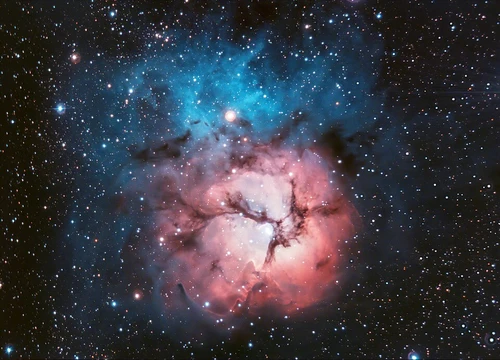
Flame Nebula
Emission nebula in Orion with a young, obscured star cluster.

The Flame Nebula is an emission nebula in the constellation Orion, also designated as NGC 2024 and Sh2-277. It lies about 1350 light-years away within the Orion B cloud of the larger Orion Molecular Cloud Complex. The nebula is notable for containing a young star cluster that includes at least one hot, luminous O-type star, IRS 2b, whose energetic ultraviolet light excites and heats the surrounding gas, producing the nebula's glow.
Quick Facts
- Epoch
- J2000.0
- Ra
- 05 · 41 · 54
- Dec
- -01 · 51 · 0.0
- Dist Ly
- 1350 ly
- Dist Pc
- 415
- Constellation
- Orion
- Radius Ly
- 6
- Names
- NGC 2024 and Sharpless 277
Facts from the source article.
Lore & Background
The Flame Nebula appears very close in the sky to the bright star Alnitak (ζ Ori), the easternmost star in the Belt of Orion, but the star and nebula are not physically associated. The nebula contains a young cluster of stars, including at least one hot, luminous O-type star labeled IRS 2b. The dense gas and dust in the foreground heavily obscures the star cluster, making studies at infrared wavelengths most useful. The energetic ultraviolet light emitted by IRS 2b causes the gas to be excited and heated, resulting in the nebula's glow. Within the nebula and surrounding the central hot star is a cluster of young, lower-mass stars, 86% of which have circumstellar disks. X-ray observations by the Chandra X-ray Observatory show several hundred young stars, out of an estimated population of 800 stars, concentrated near the center of the cluster.
Reader's Guide
The Flame Nebula's significance lies in its role as a laboratory for studying young stellar populations and star formation processes. Observations with ALMA revealed two distinct populations separated by a molecular cloud: an eastern population 0.2–0.5 million years old with a disk fraction of 45±7%, and a western population about 1 million years old with a lower disk fraction of 15±4%. The eastern part contains the O8 star IRS 2b, while the western part contains the B0.5V star IRS 1. Hubble observations have shown that the Flame Nebula contains 4 clear proplyds and 4 candidate proplyds, with three in the older western region pointing toward IRS 1 and five in the younger eastern region pointing toward IRS 2b. These findings provide insight into how circumstellar disks evolve and how radiation from massive stars shapes protoplanetary environments. The nebula's legacy is tied to multiwavelength studies—infrared, X-ray, and radio—that reveal structures hidden by dust, offering a detailed view of star formation in a nearby molecular cloud.
Did You Know?
- The Flame Nebula is about 1350 light-years away in the Orion B cloud of the Orion Molecular Cloud Complex.
- The bright star Alnitak appears close to the Flame Nebula in the sky but is not physically associated with it.
- Hubble observations have identified 4 clear proplyds and 4 candidate proplyds within the Flame Nebula.
More in Nebulae, Part 2 1-24
Spotted an error? Know more?
Reader corrections go straight into our review queue. Suggest an edit · How this site is sourced