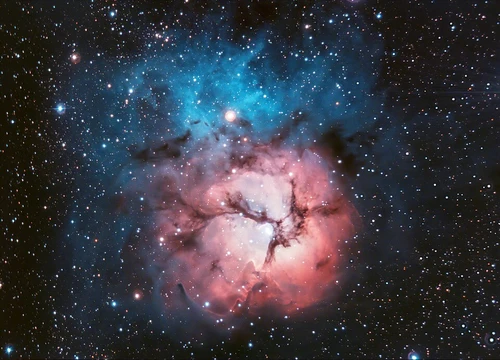
Elephant's Trunk Nebula
A dark globule in Cepheus, site of triggered star formation.

The Elephant's Trunk Nebula, cataloged as IC 1396A, is a dense clump of gas and dust embedded within the larger, glowing region IC 1396. This region lies in the constellation Cepheus, roughly 2,400 light-years from Earth. In visible light, the nebula appears as a dark, dense globule with a bright, winding edge, a shape that inspired its name. That bright rim is the cloud’s surface, illuminated and ionized by a very bright, massive multiple star called HD 206267, located just to the east. The massive star ionizes most of the IC 1396 region, but dense globules like the Elephant’s Trunk can shield themselves from its harsh ultraviolet radiation.
The Elephant’s Trunk Nebula is now recognized as a site where stars are forming. Infrared images from 2003 revealed several very young stars there, all less than 100,000 years old. Two slightly older stars—still young by stellar standards, at a couple of million years—sit inside a small, circular cavity in the nebula’s head. Winds from these young stars may have carved out that cavity. The combined effects of the massive star’s light, which compresses and ionizes the cloud’s rim, and the winds from the young stars, which push gas outward from the center, create intense compression within the nebula. This pressure has triggered the formation of the current generation of protostars.
Quick Facts
- Dist Ly
- 2,400
- Constellation
- Cepheus
Facts from the source article.
Lore & Background
The Elephant's Trunk Nebula is a dark, dense globule within the ionized gas region IC 1396. Its bright, sinuous rim is the surface of the dense cloud being illuminated and ionized by the very bright, massive multiple star HD 206267, located just to the east. The entire IC 1396 region is ionized by this massive star, except for dense globules that can protect themselves from its harsh ultraviolet rays.
The nebula is now thought to be a site of star formation, containing several very young (less than 100,000 yr) stars discovered in infrared images in 2003. Two older (but still young, a couple of million years) stars are present in a small, circular cavity in the head of the globule; winds from these young stars may have emptied the cavity.
The combined action of light from the massive star ionizing and compressing the rim of the cloud, and the wind from the young stars shifting gas from the center outward, leads to very high compression in the Elephant's Trunk Nebula. This pressure has triggered the current generation of protostars.
Reader's Guide
The Elephant's Trunk Nebula is significant as a clear example of triggered star formation, where the interplay of external ionizing radiation and internal stellar winds creates high compression that spawns new protostars. The massive star HD 206267 ionizes the rim of the dark globule, while winds from two young stars (a couple of million years old) inside a cavity in the head of the globule push gas outward. This combined action leads to very high compression, which has triggered the current generation of protostars. The discovery in 2003 of several very young stars (less than 100,000 years old) via infrared images confirms that star formation is actively occurring within the nebula. Its legacy lies in demonstrating how massive stars can both erode and compress nearby molecular clouds, initiating new rounds of stellar birth, a process that shapes many nebulae across the galaxy.
Did You Know?
- It is illuminated and ionized by the massive multiple star HD 206267, located just to the east.
- Several very young stars (less than 100,000 years old) were discovered in the nebula in infrared images in 2003.
Frequently Asked Questions
What is the Elephant's Trunk Nebula?
It is a dense, dark globule of gas and dust cataloged as IC 1396A, embedded inside the larger emission region IC 1396 in the constellation Cepheus. It sits roughly 2,400 light-years from Earth.
Why is it called the Elephant's Trunk Nebula?
In visible-light images the globule shows up as a dark, compact blob with a bright, curving rim that winds outward, giving it a silhouette that closely resembles a trunk. That luminous edge is the cloud's surface being ionized by the massive multiple star HD 206267 just to the east.
What is the Elephant's Trunk Nebula's role in star formation?
It acts as a shielded nursery: while HD 206267 ionizes most of the surrounding IC 1396 gas, the globule's dense interior blocks that radiation and instead gets compressed by the ionization front. That compression triggers the birth of brand-new stars within the cloud.
How young are the stars forming inside it?
The youngest stellar objects detected in the globule are estimated to be under 100,000 years old, making it one of the most recently active star-forming sites in the Cepheus region.
Why do astronomers consider the Elephant's Trunk Nebula important?
It serves as a textbook example of triggered star formation, where the radiation pressure from a nearby massive star both carves and compresses a dense cloud to ignite new stars. Because the process is still ongoing and the newborn stars are extremely young, it offers a rare, near-real-time look at how massive stars can seed the next generation.
More in Nebulae, Part 2 1-24
Spotted an error? Know more?
Reader corrections go straight into our review queue. Suggest an edit · How this site is sourced