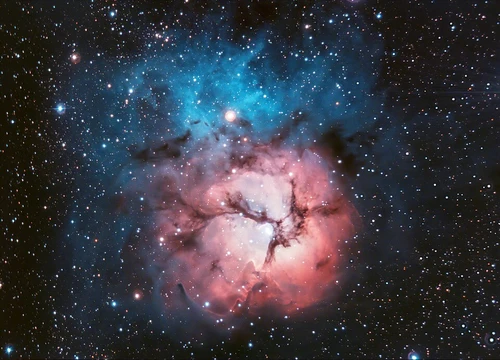
Dragonfish Nebula
A massive emission nebula shaped like a deep-sea dragonfish.

The Dragonfish Nebula is a massive emission nebula and star-forming region located 30,000 light-years from the Sun in the direction of the constellation Crux, the Southern Cross. It is notable for its appearance on infrared images, which resemble a giant toothy deep-sea dragonfish, and for containing some of the most massive stars in the Milky Way galaxy. It is the brightest and most massive cluster discovered so far, producing more microwaves than most clusters in our galaxy.
Quick Facts
- Credit
- NASA/JPL-Caltech/Univ. of Toronto
- Epoch
- J2000
- Ra
- 12 · 11 · 27.5
- Dec
- -62 · 55 · 10
- Constellation
- Crux
- Dimensions
- 130′
- Names
- GAL 298.4-00.4
Facts from the source article.
Lore & Background
The Dragonfish Nebula was first discovered in 2010 by Mubdi Rahman and Norman Murray from the University of Toronto. They discovered a cloud of ionized gas which led them to suspect that it was formed from the radiation of nearby stars. Since then more than four hundred stars have been found and there is reason to believe that many smaller stars are hiding in the cluster. The ionized gas around this cluster produces more microwaves than most clusters in our galaxy, making the Dragonfish Nebula the brightest and most massive cluster discovered so far.
Due to its distance and location, it is totally invisible in visible light because the interstellar dust absorbs and reddens its light, hiding it. So in order to study it, wavelengths that are not affected, like infrared, are required. Research done with the help of the Spitzer Space Telescope has shown this object has a size of 450 light-years, having a large cavity with a diameter of 100 light-years that was created by the strong stellar winds of the young and massive stars inside it.
The giant stars in this nebula blow a bubble in the surrounding gas, forming the mouth of the dragonfish. The two largest and luminous stars, which form its eyes, are said to be newly formed stars. The stars heat up the surrounding gas, giving off infrared light. As of 2011, approximately 400 stars of spectral types O and B have been identified within the nebula, and subsequent studies have confirmed at least 15 O-type stars and 3 luminous blue variable/Wolf–Rayet star candidates.
Reader's Guide
The Dragonfish Nebula holds significance as the brightest and most massive cluster discovered so far in our galaxy, producing more microwaves than most clusters. Its discovery in 2010 by Mubdi Rahman and Norman Murray from the University of Toronto revealed a cloud of ionized gas formed from the radiation of nearby stars. The nebula contains some of the most massive stars in the Milky Way, with approximately 400 stars of spectral types O and B identified as of 2011, including at least 15 O-type stars and 3 luminous blue variable/Wolf–Rayet star candidates. The total mass of its stars is calculated at 105 solar masses, a mass only comparable with that of the super star cluster Westerlund 1. Its legacy lies in being a key object for studying massive star formation, as it is hidden in visible light by interstellar dust and requires infrared observation. The Spitzer Space Telescope revealed its size of 450 light-years and a large cavity 100 light-years in diameter created by stellar winds. The nebula's name derives from its infrared appearance resembling a deep-sea dragonfish, with a bubble over 100 light-years long forming the mouth and two newly formed stars forming the eyes.
Did You Know?
- The Dragonfish Nebula is named for its infrared appearance resembling a giant toothy deep-sea dragonfish.
- Its total stellar mass of 105 solar masses is only comparable with that of the super star cluster Westerlund 1.
More in Nebulae, Part 2 1-24
Spotted an error? Know more?
Reader corrections go straight into our review queue. Suggest an edit · How this site is sourced