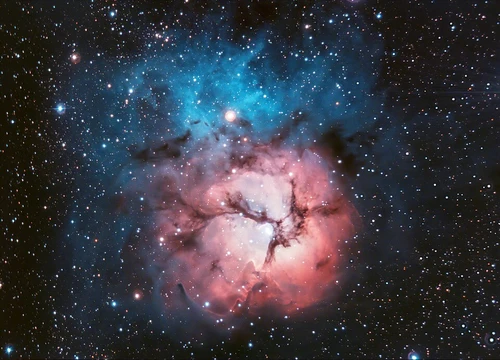
DR 21
A massive star-forming molecular cloud in Cygnus.

DR 21 is a vast molecular cloud in the constellation Cygnus, first identified in 1966 as a radio continuum source by Downes and Rinehart. It lies roughly 6,000 light-years away, spans about 80 light-years, and holds an estimated mass of one million solar masses. The region is a prolific star-forming site, linked to the larger Cygnus X complex, and hosts some of the most massive stars known in the Milky Way.
Radio observations have detected numerous molecules here, including formaldehyde, ammonia, water, and carbon monoxide. In infrared light, the cloud glows due to polycyclic aromatic hydrocarbons—organic compounds in its dust and gas. Jagged structures within DR 21 arise from the interplay of interstellar wind, radiation pressure, magnetic fields, and gravity.
About 2,900 stars have formed in this cloud, a number comparable to the Orion Nebula cluster, and they are grouped around dense clumps. Feedback from the massive stars could eventually break the cloud apart, but its extreme youth has so far prevented this. The Spitzer Space Telescope has revealed signs of protoplanetary disks around many of these young stars.
Quick Facts
- Subtype
- Emission nebula
- Epoch
- J2000
- Ra
- 20 · 39 · 01.6
- Dec
- +42 · 19 · 38
- Dist Ly
- 6,000
- Dist Pc
- 1,800
- Constellation
- Cygnus
- Names
- GRS G081.70 +00.50, GAL 081.681+00.54, W 75, 18P 78, 36P 19, RAFGL 2624
Facts from the source article.
Lore & Background
DR 21 was discovered in 1966 as a radio continuum source by Downes and Rinehart. It is located about 6,000 light-years from Earth and extends for 80 light-years, with an estimated mass of 1,000,000 solar masses. The region contains a high rate of star formation and is associated with the Cygnus X star forming region. A number of different molecules have been detected by their radio emission, including formaldehyde, ammonia, water, and carbon monoxide. Some of the most massive stars in the Milky Way have been observed in this region. DR 21 contains complex patterns of dust and gas that glow in the infrared due to polycyclic aromatic hydrocarbons. Jagged patterns within the cloud result from interactions with interstellar wind, radiation pressure, magnetic fields, and gravity. An estimated population of 2,900 stars have formed in this molecular cloud, similar to the Orion Nebula cluster, distributed in groups associated with cloud clumps. Feedback from massive stars may ultimately disrupt the cloud, but this has not yet happened due to the region's extreme youth. Study by the Spitzer Space Telescope has shown signs of protoplanetary disks.
Reader's Guide
DR 21 is significant as a nearby laboratory for studying massive star formation and its effects on a molecular cloud. Its high mass and star count, comparable to the Orion Nebula cluster, make it a key object for understanding how clusters of massive stars form and evolve. The detection of multiple molecules—formaldehyde, ammonia, water, and carbon monoxide—highlights its chemical richness and utility for radio astronomy. The presence of polycyclic aromatic hydrocarbons, revealed by infrared glow, indicates complex organic chemistry. The jagged patterns in its dust and gas, shaped by interstellar wind, radiation pressure, magnetic fields, and gravity, provide insight into the dynamic processes within star-forming regions. The Spitzer Space Telescope's detection of protoplanetary disks around its young stars suggests that planet formation begins early in such environments. The cloud's extreme youth means that feedback from massive stars has not yet disrupted it, offering a snapshot of a star-forming region before dispersal. Its legacy lies in its role as a benchmark for models of star formation and cloud evolution.
More in Nebulae, Part 2 1-24
Spotted an error? Know more?
Reader corrections go straight into our review queue. Suggest an edit · How this site is sourced