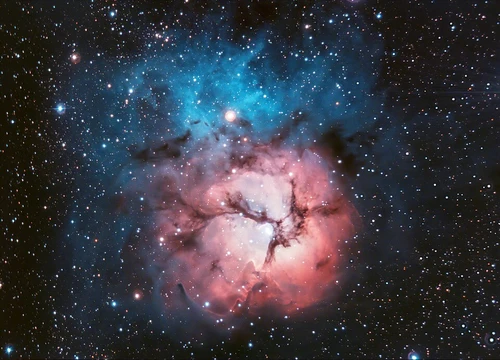
Dark Horse (astronomy)
A large dark nebula resembling a horse silhouette in Ophiuchus.

The Dark Horse Nebula, sometimes called the Great Dark Horse or the Prancing Horse, is a large dark nebula that blocks a portion of the Milky Way’s upper central bulge as seen from Earth. It is located in the equatorial constellation Ophiuchus, close to the borders of Scorpius and Sagittarius, and forms a major visible part of the Milky Way’s Great Rift. On Earth, it can only be seen on clear, moonless nights with low humidity and no light pollution. The region gets its name because its shape resembles the side silhouette of a horse, appearing dark against the glowing background of stars and star clouds. It is called “Great” because it is one of the largest groups of dark nebulae in the sky by apparent size. The rear of the Great Dark Horse—its rump and hind legs—is also known as the Pipe Nebula, which carries the designations B77, B78, and B59 in the Barnard Catalogue of dark nebulae. The Snake Nebula (B72) is a smaller, S-shaped nebula that emerges from the west side of the northern part of the Pipe’s bowl (B77). Barnard 68 is another named dark patch of molecular gas and dust appearing in the Dark Horse Nebula.
Quick Facts
- Epoch
- J2000.0
- Ra
- 17 / h / 21 / m
- Dec
- −21° 07
- Constellation
- Ophiuchus
- Names
- Great Dark Horse
Facts from the source article.
Lore & Background
The Dark Horse Nebula is named for its resemblance to the side silhouette of a horse, appearing dark against the background glow of stars and star clouds. It is called 'Great' because it is one of the largest groups of dark nebulae in the sky by apparent size. The nebula unites several individually catalogued dark nebulae, including the Pipe Nebula, which forms the rear (rump and hind legs) of the horse and carries the Barnard designations B77, B78, and B59. The Snake Nebula (B72) is a small S-shaped nebula emerging from the west side of the northern part of the bowl of the Pipe. Barnard 68 is another named dark patch of molecular gas and dust appearing within the Dark Horse Nebula.
Reader's Guide
The Dark Horse Nebula is significant as a large, visible dark nebula that obscures part of the Milky Way's upper central bulge, making it a notable feature for observers in the equatorial constellation Ophiuchus. Its legacy lies in its role as a unifying structure for several individually catalogued dark nebulae, such as the Pipe Nebula (B77, B78, B59), the Snake Nebula (B72), and Barnard 68, which are part of the Barnard Catalogue. The nebula is only visible under specific conditions—clear, moonless nights without light pollution and with low humidity—underscoring its dependence on pristine viewing environments. As a component of the Milky Way's Great Rift, it contributes to the understanding of dark nebulae as obscuring clouds of molecular gas and dust. Its common name, derived from its horse-like silhouette, and its designation as 'Great' due to its large apparent size, highlight its prominence in the night sky for amateur and professional astronomers alike.
Did You Know?
- The Dark Horse Nebula is also called the Prancing Horse.
- It lies in the constellation Ophiuchus near the borders of Scorpius and Sagittarius.
- The Pipe Nebula forms the rear (rump and hind legs) of the Dark Horse.
- Barnard 68 is a named dark patch of molecular gas and dust within the Dark Horse Nebula.
Frequently Asked Questions
What is the Dark Horse Nebula?
It is a large dark nebula in the constellation Ophiuchus that silhouettes a chunk of the Milky Way's central bulge, earning nicknames like the Great Dark Horse or the Prancing Horse. Its dark shape is visible only because it sits in front of a bright band of stars and gas, creating a horse-like profile against the glow.
Where exactly is the Dark Horse Nebula located?
It stretches across Ophiuchus, hugging the borders with both Scorpius and Sagittarius. In that stretch of sky it forms one of the most prominent dark lanes within the Milky Way's Great Rift.
What smaller nebulae are nested inside the Dark Horse?
The region encompasses the Pipe Nebula complex (Barnard 77, 78, and 59), the Snake Nebula (Barnard 72), and the famous dense core Barnard 68. Together these sub-structures give the larger dark cloud its intricate, layered appearance.
Under what conditions can I actually see the Dark Horse from Earth?
You need a genuinely dark site with zero light pollution, a clear and moonless night, and low atmospheric humidity. Even then it appears as a subtle dark smudge rather than a sharp shape, so patience and averted vision help bring out the horse silhouette.
Why is the Dark Horse important to observers and astronomers?
It serves as a natural laboratory for studying how dense molecular clouds obscure background starlight and how star formation proceeds inside such shielded regions. For amateur stargazers it is one of the most rewarding naked-eye Milky Way features, offering a dramatic reminder of the dust lanes threading our galaxy.
More in Nebulae, Part 2 1-24
Spotted an error? Know more?
Reader corrections go straight into our review queue. Suggest an edit · How this site is sourced