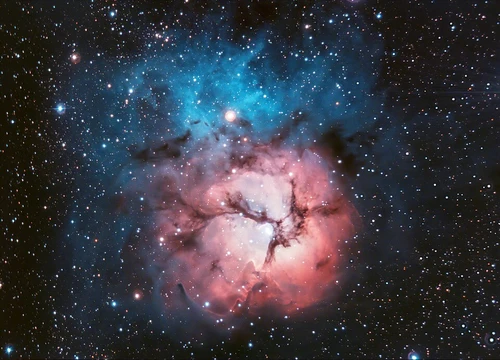
Cygnus X (star complex)
A massive star formation region behind the Cygnus Rift.

Cygnus X is a vast star-forming complex in the constellation Cygnus, about 4,600 light-years (1.4 kiloparsecs) from Earth. Spanning roughly 560 by 560 light-years (170 by 170 parsecs), it appears as a 7° by 7° patch of sky. Because it sits behind the Cygnus Rift—a dense band of interstellar dust in the Milky Way—its visible light is heavily blocked, so astronomers study it mainly in infrared and other wavelengths that can pierce the dust.
Observations from the Spitzer Space Telescope reveal that Cygnus X stretches about 200 parsecs across. Within 2 kiloparsecs of the Sun, it holds the highest concentration of massive protostars and the largest stellar association, Cygnus OB2, which contains up to 2,600 OB-type stars and a total mass of up to 105 solar masses. The region is also tied to one of the biggest known molecular clouds, with a mass of 3 million solar masses. Its stellar population includes many early-type stars, plus evolved massive stars such as candidate luminous blue variables, Wolf–Rayet stars, and O- and B-type supergiants.
Research shows Cygnus X contains two stellar associations: Cygnus OB2 and Cygnus OB9. Among its many early-type stars is BD+40°4210, a blue supergiant and candidate luminous blue variable that ranks among the brightest in the association, along with other O- and B-type supergiants. Star formation here has been ongoing for at least 10 million years and continues today. The Cygnus OB7 association lies in front of the complex.
- Distance
- 1.4 kiloparsecs (4,600 light years)
- Size
- 200 parsecs
- Angular dimension
- 7° x 7°
- Physical dimension
- 170 x 170 parsecs (560 x 560 light years)
- Mass of molecular cloud
- 3 million solar masses
- Stellar association mass
- up to 105 solar masses
- Number of ob stars in cygnus ob2
- up to 2,600
Lore & Background
Cygnus X is located behind the Cygnus Rift, and its light is heavily absorbed by the Milky Way's interstellar dust, making it better studied in other wavelengths such as the infrared. Studies with the Spitzer Space Telescope have shown it has a size of 200 parsecs and contains the largest number of massive protostars within 2 kiloparsecs of the Sun. It is associated with one of the largest molecular clouds known, with a mass of 3 million solar masses.
Its stellar population includes a large number of early-type stars as well as evolved massive stars such as luminous blue variable candidates, Wolf–Rayet stars, and supergiant stars of spectral types O and B. Ongoing research has shown Cygnus X includes two stellar associations: Cygnus OB2 and Cygnus OB9, as well as additional early-type stars including BD+40°4210, a blue supergiant star and luminous blue variable candidate. Star formation has been taking place there for at least 10 million years, continuing to the present day. Cygnus OB7 lies in its front.
Reader's Guide
Cygnus X is significant as a nearby laboratory for studying massive star formation, containing the largest number of massive protostars and the largest stellar association (Cygnus OB2) within 2 kiloparsecs of the Sun. Its association with a molecular cloud of 3 million solar masses underscores its role as a major star-forming complex. The region's heavy obscuration by interstellar dust means it is primarily studied at infrared and other wavelengths, as demonstrated by Spitzer Space Telescope observations. The presence of evolved massive stars, including luminous blue variable candidates and Wolf–Rayet stars, indicates ongoing stellar evolution. The identification of two stellar associations (Cygnus OB2 and Cygnus OB9) and a star formation history spanning at least 10 million years highlights its long-term activity. Its legacy lies in providing insights into the processes of massive star birth and evolution, and it is often compared to other nearby star-forming regions such as the Orion molecular cloud complex.
Did You Know?
- The stellar association Cygnus OB2 includes up to 2,600 stars of spectral type OB.
- Star formation in Cygnus X has been ongoing for at least 10 million years.
More in Nebulae, Part 2 1-24
Spotted an error? Know more?
Reader corrections go straight into our review queue. Suggest an edit · How this site is sourced