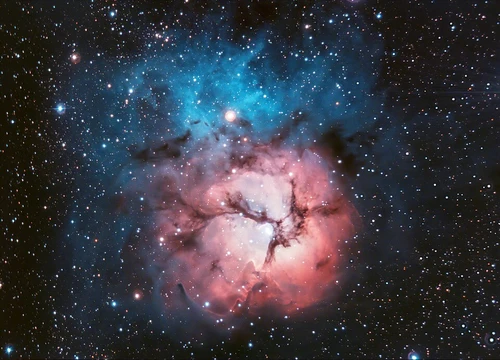
Clamshell Nebula
Emission nebula in Cygnus with a clamshell shape.

The Clamshell Nebula, cataloged as Sh 2-119, is an emission nebula and star-forming region in Cygnus. It gets its name from its two-lobed structure, split into eastern and western sections by the blue giant star 68 Cygni, which sits between them. This star is the nebula’s main source of ionization. The nebula’s shape is that of a Strömgren sphere, and it contains multiple dust lanes and Bok globules. First spotted in the early 1950s by Grigory Shajn and Vera Gaze during a photographic survey, they labeled it Gaze+Shajn [GS55] 240. In 1959, Stewart Sharpless mapped the area in greater detail, finding the nebula far larger than initially thought, and added it to his catalog as Sh 2-119. Originally, astronomers thought the nebula formed from 68 Cygni’s stellar wind, but it now appears the wind is actually a bow shock caused by the star’s high speed through space. Within the nebula lies the planetary nebula PK 87-3.1, and the open cluster NGC 7044 is nearby.
Quick Facts
- Ra
- 21h 18m 30s
- Dec
- +43° 56' 00"
- Dist Ly
- ~2,200
- Appdia
- 3°
- Constellation
- Cygnus
- Names
- Sh 2-119, LBN 391, [GS55] 240
Facts from the source article.
Lore & Background
The Clamshell Nebula was discovered in the early 1950s by Grigory Abramovich Shajn and Vera Fedorovna Gaze while conducting a photographic survey, and they named it Gaze+Shajn [GS55] 240. Stewart Sharpless would survey the region of the sky in more detail in 1959, revealing that the nebula was much more extensive than originally thought. He included it in his Sharpless catalog, giving it the designation Sh 2-119.
The nebula surrounds blue giant 68 Cygni and contains multiple dust lanes and Bok globules. 68 Cygni is the primary source of ionization within the nebula. The structure of the nebula is that of a Strömgren sphere, and is divided into an eastern and western section, with 68 Cygni between the two. These two sections are the reason for the 'clamshell' name. It was originally proposed that this nebula was formed from 68 Cygni's stellar wind. Instead, the stellar wind is likely due to the star's high velocity through space, forming a bow shock.
Reader's Guide
The Clamshell Nebula holds significance as a star-forming region and as an example of a Strömgren sphere, where the ionization of surrounding gas is dominated by a single massive star, 68 Cygni. Its discovery by Shajn and Gaze in the early 1950s, followed by Sharpless's more detailed survey in 1959, illustrates the progressive refinement of astronomical catalogs. The nebula's two-lobed appearance, caused by the central star lying between an eastern and western section, is a distinctive morphological feature that led to its common name. The presence of dust lanes and Bok globules indicates ongoing star formation. The planetary nebula PK 87-3.1 lies within the Clamshell Nebula, and the open cluster NGC 7044 is located nearby, adding to the region's richness. The debate over the nebula's origin—whether from 68 Cygni's stellar wind or from a bow shock due to the star's high velocity—remains unresolved in the source article, preserving the uncertainty of its formation history.
Did You Know?
- The Clamshell Nebula was originally designated Gaze+Shajn [GS55] 240 by its discoverers.
- The nebula is divided into an eastern and western section, with the star 68 Cygni between them.
- The planetary nebula PK 87-3.1 is located within the Clamshell Nebula.
- The nebula's stellar wind origin was proposed but later thought to be a bow shock from the star's high velocity.
More in Nebulae, Part 2 1-24
Spotted an error? Know more?
Reader corrections go straight into our review queue. Suggest an edit · How this site is sourced