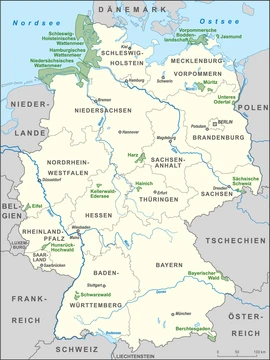
Western Pomerania Lagoon Area National Park
Largest national park in Mecklenburg-Vorpommern, protecting Baltic lagoons and coastal fauna.

The largest national park in Mecklenburg-Vorpommern, Western Pomerania Lagoon Area National Park lies along the Baltic Sea coast. It covers a sprawling 805 square kilometers across the district of Vorpommern-Rügen, made up of peninsulas, islands, and lagoon shorelines. The park includes the Darß peninsula, the western coast of Rügen, the islands of Hiddensee and Ummanz, and numerous tiny islets between them, along with the lagoons that separate these landmasses.
The park’s defining feature is its very shallow water, which supports a unique coastal fauna. These waters are a vital stopover for tens of thousands of cranes and geese. About half of the park’s area is open Baltic Sea, while more than a quarter consists of lagoons from the Darss-Zingst Bodden Chain and the West Rügen Bodden. The park’s boundary in the Baltic follows the ten-meter depth contour, protecting these shallow zones and their rich plant and animal life. The varying salt levels in the brackish water habitats—between the Baltic and the bodden (shallow lagoons)—greatly boost local biodiversity; for instance, Baltic Herring regularly visit the shallow bays to spawn.
On land, the park includes parts of the Darß and Zingst peninsula, most of Hiddensee, and a narrow strip of Rügen next to the bodden. Pine and beech forests, such as the Darß Forest, cover much of the terrain. In treeless areas, bogs formed by coastal flooding are found.
Quick Facts
- Iucn Category
- II
- Location
- Mecklenburg-Vorpommern, Germany
- Nearest City
- Rostock and Stralsund
- Established
- 1 October 1990
Facts from the source article.
Lore & Background
The differing salt content of the brackish water habitats of the Baltic and the bodden (shallow lagoons) contributes significantly to local biodiversity. For example, the Baltic Herring visits the shallow bays regularly to spawn. On land, pine and beech woods such as the Darß Forest cover much of the area, and treeless areas contain bogs resulting from coastal flooding.
Reader's Guide
Western Pomerania Lagoon Area National Park is significant as a protected area that preserves a unique coastal ecosystem of shallow lagoons and brackish water habitats. Its importance is underscored by its role as a major resting site for tens of thousands of cranes and geese, making it a critical stopover for migratory birds. The park's inclusion of both open Baltic Sea and bodden zones, with varying salt content, supports a diverse range of species, including the Baltic Herring that spawns in its shallow bays. The park's territory includes parts of the Darß and Zingst peninsulas, most of Hiddensee, and a narrow strip of land on Rügen, encompassing forests, bogs, and coastal areas. As the largest national park in Mecklenburg-Vorpommern, it serves as a key conservation area for the region's natural heritage.
Did You Know?
- The national park is Mecklenburg-Vorpommern's largest national park.
- It is famous for being a resting place for tens of thousands of cranes and geese.
- The park boundary in the Baltic Sea is based on the ten-metre depth contour.
More in National parks of Germany 1-19
Spotted an error? Know more?
Reader corrections go straight into our review queue. Suggest an edit · How this site is sourced