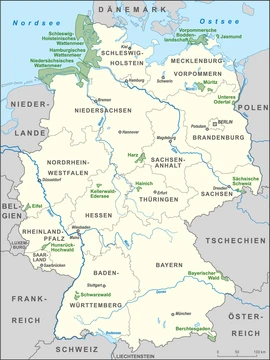
Lower Oder Valley National Park
German core area of the Lower Oder Valley International Park.

The Lower Oder Valley National Park is the German core area of the Lower Oder Valley International Park, a shared German-Polish nature reserve. It comprises the western banks of the Oder river within the Uckermark district in the German state of Brandenburg. The park is part of a larger protected area system created by decision of the German-Polish Environmental Council in 1992.
Quick Facts
- Iucn Category
- II
- Location
- Germany Brandenburg, Germany
- Nearest City
- Schwedt
- Area
- 165 km2 Total / 105 km2 Germany / 60 km2 Poland
- Established
- 1997
- Governing Body
- Nationalparkverwaltung Unteres Odertal / Park 2 / 16303 Schwedt
Facts from the source article.
Lore & Background
The Lower Oder Valley National Park covers 105 square kilometers of the western banks of the Oder river in the Uckermark district of Brandenburg. It is the German portion of the larger Lower Oder Valley International Park, which also includes the Polish Park Krajobrazowy Dolina Dolnej Odry. The international park was created by decision of the German-Polish Environmental Council in 1992, involving German, Polish, and Brandenburg environment ministers as well as the voivode of Szczecin.
Reader's Guide
The Lower Oder Valley National Park is significant as the German component of a transboundary nature reserve that spans 1,172 square kilometers when combined with adjoining reserves in both countries. Its flat western shore features levees that are regularly opened in winter and spring to control water levels and prevent high floods, allowing water to flow freely into extensive floodplains until April when the dikes are closed and remaining water is drained. This managed flooding creates habitats for birds such as the black stork, aquatic warbler, and corn crake, as well as mammals like the European otter and European beaver. The park also hosts plants such as the submediterranean pubescent oak. An information centre at Criewen serves visitors. The park's legacy lies in its role as a model for German-Polish environmental cooperation and floodplain conservation.
Did You Know?
- The park covers 105 km² of the western banks of the Oder river in Brandenburg.
- Its levees are regularly opened in winter and spring to allow water into floodplains.
- The park is part of a Special Protection Area for birds.
- An information centre is located at Criewen.
Diplomatic Birth of a Transboundary Reserve
Born from a landmark 1992 decision by the German-Polish Environmental Council, the Lower Oder Valley International Park stands as one of Europe's most symbolic cross-border conservation projects. The agreement was formalized jointly by the German, Polish, and Brandenburg environment ministers alongside the voivode of Szczecin, weaving together two national landscapes into a single protected entity. On the German side, the reserve stretches along the western banks of the Oder river through the Uckermark district in the state of Brandenburg. On the Polish side, it follows the steeper eastern banks across the Gryfino and Police counties within the West Pomeranian Voivodeship, reaching further north than its German counterpart. This deliberate pairing of flat western floodplains with elevated eastern riverbanks creates a natural corridor that transcends the political boundary between the two nations, turning what was once a contested border into a shared ecological heritage.
The Living Rhythm of the Floodplains
The western shore of the Oder within the park presents a strikingly flat landscape, and its most defining feature is a network of levees that governs the annual rhythm of the water. Each winter and spring, these dikes are deliberately opened, allowing the river to spill freely across vast stretches of floodplain. This controlled inundation serves a dual purpose: it moderates the water level to reduce the risk of destructive high floods downstream, and it sustains the wetland ecosystems that depend on seasonal submersion. The plains remain covered until April, at which point the dikes are sealed once more and the residual water is drained away, returning the land to its dry state. This annual cycle of opening and closing transforms the floodplain into a living, breathing landscape, one that shifts dramatically between a wide, mirror-still lake in the colder months and a dry grassland by late spring. The entire system demonstrates how human engineering and natural hydrology can be woven together to protect both communities and wildlife.
A Corridor for Storks, Beavers, and Unlikely Oaks
Designated as a Special Protection Area for birds, the Lower Oder Valley is a haven for species that depend on open wetland habitats. Among the most notable avian residents are the black stork, the aquatic warbler, and the corn crake, each finding in the seasonal floodplains and adjacent grasslands the foraging grounds and nesting sites they require. Beyond the birdlife, the waterways and riverbanks support populations of the European otter and the European beaver, two semi-aquatic mammals whose presence signals a healthy, functioning riverine ecosystem. On the botanical side, the park shelters the submediterranean pubescent oak, a plant whose presence in this northern European setting speaks to the unusual microclimatic conditions the valley provides. Together, this assemblage of species—ranging from wading birds to beavers to a Mediterranean-adapted tree—paints a picture of a landscape that, while geographically modest, packs an extraordinary density of ecological value into its floodplain corridors.
Two Names, One Valley: Structure and Scale
The park's administrative structure mirrors its transboundary character. The German core area is formally designated as the Nationalpark Unteres Odertal, while the Polish counterpart carries the title Park Krajobrazowy Dolina Dolnej Odry, or Lower Odra Valley Landscape Park. Together, these two core zones span 165 square kilometres, with the German portion accounting for 105 square kilometres and the Polish section covering 60. However, the protected footprint extends far beyond these core boundaries: when adjoining nature reserves on both sides of the border are included, the total managed area swells to 1,172 square kilometres, making the broader landscape a substantial ecological region. For visitors seeking orientation, an information centre is located at Criewen on the German side, serving as a gateway for those exploring the floodplains and the wider Uckermark countryside. The park also maintains a dedicated website and is supported by a local tourism association, ensuring that the natural heritage of the valley remains accessible and understood by the public.
Frequently Asked Questions
What is the Lower Oder Valley National Park?
It is the German portion of the Lower Oder Valley International Park, a transboundary nature reserve shared with Poland. The park runs along the western banks of the Oder River in the Uckermark district of Brandenburg.
Where exactly is the Lower Oder Valley National Park located?
The park occupies the floodplain on the German (western) side of the Oder River, within the Uckermark district of the state of Brandenburg. It forms one half of a larger protected landscape that extends across the border into Poland.
How large is the Lower Oder Valley National Park?
The German national park covers roughly 105 square kilometres, or about 41 square miles, of riverbank and floodplain habitat along the Oder.
What is the Lower Oder Valley National Park's key feature or management focus?
Its central role involves floodplain management through a network of levees along the Oder. This makes it a working example of how water-control infrastructure can coexist with a protected natural landscape.
When and how was the Lower Oder Valley National Park established?
It was created in 1992 following a joint decision by the German-Polish Environmental Council to set up a shared international park. The German section was then designated as the national-park core area within that broader transboundary framework.
More in National parks of Germany 1-19
Spotted an error? Know more?
Reader corrections go straight into our review queue. Suggest an edit · How this site is sourced